23.8.07

Taste, etc.

In a comment on my post about John Adams's Doctor Atomic Symphony, A. C. Douglas quoted from the post:

As always, my reaction to him says more about me than it does the music.

His comment: "Maybe not."

I believe I understand what he is getting at with this, but I was very careful in how I worded my response to Mr. Adams's music. When I said "it doesn't speak to me", I meant that and nothing more. I didn't state an opinion of the quality and/or value of his music because I've never studied it enough to feel qualified to render one. I was released from my duties as a columnist for the American Record Guide for similar ideas about how new music could be reviewed.

I didn't get Brahms until graduate school, and now he's one of my favorites. I didn't get Mozart until even more recently. But even before then, I had studied enough of their music to know better than to say that my dislike said anything meaningful about the music itself, but might reveal something about me. I've not had any experiences since then to change that fundamental idea. An up or down evaluation of a work of art or an artist tells me next to nothing about the art or artist, but it does tell me something about the evaluator. Enough of these data points from a critic/observer and I can get a pretty good idea about how their tastes may or may not align with mine.

Naturally, when the criticism goes beyond an overall evaluation, the criticism can tell me something about the work or artist in question. But most of the time, I learn more about the writer--and that's not necessarily bad, as I've indicated. When I have an opinion on something, I'll try to state it clearly and with backing arguments.

When I merely like something or don't especially like it, I'll say that, too.

John Adams: Doctor Atomic Symphony (2007)

I listened to the streaming audio of Tuesday evening's premiere of John Adams's Doctor Atomic Symphony, part of a Proms concert by the BBC Symphony Orchestra, conducted by Mr. Adams. The program began with a flabby and indifferent account of Aaron Copland's Billy the Kid, and continued with a performance of Mr. Adams's Century Rolls, for piano and orchestra, with Olli Mustonen as soloist. Mr. Mustonen was an able soloist and the accompaniment was crisp and precise.

The main event of the concert was, of course, the premiere. I have to say again, for the record, that I don't get John Adams's music. It doesn't speak to me. There are moments in almost every piece of his that I've heard (and I've probably given him more chances than any other composer) that resonate, but they are far and few between (as Stevie Wonder put it), and not big enough to make a whole movement or composition work for me. This was true of the new Symphony--there's an extended passage in the first movement that is reminiscent of the last movement of the Stravinsky Symphony in Three Movements, but not as telling, and the trumpet solo near the end is very fine.

Many people whose ears I respect continue to sing the praises of John Adams, and I'll still listen to him. As always, my reaction to him says more about me than it does the music.

[Edited on 8 Mar 14 for spelling and usage.]

22.8.07

Topic A

The concert music blogosphere continues to be focused on the ongoing discussion of what is roundly called the "decline" of concert music. (In fact, one could argue that this issue is the reason the concert music blogosphere is as robust as it is.) Here are some links to recent posts on the subject, mostly from familiar players in the discussion (a tip of the fedora to Lisa Hirsch):

Matthew Guerrieri
Marc Geelhoed
A. C. Douglas
Alex from Wellsung
Greg Sandow

It's not clear to me that concert music is in "decline" in any meaningful sense of the word. There is today more of the music available in more formats than ever before and some musical institutions are reporting record ticket sales for the coming season, even while others report lower sales. Most important, from my particular perspective, a thousand compositional flowers continue to bloom, despite ongoing style wars offensives from all points on the stylistic continuum.

If "decline" or even "death" is not the issue, what is?

In the (increasingly distant) past, concert music held a place at the center of intellectual/cultural life in the West. That is no longer the case, and hasn't been for a very long time, probably since the West nearly obliterated itself in the Second World War. In fact, as Alex Ross masterfully demonstrates in his forthcoming The Rest is Noise, the centrality of concert music (especially opera) to the Nazi horror triggered a cultural backlash that continues today. From the other end of the political spectrum came stylistic requirements imposed on composers under penalty of ostracism, disappearance, and sometimes death. No such political strictures exist today, in part because music just isn't that important to the powers that be, though one could say that the part of the Composers' Union in the propaganda machineis now played by the Academy of Country Music and Clear Channel radio.

So it seems to me that the discussion is really about the place of concert music in our cultural and intellectual life is and what it should, or rather could be. I don't know the answers, but I do think it's an important conversation.

14.8.07

Bang the Drum Slowly

Inside the mind of a working musician:

I gave John Parks (for whom I am writing a concerto) a copy of the recent Pierre Boulez recording of the Mahler 2 the other evening. Here are some of his comments (from e-mail, published with his permission):


. . . listening to the Mahler right now. It's a shame that the percussion section really didn't think out their sounds. The cymbal playing makes me angry.

After I asked for specifics about the cymbals comment:

European orchestras typically use very old cymbals; usually what we call "Old K" Zildjian cymbals (pre-WWII), and there aren't tons of these instruments left because of the war and the collateral damage of bombing the opera and concert halls. Very dark sounds, which I really like and are totally appropriate for Mahler. In this recording, there's no blossom or body to any of the cymbal sounds, so the cadences don't really have the color, shimmer, and "arrival" that I think appropriate. When I hear cymbals, I want to hear Michael Bookspan with Philly. Anything else is just noise.

Zildjian has, in the past years, rededicated themselves to making new instruments that sound like these old ones-I have several pairs and love them.

Europeans are known for great timpani sounds, but some "schools" over there do not concentrate on the other instruments with the same degree of seriousness. [T]he way the cymbals are being played [in this recording] never allows them to blossom or open up.

"The cymbal playing makes me angry" is my new all-purpose rallying cry.

Here and There

Additions to the blogroll:

Intermezzo, a blog about music in London.

flyover, a group blog about arts journalism in the provinces.

Elsewhere:

ACD clarifies his view of recordings, and in no uncertain terms.

Matthew Guerrieri has an excellent post on the recurring discussion of the "death" of concert music.

13.8.07

Open Question

To ACD--

Since you don't have comments, I'll here. Are you saying that listening to concert music on iPods or via mp3s on computer is worse than not listening to it at all?

Signed,

Perplexed in the Provinces

8.8.07

Langsam, Wozzeck! Laaaaaangsam!


What major work of Alban Berg are you!?!?!


You are Berg's masterful first opera, "Wozzeck", op. 7, a tragic and expressionistic tale of a soldier who goes mad and kills his mistress due to the lack of power and wealth. Society done did him wrong.You are compassionate, emotional and righteous. And a tad sentimental (for good reasons).
Take this quiz!


Quizilla |
Join

| Make A Quiz | More Quizzes | Grab Code


Thanks, and a tip of the retrograde to Alex Ross.

1.8.07

Four

String quartets (both the genre and the medium) are an obsession of mine, yet I never fail to be surprised and struck by the power of a really good performance of a really good quartet, given the right piece at the right time. So it was this morning when, in the normal course of my work day as I play discs mostly on a whim, I listened to the Juilliar Quartet's recording of the two Quartets of Leoš Janáček and the Lyric Suite of Alban Berg. The raw intimacy of all of three of these works is given full-throated expression by the Juilliards, with their often edgy sound especially appropriate in Janáček's sometimes rusticated soundworld.

Other listening:

Lee Hyla: Trans, Bass Clarinet Concerto, Violin Concerto. Tim Smith, bass clarinet; Laura Frautschi, violin; Boston Modern Orchestra Project/Gil Rose.

Bohuslav Martinů: Symphonies 2 and 4; Ukraine National Symphony Orchestra/Arthur Fagen.

31.7.07

MySpace, Listening

I've set up a page at myspace.com. There's not much there yet (Episodes in Anticipation cranks up as the page comes up), but check it out via the link on the right hand side of this page.

Recent Listening:

Luciano Berio, Sinfonia; both the Boulez and Eotvos recordings.

Elliott Carter, Concerto for Orchestra; Leonard Bernstein/NYPO.

Jean Sibelius, Symphony 4; Osmo Vanska/Lahti Symphony.

Carl Nielsen, Symphony 4; Osmo Vanska/BBC Scottish Symphony.

Johannes Brahms, Symphony 4 (nothing intentional about all these Fourths, that I'm aware of); Karajan/Berlin.

Igor Stravinsky, Symphonies of Wind Instruments; Salonen/London Sinfonietta.

Gyorgy Ligeti, Piano Music; Pierre-Laurent Aimard.

Maurice Ravel, Boléro, Ma Mère L'Oye (complete ballet), Rapsodie espagnole, Une Barque sur l'océan, Alborada del Gracioso; Boulez/BerlinPO.

Beatles, Rubber Soul and Revolver.

Steely Dan, Gaucho.

Stevie Wonder, Songs in the Key of Life.

30.7.07

Additions and Workshop (IX)

A couple of additions to the blogroll:

Jeff Low, who's posting about some obscure operas being staged in Germany.

William Zick, whose AfriClassical blog is a companion site to AfriClassical.com, which treats of the "African heritage in classical music".

Work on my Percussion Concerto proceeds. I'm working on a marimba heavy section of the second (of two) movements, for those keeping score (I kill myself sometimes) at home. Fall 2008 premiere is likely.

23.7.07

50K

Site Meter just registered the 50,000th visitor to listen. I want to thank everybody who's clicked in and I hope you will continue to do so.

On to 51,000!

4.7.07

Happy Fourth!

Last year's holiday listening.

listen's first July 4th listening list, from 2005.

Here's this year's July 4th list, focusing on America as place:

Aaron Copland, Music for a Great City
Elliott Carter, A Symphony of Three Orchestras
Charles Ives, Three Places in New England
John Adams, El Dorado
Leonard Bernstein, On the Town
Alex Shapiro, Desert Waves
Steve Reich, Vermont Counterpoint

Bonus Tracks (long distance dedication to "GWB in Washington"):

Peter Maxwell Davies, Eight Songs for a Mad King
Stevie Wonder, "You Haven't Done Nothing"

3.7.07

Noise

Alex Ross links to his new article in the New Yorker, a chapter (on Sibelius) from his forthcoming The Rest is Noise: Listening to the Twentieth Century. The chapter gives us a sense of Sibelius' accomplishment, a feeling for what his music actually sounds like and how it works, and its place in our current musical life:

“A symphony is not just a composition in the ordinary sense of the word,” Sibelius wrote in 1910. “It is more a confession of faith at different stages of one’s life.” If the Fourth is a confession, its composer might have been on the verge of suicide. Yet, like so many Romantics before him, Sibelius took a perverse pleasure in surrendering to melancholy, and finding joy in darkness. “Joyful and sorrowful,” he wrote in his diary. In his next symphony, he set himself the goal of bringing to the surface the joy inherent in creation.

This chapter (as well as the table of contents which Mr. Ross gives us in this post) points to a challenging and provocative read when the book appears in October.

Beverly Sills

The great soprano, administrator, and ambassador for the arts Beverly Sills has died. Here is a fine obituary by Anthony Tommasini:

In a conversation with a Times reporter in 2005, reflecting on her challenging life and triumphant career, Ms. Sills said, “Man plans and God laughs.” She added: “I have often said I’ve never considered myself a happy woman. How could I, with all that’s happened to me. But I’m a cheerful woman. Work kept me going.”

21.6.07

Criticism Criticism

What are the purposes of criticism?

I wrestle with this question quite a bit in my roles as a critic, a composer, and as a consumer of criticism. When I read criticism, especially of the daily newspaper or weekly magazine sort, I want to know what the event (or movie or book, etc.) was like—how the art in question came off, what the artists may have been trying to do, and the like.

I return to certain critics again and again more because they are fine writers whose prose is a joy to read. Alex Ross is a current example; he is a fine stylist, despite his excessive love for the music of John Adams. Jack Kroll (of Newsweek) was a delightful film critic, whether I agreed with him or not. His opinions were often thought-provoking and always well put.

I bring all of this up as prelude to a couple of reviews of the same event: the world premiere of Kaija Saariaho’s Terra Memoria by the Emerson String Quartet this past Sunday at Carnegie Hall. I’ve indicated before that I’m a big fan of Ms. Saariaho’s music, and that undoubtedly colors my reading of these excerpts.

Let’s go to the tape. Bernard Holland of the New York Times (18 June 2007):

No rough sounds for Ms. Saariaho’s “Terra Memoria,” commissioned by Carnegie Hall and having its first performance here. Ms. Saariaho’s elegant music begins and ends in whispery near-silence. Her care for the sound properties of instruments is a double gift to listeners. The overlapping conversations between voices are received as counterpoint, and yet the assembled sounds create a single cloudlike sonority. Most of the piece sings in a pervasive tenor-to-treble range reminiscent of Ravel or Fauré. The more Ms. Saariaho engages the past, the more original her music becomes.
And Ben Finane of the Newark Star-Ledger (19 June 2007):

The Emerson's final concert of the series, delivered to a packed hall, featured a world premiere by Finnish composer Kaija Saariaho, bookended by two late Beethoven quartets. This work, "Terra Memoria," is only the second string quartet by the 54-year-old Saariaho.

The premiere of "Terra Memoria" began softly, with low and high strings establishing the peaks and pits of the landscape that was to unfold. Languid motives gradually developed and expanded, sliding up and down the register, advancing and receding within the aural spectrum. The schema of the piece, which was simply to explore a sliding wash of color, made for music that was vociferous and angst-ridden, but also cold, clinical and removed.

Dedicated by the composer "for those departed," the work clearly has an element of lament and nostalgia, but there is no catharsis here. The only brightness in the premiere arrived in the form of Saariaho's vivid pink scarf, which came into view when the composer emerged from the audience and made her way to the stage to exchange bisou bisou (kisses in French, Saariaho lives in Paris now) with the members of the Emerson -- 12 in all for four bewildered players.
Mr. Holland is not what I would call a friend of Modernism, but that does not prevent him from writing a very clear and perceptive description of the piece and of Ms. Saariaho’s compositional evolution. In a few short sentences and telling phrases (“whispery near-silence”), he gives us an impression of the experience and is able to place the piece, (sonically and historically) for the reader. I don’t know for certain whether he liked it or not (that’s not the point), but there is no doubt that Mr. Holland listened, heard, and articulated a musical experience.

Mr. Finane, on the other hand, is all over the place. I’m pretty sure he didn’t like the piece, but I can’t be certain he engaged with it. Some of the adjectives he threw out (“angst-ridden”, “calculated”) seem contradictory, which can be an effective means of communicating an impression, but it doesn’t work that way here, for me.

Mr. Finane falls into the trap of claiming to know the composer’s intentions (“[t]he schema of the piece, which was simply to explore a sliding wash of color . . .”) while criticizing the piece for not having different aims (“but there is no catharsis here”). When a critic does this he is substituting a sort of Platonic ideal of the piece (based on his own private standards) for the piece itself, which is found to be lacking.

I’ll admit to piling on Bernard Holland when I think he is wrong or, more importantly, wrong-headed. But in this case, his piece is a very good example of how good criticism can be done. Especially in contrast.

My Desk, 20 June 2007


17.5.07

Invisibility

Elaine Fine has posted a story about composer invisibility that will will set off pangs of recognition in most of us. It's an odd but common phenomenon that is manifest in a number of ways. I've been to many new music festival events where the performers failed to acknowledge the composer (and they had to have known the composer was there because the composer had coached them prior to the performance), and read numerous stories on new operas where the composer's name was buried in the story if s/he was even mentioned at all.

Art without artists!

10.5.07

On Difficulty

Poet Robert Pinsky writes in Slate about the "stupid and defeatist idea that poetry, especially modern or contemporary poetry, ought to be less 'difficult'". I don't know about "stupid and defeatist", but there's no question but that the idea that poetry (and the other arts) should be easier to apprehend than it is.

Mr. Pinsky goes on to quote and explicate a number of poems from all periods that have difficulty as their subject matter. That's all well and good, as far as it goes. He says that there is intrinsic value in difficulty:

Difficulty, after all, is one of life's essential pleasures: music, athletics, dance thrill us partly because they engage great difficulties. Epics and tragedies, no less than action movies and mysteries, portray an individual's struggle with some great difficulty. In his difficult and entertaining work Ulysses, James Joyce recounts the challenges engaged by the persistent, thwarted hero Leopold and the ambitious, narcissistic hero Stephen. Golf and video games, for certain demographic categories, provide inexhaustible, readily available sources of difficulty.

Oddly, the poems Mr. Pinsky explicates (by Michelangelo, Shakespeare, and listen favorite Wallace Stevens, among others) aren't especially difficult to understand, which I think undercuts his thesis as I understand it--that difficult art gives pleasure directly because of that difficulty, not in spite of it.

That's not to say that difficulty is inherently a good thing in art, any more than simplicity is an inherent good thing. There are those who would argue both sides of that, as well as their corollaries, that difficulty and simplicity are inherently bad artistic qualities. This is the basis of the Style Wars.

Since music is inherently abstract and poetry is not, the issue of difficulty in music requires a different approach. One parallel does exist, though, in the virtuoso composition, be it a concerto or unaccompanied work. There, difficulty of execution is definitely one of the subjects of the piece.

Pieces of music that pose difficulty of apprehension are a different kettle of fish, and you will often read commentary along the lines of the point-of-view derided by Randall Jarrell, as quoted by Mr. Pinsky:


When a person says accusingly that he can't understand Eliot, his tone implies that most of his happiest hours are spent at the fireside among worn copies of the Agamemnon, Phèdre, and the Symbolic Books of William Blake.

I think Jarrell's tone is unnecessarily snotty, with its implication that anyone who decries Eliot is an utter philistine, but there is a point there. Many people who decry certain what they call excess difficulty in music draw the line at the most "difficult" music that they dig, and say "This far; no further". (It's different when composers do it, because attacking music that's different from yours is a time-honored defense mechanism.) For some, Beethoven is the limit in difficulties, for some, it's Wagner. For some, it's Dylan.

To my ears, music is "difficult" when the ambiguities in the musical discourse exceed what I have learned to process or are of a different nature altogether from what I am accustomed to. When the ambiguities are overcome, the music is assimilated and is no longer difficult, at least not in the same way.

When a critical mass in difficulty is reached, a significant number of composers begin a simplifying movement, and the process starts anew. We can see that happening in recent times, with the rise of aggressively simple (not simplistic or simple-minded, to be sure) tonal music in response to the ambiguities of various schools of High Modernism and Postmodernism in the 50s through the 70s of the century just past. And we are now seeing rising complexity in music that derives from those schools (postminimalism and metametrical msuic, e.g.). And then it will star all over again.

Daniel Wolf has some related posts here and here, and Kyle Gann here.

28.4.07

FSU Percussion Tour

The Florida State University Chamber Percussion Ensemble, under the direction of John W. Parks IV, is giving a performance at the Weill Recital Hall at Carnegie Hall in New York City this coming Friday, 4 May 2007, at 8pm.

DISCLAIMER: I am proud to consider John Parks a friend and colleague. I am writing a concerto for him, and consider him an artist of the highest caliber. I want to be upfront about that.

The Ensemble will play music by David Skidmore, Blake Tyson, Andrew Thomas, Bob Becker, and Minoru Miki on the program, which they previewed here in Tallahassee last night. Post-minimalism carried the day in just about all of the pieces, and its influence could be heard throughout the program.

The performances were really good--intense, tight, and expressive. The Ensemble will be stopping along the way to New York to paly the program:

April 29, The University of Georgia (Athens) School of Music , 8pm
April 30, Furman University (Greenville, SC), Daniel Recital Hall, 8pm
May 1, Spring Arts Festival, Kimbrell-Warlick Fine Arts Center (Gastonia, NC), 7:30pm
May 2, The University of Virginia (Charlottesville) School of Music, 8pm

If you have the opportunity to hear them, go. You won't be sorry if you do.

27.4.07

Tristan Does New York

What do A. C. Douglas and Savanna Samson have in common? A love of Wagner, of course!

Ms. Samson is interviewed as part of WNYC radio's multimedia "Tristan Mysteries" project, a web and radio enterprise timed (it runs from 28 April to 5 May) to coincide with the Lincoln Center presentation of the Los Angeles Philharmonic performing the Peter Sellars/Bill Viola/Esa-Pekka Salonen Tristan Project.

(Alex Ross vividly reviewed a Paris performance here.)

"Tristan Mysteries" includes an interview with composer/writer Danny Felsenfeld, among others. An overview can be found here.

Tristan und Isolde was the first opera I ever saw. It was at the Met in January 1975, with Erich Leinsdorf conducting. I had studied the "Prelude and Liebestod" in school, but had not heard the rest of the opera. It was an overwelming experience, and perhaps the fastest five hours of my life.

If you build it . . . (I)

A reader writes:

What determines the formal structure in 20th century music? It seems that much of the music written in the early decades of the 20th century would lack structure (so it sounds to me)... Any thoughts?

I'll deal with this in some detail soon, but I want to open the question up to anybody who cares to take a shot at it, either in the comments or from their own podium.

I think that musical structure is, regardless of style, a very useful illusion. Wallace Stevens built an entire poetics around the idea that the human mind has such a "rage for order" that we will impose order, or "structure", even where there is no inherent order:

Anecdote of the Jar

I placed a jar in Tennessee,
And round it was, upon a hill.
It made the slovenly wilderness
Surround that hill.

The wilderness rose up to it,
And sprawled around, no longer wild.
The jar was round upon the ground
And tall and of a port in air.

It took dominion every where.
The jar was gray and bare.
It did not give of bird or bush,
Like nothing else in Tennessee.

Composers place "jars" in their music as ways for listeners to create/perceive and order to the music they are hearing. Performers can differ as to where in the piece the jars are located, and through accents of various kinds point them out to the listener.

We think of structure in functionally tonal music as a result of the deployment of changes and different melodies in time, to create a convincing musical argument. How is structure created or implied or facilitated in music that is not functionally tonal? Conversely, given our rage to order, is unstructured music even possible?

Slava

The great Russian cellist, conductor, and artistic rights champion Mstislav Rostropovich has died.

Allan Kozinn's New York Times obituary includes this:

As a cellist, Mr. Rostropovich played a vast repertory that included works written for him by some of the greatest composers of the 20th century. Among them were Shostakovich Cello Concertos, Prokofiev’s Cello Concerto, Cello Sonata and Symphony-Concerto, Britten’s Sonata, Cello Symphony and three Suites. He also played the premieres of solo works by Walton, Auric, Kabalevsky and Misaskovsky, and concertos by Lutoslawski, Panufnik, Messiaen, Schnittke, Henri Dutilleux, Arvo Pärt, Krzysztof Penderecki, Lukas Foss and Giya Kancheli.

As if that list wasn't amazing enough, for its variety as well as its length, there's this:

Mr. Rostropovich always said that one of the principal lures of the podium was that the orchestral repertory seemed so vast when compared with the cello repertory. But he did not confine himself to the established classics. He commissioned regularly, and led the premieres of more than 50 works. Two of the pieces written for him during his National Symphony years — Stephen Albert’s “Riverrun” Symphony and Morton Gould’s “Stringmusic” — won Pulitzer Prizes. Leonard Bernstein, Jacob Druckman, Richard Wernick, Gunther Schuller and Ezra Laderman were among the other composers who wrote for him, or whose works had their world premieres under his baton.

He will be missed, but his artistic legacy remains as comfort, inspiration, and living memorial.

9.4.07

Future: Tense

The debate about the future of our music continues apace.

With friends like Gene Weingarten, who needs enemies? The condescending tone of Mr. Weingarten's article about Joshua Bell playing in a Washington (DC) subway station, has drawn notice elsewhere in the popular press and in the political blogosphere. I'm not sure concert music's worst enemy could have put together a more embarrassing and guaranteed-to-blow-up-in-everbody's-face cock-up if they had tried.

[Side note from the Pedagogy Department here at listen101: Mr. Bell oversells the Bach "Chaconne" here:

not just one of the greatest pieces of music ever written, but one of the greatest achievements of any man in history. It's a spiritually powerful piece, emotionally powerful, structurally perfect.
I can tell you from painful experience that that is a set-up for a tepid response, even though it's true. Tell them it's got some great moments, show them how to follow it, and make sure they know it's long.]

And speaking of pompous, Norman Lebrecht doesn't even have the whatever to name ALEX ROSS by name when attempting to refute ALEX ROSS' very fine post on the sale of recording of concert music. Mr. Lebrecht seems to equate the world of concert music with big recording companies, which equation doesn't add up, as ALEX ROSS demonstrates. Also, be sure to read ALEX ROSS' survey of the New York music scene here.

Finally, Helen Radice offers her always-more-than-two-farthings-worth:

Some people may be more fufilled by literature, galleries, the theatre, football, or even by what I believe is called 'popular music'. But there remain many people throughout the world passionately in love with 'classical music' (if so it must be called). Like any other major art form, it - recorded or otherwise - is not fucking dying. It is evolving, like anything else alive. It may be there is less of a market for more CDs of 'The Four Seasons', but there now exist 435 recordings of this piece, and even a seminal pop album like The Bends only comes out the once, give or take some re-mixes.

Read the whole enlightening thing here.

7.4.07

Arts Funding

The Tallahassee (FL) Democrat published a piece by a local political columnist this past Thursday, which piece called for the elimination of public funding for the arts.

My response is here. There's a lot more to say on this topic, and I hope at least some of you will say what you have to say in comments.

3.4.07

400

According to Maynard Solomon (my memory may be less than perfect on this, and any corrections would be more than welcome) about 400 people heard the three premiere performances of Wolfgang Amadeus Mozart’s Piano Concerto 24, in c minor (K. 491, 1786). The fame and reputation of the concerto and its composer has grown exponentially since that beginning. Of course, Mozart was, well, Mozart, and times are different, but I wonder if there isn’t an encouraging lesson to be found here.

Among these 400 there must have been other musicians of the professional or amateur variety. Musicians who talked about the piece, obtained a copy of the score, and learned it. More important, there must have been people in the audience who heard the piece and were struck or moved by it, and proceeded to talk about it with others, people who weren’t in the audience for the premiere.

Mozart’s time was a before mass markets and mass media, obviously. Just as obviously, our time is an age of mass media and related markets:

We live in a society that observes very much the mass reactions, and is all about markets, including in music. I think our responsibility is to work against that, to have a taste for adventure, to be courageous enough to go forward into the emptiness, to open new doors, and then be followed—or not—by our audiences. --Pierre-Laurent Aimard, quoted by Jeremy Eichler in the Boston Globe, 25 March 2007

I think Mozart’s experience and Aimard’s comments point us to a new approach, one that is rooted, in part, in the long tail theory and in compound interest. Concert music is a niche market, very small and diminishing, or slowly growing, depending on who you read and on their agenda. The new and emerging technologies of internet distribution and electronic “rendering” of scores in recordings that are very close to performance quality enables composers to find their 400. If they are like the audience Mozart had you may see interest in your work grow. It’s a long, agonizing process, but if you can get 400 people to “go forward into the emptiness” with you, it will be worth it in the long run.

30.3.07

The Best Disinfectant

Stirling Newberry, posting at the Agonist, asks bloggers to remove On an Overgrown Path from our blogrolls because of this post, which links to an article in the American Spectator on affirmative action in orchestras. Mr. Newberry believes that the linking of the article is an indication of "soft bigotry" on the part of Pliable, the Path blogger.

The article is indeed a fetid pile of half-truths, unsupported assertions, condescension, frat-boy style bigotry, and false concern. (I say "false concern" becuase in the world dreamed of by the editors and writers of that magazine, there would be no elite orchestras, because they wouldn't be able to make it in that market-driven pit.) However, I won't remove the blog from my roll because I believe that we do better in fighting for what we believe in when those we opposed are exposed to the light of day. I don't know if that was Pliable's point in linking to the article, because he doesn't comment on it.

And that brings me to the action that I will take in response to this. I frequently post links to other sites, be they blogs, magazines, etc., and offer them without comment. In the future I will endeavor not to do that.

27.3.07

Oh, why not?

Matthew Guerrieri's Proustian quiz:

1. Name an opera you love for the libretto, even though you don't particularly like the music.

Stephen Paulus' The Postman Always Rings Twice.

2. Name a piece you wish Glenn Gould had played.

Basic Training, Lee Hyla.

3. If you had to choose: Charles Ives or Carl Ruggles?

Ives, but I love Ruggles' Sun-Treader.

4. Name a piece you're glad Glenn Gould never played.

Trois Gymnopédies, Erik Satie.

5. What's your favorite unlikely solo passage in the repertoire?

The piccolo solo that ends Carter's Symphonia.

6. What's a Euro-trash high-concept opera production you'd love to see? (No Mortier-haters get to duck this one, either—be creative.)

Parsifal in Vegas.

7. Name an instance of non-standard concert dress you wish you hadn't seen.

Pass; we don't get much of that around here. One I'm glad I did see was Dr. John Boda wearing a scarlet tux to play on my doctoral recital.

8. What aging rock-and-roll star do you wish had tried composing large-scale chorus and orchestra works instead of Paul McCartney?

Ugh. Jeez. Hell, I don't know. Crap. The guy that sang for the Ides of March, I guess.

9. If you had to choose: Carl Nielsen or Jean Sibelius?

The Finn.

10. If it was scientifically proven that Beethoven's 9th Symphony caused irreversible brain damage, would you still listen to it?

It doesn't?

21.3.07

The Times Are Never So Bad (II) (Updated)

Stirling Newberry has another essay up at The Agonist, the subject of which is the response of the arts to the events of the last five years. Needless to say, he finds the response inadequate, to say the least. However, there is hope, if not for redemption, at least for realization and rebuilding.

The first comment is very good.

Update: Mr. Newberry puts his music where his mouth is, with a video based on the last three minutes of the second movement ("There Must Be Peace") of his C Major Piano Sonata (Ares), from a soon-to-be-released CD. I'm agnostic on the idea of attaching images to concert music, but it is certainly one way to to provide entrée into the music.

20.3.07

Liberation

Stirling Newberry posts on the "liberation of classical music" over at The Agonist. The questions that Stirling raises in this piece are not new; in fact, raising them again and again in new contexts seems to be an important part of his work. They are worth asking and worth thinking about.

14.3.07

Class Divide

Daniel Wolf wants to start a campaign to get publishers to make study scores available on the web for free. That's a very good idea. An indication that publishers would not be the only roadblock to this open source conception of music comes in this article (from The New York Sun) by Fred Kirshnit (h/t to Robert Gable):

Copyright and royalties are a major issue as well. Mr. [John] Corigliano recalled encountering a student in Beijing who is writing her thesis on his Symphony No. 2, a work neither published nor commercially recorded. She possessed on her computer not only the score to the piece, but a pirated recording as well.

I'm assuming here that Mr. Corigliano was not celebrating this as a triumph of the internet's ability to spread our music all over the world, and if I'm wrong about that I'd love to be informed about it. (I'm less thrilled about a pirated recording, but I don't know the specific circumstances of that, either.)

My point in quoting this is to say that there is a class divide between the haves of the composition world, represented by Mr. Corigliano, and those of us who struggled to be heard and studied. Mr. Wolf's idea, even if it were to be implemented on a modest scale, would be a step in the direction of getting more of us studied, played, and heard.

12.3.07

Catching Up

The American Music Center has launched Counterstream Radio, billed as a "showcase for new music by United States composers". Check it out.

I want to echo Daniel Wolf's call for music publishers to make study scores available for downloading over the internet at no charge. Mr. Wolf makes a convincing case that any hit the publishers might take on sales of these scores (which wouldn't be all that much) would be made up for in the increased performances and the related performance and mechanical reproduction fees. A few of my scores are posted (in pdf form) at my Classical Lounge page. I'm working on ways to get more of them out there, and am interested in hearing from composers and performers about what works from their repective perspectives.

Not un-related to this is Mr. Wolf's earlier call for those of us with an interest of one kind or another in new concert music to increase the web presence of ourselves and our music:

After having spent too much of the past two weeks monitoring activity in the online new music blogs and fora, I've come to the conclusion that one problem is that we, as a community, are generating simply too little heat: too little new of interest in the way of sounds, scores, or ideas, and too little controversy or passion, and even too little in the way of intellectual challenges. But most of all, through the underwhelmingly small amount of material we present to the world, we're simply giving out the impression that nothing is really happening in little Newmusicville. At this point in time, a new music equivalent of the "Instapundit" could probably get by with a bi-weekly post delivered by burro.
Matthew Guerrieri posts a thoughtful, evocative response to an essay on the atmosphere at performances of concert music by Erika Lange, a student of Greg Sandow. Ms. Lange's essay includes a number of extra-musical suggestions for "add[ing] some spice" to concert music events, including lighting effects, attire, etc. Mr Guerrieri sums up his disagreement:

. . . I finally figured out that it's not about being knocked out of my chair, it's about being able to aurally go up to the music and engage it actively, openly, maybe even foolishly. The more that classical music borrows from popular music, the more the artistic content is skewed in a pop direction: towards sensation and away from contemplation, and more crucially, towards expectation and away from exploration. The most important music is the music we don't yet know that we want. Structuring the presentation along popular lines makes it that much more unlikely that we'll ever find it.

I come upon performers blogs less frequently than I do composers' or crtics' blogs, but when I do I always learn alot about performers' all-important perspective. So it is with soprano Anne-Carolyn Bird's blog. In this post, she links to a discussion by baritone Thomas Meglioranza about the process he goes through to learn complex and/or pantonal pieces. Note the comment by a listener to the effect that this kind of inside knowledge is valuable to his experience with music.

Adam Baratz has a quote from Jon Brion (composer of some of my favorite film scores):

The truth of the matter is, most rock bands are classical musicians and they don’t know it. Because it’s "This song starts with this drumbeat, at this time; halfway through, the guitar comes in, playing this part, with all down strokes on the fifth, with a clean sound; at this point you turn on your distortion and you play the barre chord, and then it’s muted at this point . . ." And every time they play the song, it’s the same thing. That’s classical music!

Actually, it's my experience that there is far more of this particular form of anality in the rock/pop world than there is in concert music. Stories of rock/pop performers wanting the concert to sound just like the record are legion, while it is very rare for (especially experienced) concert music performers not to try new things during a performance, even if they've played a piece hundreds of times.

The Standing Room offers this observation:

Snobbishness is not the opposite of ignorance; in fact, I would argue that they share space on the same side of the coin.

Finally, if you are thinking of getting me a gift, I'd really like to have this.

Borodin Quartet

Review, Tallahassee (FL) Democrat, 12 March 2007.

6.3.07

Workshop (VIII)

At the risk of giving A. C. Douglas the vapors, I want to talk a little bit about my working methods on the percussion concerto I'm writing for John Parks.

The piece is cast in three movements, with the second movement constituting an interruption of the first and third. I find myself approaching II very differently from I/III. II is a slow movement in which I'm "building" the percussion part as I write the band part--the solo part is growing as the piece grows. On the other hand, in I/III, which is mostly fast music of one kind or another, I find myself writing the percussion part first, and following 20 measures or so with the band, so the percussion line is like a spinal cord, holding up the whole thing.

The three movements share a common harmonic basis, which I'm not inclined to discuss at this time.

Listening:

Walkin', Miles Davis All Stars
"Someone to Love", Fountains of Wayne

23.2.07

Record Year

Brendan I. Koerner of Slate magazine has posted an article trumpeting the recent announcement that sales of "classical" recordings increased more than any other genre in 2006. Mr. Koerner emphasizes the contribution of "crossover classical" recordings to this occurrence, and Alex Ross convincingly questions that conclusion.

The rumors of concert music's death remain exaggerated.

14.2.07

High Hat 8

Just in time for the holiday: The new issues of The High Hat is up. There's a special section on "First Loves" (my article on the trombone is here) as well as the usual commentary on culture pop and non-pop (my piece on Terry Riley's In C is here). Enjoy!

12.2.07

Misc

Tallahassee Symphony review, Tallahassee (FL) Democrat, 12 Feb 2007.

Kyle Gann has posted a thought-provoking keynote address he delivered to a new music group in Canada.

Galen Brown reviews a new release of music by Lee Hyla.

Listening:

Beethoven, String Quartet in F, Op. 135; Guarneri Quartet.
Stravinsky: Symphonies of Wind Instruments; London Sinfonietta/Salonen.
Hyla: Orchestral Music; BMOP.
Gershwins: Songs; Ella Fitzgerald.

8.2.07

Context

Context is everything.

No one likes for their words to be removed from their context and their meaning changed. Statements taken out of context can be twisted so that they appear to mean the opposite of the speaker's intention, or at least in conflict with the speaker's beliefs.

As much as we often want to say we hear pieces of music on their own terms, it is all but impossible to listen to music without putting it in a context of some kind, be it an aesthetic, historical, or social context, or some combination of those. (As an aside, I don't think it would be especially desirable to be able to experience works of art in such a vacuum, but that's a different post.)

What might it mean for a piece of music to be taken "out of context"? What does "context" even mean in this, well, context? If the groundwork has been laid for a piece in a new or locally-unfamiliar style, then the piece has a context in which to be heard. Even if a piece is radically new, the presence in a culture of other artifacts related to the radical piece provides a context for an audience's understanding.

A piece can be played, of course, even if there is no such context, but I have my doubts as to whether it can really be heard as music. The syntax, materials, structure, everything about the piece may be incomprehensible to the audience, even the performers. It's very important, then, for composers, performers, and presenters to help create an infrastructure for their art. Only then can a context for this art be assured and perception made possible.

31.1.07

Around the 'sphere

Daniel Wolf has Anton Webern's back here, Marc Geelhoed a deliciously evil review here, and I review a disc by eighth blackbird here.

And a happy 70th to Phil Glass!

25.1.07

Words of Caution

Clement Greenberg:

One cannot condemn tendencies in art; one can only condemn works of art. To be categorically against a current art tendency or style means, in effect, to pronounce on works of art not yet created and not yet seen. It means inquiring into the motives of artists instead of into results. Yet we all know — or are supposed to know — that results are all that count in art.

These words should give pause to anyone contemplating engaging in Style Wars criticism. (h/t to Leonard Pierce)

18.1.07

Electric Now

Stirling Newberry has written a telling introduction to George Crumb's Black Angels and posted it on the Crooks and Liars blog. Crooks and Liars is a center-left political blog that chronicles the top down media's treatment of politics. I've posted about my mixed feelings concerning political posting on cultural blogs, but I think posting on political blogs about cultural matters and artifacts is a spectacular idea, especially when the two realms meet as they do in Black Angels.

I also want to add my conratulations to Alex Ross for completing his book on 20th century music. It appears, though, that the critics are already being catty.

14.1.07

Lee Hyla

Jeremy Eichler of the Boston Globe writes about Lee Hyla (registration may be required to get theough the whole article).

Here's my take on Mr. Hyla, from The High Hat.

29.12.06

Year-Enders

The High Hat year-end supplement is up. My review of news in the concert music world is here.

23.12.06

And to all. . .

a happy holiday seaon. Posting will be sporadic, if that, while I am traveling over the next ten days visiting family.

18.12.06

The Beginning of Things

A recording of the Alazan Trio performance of The Beginning of Things (2006, piano trio) is posted on my page at Classical Lounge. They did a fine job on the piece, especially considering it was the first performance.

11.12.06

Elliott Carter

Today is Elliott Carter's 98th birthday. I posted on his birthday in 2004 and in 2005. Matthew Guerrieri's list of recipes named for composers includes this:

Eggs Carter: Break an egg into a pan with a multitude of other ingredients, and place on the stove. Continually and simultaneously vary both the temperature and the cooking time. The dish is done when the aggregate intervals of the other ingredients allegorically crush the individuality of the egg.

5.12.06

Links and Listening

Scott Spiegelberg links to an online music dictionary maintained by Virginia Tech.

Matthew Guerrieri on the value of whimsy, magic, and serious lightness in literature and music.

Listening:

Max Levinson, piano. Music by Brahms, Schumann, Schoenberg, and Kirchner.

The Lanier Trio. Music by Stephen Paulus.

Michael Boriskin, piano. Music by Lou Harrison.

Andrzej Wasowski, piano. Chopin, Mazurkas.

Dallas Symphony/Andrew Litton. Ives, Symphonies 1 and 4, Central Park in the Dark.

Bonus Tracks:

A compilation of seventies soul and R&B, featuring, among others, The Spinners, Earth, Wind, & Fire, Marvin Gaye, The Temptations, and Al Green.

29.11.06

Elitism

Anne Midgette reviews the first performance of Kaija Saariaho's La Passion de Simone. Ms. Saariaho's piece concerns the life and death of Simone Weil, the French "philosopher, mystic and activist. Near the end of the very thoughtful review, Ms. Midgette writes:

. . . this piece represents many things Weil wanted to get away from; even if it is conceived in a spirit of breaking down barriers and challenging the status quo, a work presented in this form will reach only the elite it ostensibly sets out to reach past.


A large part of the on-going discussion of the future of concert music, which discussion often dominates writing about concert music, concerns the music's status as an "elite" art. I have no answers, but lots of questions:

What is meant by "elitism", particularly in the artistic world?

Is elitism a good, bad, or value-neutral thing?

Are there different kinds of elitism and different kinds of elites?

Does it mean anything w/r/t elitism that, in very general terms, popular musicians are wealthier than their audiences and, in very general terms, audiences for concert music are wealthier than the musicians?

Which is, in that case, the more elitist art form?

Rather than attempting to "reach past" the monied elite that can afford to see/hear works like La Passion de Simone, isn't that elite precisely the audience that need to get the message?

Which artform has a greater claim to being "counter-cultural", popular music or concert music?

What, if anything, does the answer to that last question have to do with elitism?

28.11.06

Around and About

Helen Radice on education.

Alex Ross on Adams and Kurtág.

Greg Sandow on cultural boundaries. I disagree with a lot of Mr. Sandow's ideas about how to expand the audience for concert music, but I admire his willingness to think out loud about issues that are fraught with emotion for many people.

Pliable on how commemorations of the biggest name composers often sucks all of the oxygen out of the room, leaving lesser-known, worthy composers to struggle in a smaller cultural space.

Sun sets in east.

23.11.06

Thanksgiving

I hope everyone is enjoying the day, whether it's a holiday where you are or not.

Here's a post from two years ago about Thanksgiving Day listening.

21.11.06

There's a long goodbye . . .

Robert Altman has died at age 81.

Obituaries and tributes will accumulate on the web and elsewhere, but I want to point again to the recently pulished issue of The High Hat, which contains a special section on Altman, who I believe is one of the greatest artists of the second half of the 20th centruy.

17.11.06

The Still, Small Voice (III)

Part I

Part II

Jeffrey Potter collects reminiscences of Jackson Pollock’s wake in his “oral biography” of the artist, called To a violent grave (New York: Putnam, 1985):

MORTON FELDMAN: What stays with me is that baked Virginia ham. I have never tasted such ham, never.

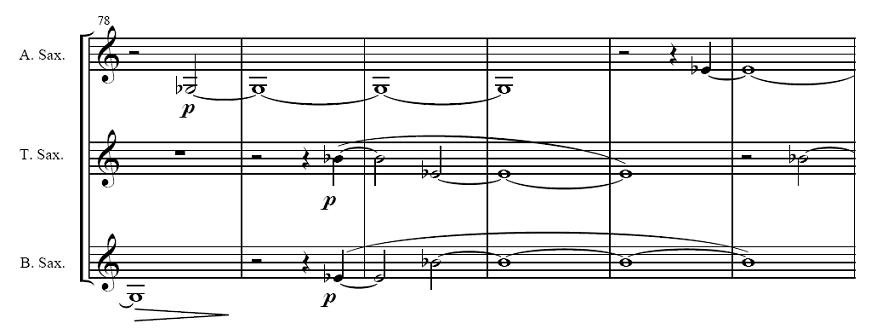
I was asked to write a piece for saxophone trio in 1988, and I decided to make it a memorial to Feldman, who had recently passed the previous year. Feldman’s influence on my music up until that time had been manifest in the slow movements/sections of my pieces, which tended to be really slow and very soft. On the surface of these pieces, with fast rhythms, irregular phrase structures, and frequent changes in harmony, Carter’s influence was clearer.

I can see in retrospect that the occasion of the sax trio was an opportunity for me to explore a reconciliation between what I had learned from Feldman and Carter. The solution (I’m not sure “solution” is the right word, because this is a “problem” that I’m not sure anybody else had) was simple: Combine the kinds of slow and soft textures that had attracted me to Feldman’s music in the first place with the fixed vertical sonorities around which Carter’s music was organized.

Without getting overly technical about it, but providing enough information to communicate the issues, the resulting piece, What stays with me, is made from a specific voicing of a particular six-note pitch-class set (Forte number 6-Z17, for the terminally dorky, and you know who you are). This set is unique in that it contains at least one iteration of every three-note set in the 12-note equal temperament universe.

The materials of What stays with me are the single notes (six), intervals (15), and three-note chords (20) that can be drawn from a six-note set whose notes are fixed in a specific register. (The chord is voiced so that all six notes are playable by all three saxes.) As the piece unfolds over its approximately eight minutes, each of these 41 “sonorities” is sounded once. The sonorities are often extended by the instruments trading notes or overlapping entrances and exits.

I didn’t realize it at the time, but the techniques I worked out for myself for What stays with me would resurface in different and surprising ways in almost every piece I’ve written since then.

14.11.06

The High Hat

The new issue of The High Hat is up. My article on Pierrot Lunaire is here, and my article on Robert Altman is here.

As usual, the whole issue is worth a read.

13.11.06

Time for Another Blogger Ethics Panel?

In the summer of 2003 The Washington Post ran an article ridiculing former Vermont governor Howard Dean's plans to raise money and support for his 2004 presidential campaign over the internet. Also in for criticism was Dr. Dean's reliance on bloggers for support as well as for position dissemination. The article, and its placement in the establishment beltway newspaper, was an attempt to downplay and ultimately squash the idea that the political discourse could be taken out of the hands of the top-down media. It was the beginning of a campaign against the emergence of a wider political community of interest that would have to be dealt with directly, through blogs and other new media, rather than business as usual.

We know how that turned out--newspapers and other old-line top-down media are struggling to adapt to the new, open source, world of contemporary politics. The citizen's media as broken through in the world of politics, and the genie will not go back in the bottle.

Which brings us to Norman Lebrecht.

In this column, Mr. Lebrecht writes that "[c]lassical blogs are spreading but their nutritional value is lower than a bag of crisps" and that "[u]ntil bloggers deliver hard facts and estate agents [Mr. Lebrecht earlier refers to a blogger who is a 'New York estate agent'] turn into credible critics, paid-for newspapers will continue to set the standard as only show in town". The body of the column is devoted to praise for some blogs, which praise is accepted, but not without reservation.

Bob Shingleton, of On An Overgrown Path, responds to criticisms of him in Mr. Lebrecht's column here. The errors Mr. Shingleton points out in Mr. Lebrecht's piece about the unreliability of blogs reminds me of Atrios' refrain when the top-down media make inaccurate attacks on political bloggers: Time for another panel on blogger ethics!

What does this have to do with the Washington Post article I started off with? That article came at a time when political blogs were on the cusp of breaking out into the mainstream and becoming the important part of politics that they are today, and the Post saw its revenue and prestige streams threatened and responded accordingly. Could it be that the same thing may be coming in classical music and the Norman Lebrechts of the world see their positions threatened?

What it would take would be a pushback against a musical institution from the blogs, a pushback that is covered in the top-down musical press. There was some pushback earlier this year from blogs when the musical establishment declared teen sensation Jay Greenberg the Next Big Thing. Very little of the establishment press (Alan Rich being a notable exception) offered a differing view, but many blogs did. The pushback was not covered, though. There will eventually be another flavor-of-the-month, either in composition or performance, that music bloggers are not sold on, and when the pushback is covered it will be a sign of the growing prominence of blogs in musical journalism.

(h/t to Stirling Newberry for some background and context for this post.)

11.11.06

Veteran's Day

Last year.

Addition:

Bernd Alois Zimmermann: Die Soldaten
Franz Joseph Haydn: Mass in Time of War
Charles Ives: From Hanover Square North, at the End of a Tragic Day, the Voice of the People Again Arose

8.11.06

Coming Soon to a Blog Near You

I'm working on the third installment of "The Still, Small Note" (Parts I and II), which will deal with specific instances of how I came to write the series of quiet pieces I recently completed with The Beginning of Things, which premieres tomorrow evening at Stephen F. Austin University in Nacogdoches, Texas. I'm wrestling with the age-old problem of how technical/detailed to get in writing about the music itself.

Adam Baratz' post on Morton Feldman's writings highlights the difficulty of writing about one's own music:

Don't get me wrong. A solid technical piece on "so you think this music is intuitively assembled, but really it's highly structured and organic" is invigorating in its own way. There is something particularly probing, though, about Feldman writing about "concentration," or why he only worked only in pen, or the time when he finally found the perfect chair. It's a view of composition not fixated on the end product, but as a process that is a kind of performance.

Last year, I wrote about perhaps why composers are so guarded about these issues. I still feel the same way, that the act of writing music is a very personal process, one
that other people shouldn't necessarily be privy to. With that in mind, Feldman's writings on compositional process strike me now as courageous in a certain way.


I'm working on finding the balance between technical and personal that will enable me to write about my experience and my music that's useful to me and informative to you, and to performers.

Listening in the meantime:

Stravinsky: Symphony of Psalms, Les Noces, Threni; Robert Craft.
Beethoven: Quartet, Op. 130. Guarneri Quartet.

7.11.06

Election Day

VOTE!!

Listening for the day:

John Adams, The Wound Dresser
Charles Ives: "Majority"
Elliott Carter, Concerto for Orchestra
Steve Reich, Come Out
Aaron Copland, Fanfare for the Common Man
Laurie Anderson, United States
Leonard Bernstein, Songfest
Julia Wolfe, Arsenal of Democracy

6.11.06

FSU Percussion Ensemble

I attended a very well-played and enjoyable concert by the Florida State university Percussion Ensemble, directed by John Parks. As I have mentioned before, I am working on a concerto for Mr. Parks, who is an energetic conductor as well as a fine player.

Among the pieces on the program was John Mackey's Damn, for clarinet and percussion quartet. The soloist was FSU faculty member Deborah Bish, who gave a good accounting of herself against the brash drumming behind her. I liked this piece much more than Mr. Mackey's Percussion Concerto, for whatever, if anything, that's worth.

The highlight of the concert for me was a performance of Steve Reich's Six Marimbas, which was the freshest, most challenging, and most entertaining piece on the program. The players made a strong case for Mr. Reich's music, which is everywhere (even Tallahassee!) this fall.

Speaking of making strong cases for Steve Reich, here's Alex.

5.11.06

Alazan Trio

This coming Thursday, 9 November, the Alazan Trio (Jennifer Dalmas, violin, Evgeni Raychev, cello, Ron Petti, piano) will give the premiere of my The Beginning of Things (2006). The rest of the program consists of Robert Muczynski's third Piano Trio, Op. 46 (1987), Leonard Bernstein's Trio for Violin, Violincello, and Piano (1937), and Ned Rorem's Spring Music (1991).

The concert will be given at the Cole Concert Hall on the campus of Stephen F. Austin State University in Nacogdoches, Texas, where the Alazans serve on the faculty. The program begins at 7:30.

FSU Opera: Falstaff

Review, Tallahassee (FL) Democrat, 5 Nov 06.

And it really was that good.

1.11.06

Score Marking

Conductor Kenneth Woods provides yet another fascinating look inside his profession with this post on score marking. Among the many gems is this:

Some conductors highlight every meter change- I was taught to do this, but rarely do it at all anymore. However, if there is a choice between putting in a big, ugly, yellow highlighter mark or fucking up a concert, I find that is an easy choice.
When I was conducting regularly, I was doing mostly new pieces, my own and others. I found that the more conducting I did, the less I marked. Looking through scores I performed, I find the occasional circle around something, or an expression marking underlined.

I own most of the scores I own for analytical, not performing, purposes. For the pieces I constantly return to, I have at least two copies, one for analysis (with tons of markings), and a clean one for reading/listening.

Speaking of listening:

Brahms: Symphony 4. Karajan, BPO. I love this performance, but I'd also be interested in recommendations of others, especially by active conductors.

Golijov: Ayre. I remain unconvinced by this piece as a whole, as I remain in awe of Dawn Upshaw's performance. This time though, I found myself quite moved by the final song, "Ariadna en su labertino".

Bartok: Quartet 4. Emerson Quartet. A tough-minded reading of this terse, hard-boiled work.

Matthew Sweet, 100% Fun. Power-pop, my favorite kind: Melodic and crunchy.

31.10.06

The Still, Small Note (II)

Part I

Later, while an undergraduate, I discovered the music of Morton Feldman and Elliott Carter. The experiences described in the first part of this essay occurred over a period of about 18 months in the first half of the 1970s. The cultural moment embodied in these musical encounters now seems incredibly remote and as though they had happened yesterday. My memory is that I found them on my own, without direction from a teacher or a peer, though that is hard now to credit.

At any rate, I did find them, and the experience was galvanic. I found, in their very different musics, a fulfillment of the promise of the initial encounters with Satie, Cage, and Stockhausen. When I mention Feldman and Carter as my two favorite composers, and, more important, as the two composers with the most direct influence on my own music, people are puzzled. I understand this, as it puzzles me sometimes.

The first pieces of Feldman’s that I dug into were The viola in my life and False Relationships and the Extended Ending. What I found there was what I’ve found in all of the composer’s music I’ve heard—a strong sense of color and a keen awareness of how music works in time.

With Carter, it was the Piano Concerto and the seventh Etude from Eight Etudes and a Fantasy. In these pieces, and in Carter’s other music, I found the same strong sense of color I had heard in Feldman’s music and an awareness of how time passes that was just as keen as Feldman’s but expressed in a very different rhythmic environment.

What these pieces had in common for my ears at that time (and this is really the whole point of talking about the subject) was an insistence on the expressive power of single notes, repeated, sustained, or recurring.

Feldman’s music is replete with this emphasis on single, recurring notes. To a great extent, it is a central feature of his style. In False Relationships, the opening chord reverberates in waves over the course of the piece, with notes from the chord coming back at unpredictable times, as the instruments go their separate ways (the “false relationships” of the title). The viola in my life includes almost obsessive repetitions of chords and melodic fragments. These melodic fragments were to become the means the composer used to create the vast pieces of the late part of his career.

Carter’s seventh etude is the “one note” piece whose expressive structure comes from changes in color, dynamics, and attacks. The passage in the Piano Concerto that is relevant to this discussion is towards the end of the second movement. The orchestral strings play monolithic chords that get ever thicker, taking up more and more space. As the strings appropriate new notes, the space for the piano to move expressively in is gradually reduced, so that finally the piano is reduced to one note (the F natural above middle C, to be precise), surrounded by the string cloud. Further study of Carter revealed that he uses pitches in fixed registral positions (like the F in the piano) in many ways in almost all of his pieces since the Concerto.

All of this came to the surface in my music in the first piece I wrote after Feldman died.

27.10.06

The Still, Small Note (I)

(A great deal of my music over the last 18 years has been conceived out of a desire to explore the expressive possibilities of extremely limited amounts of material. To my mind, this dovetailed closely with an interest in exploring the relationship between sound and silence, and between stasis and change. In looking back over what now seems like a group of pieces, I can see where they came from (influences) and where I might be going as a composer. The following is the first of an as-yet-to-be-determined-number part essay on the subject.)

The most striking moment of a performance of Erik Satie’s Pages Mystique comes at the end of the second movement, “Vexations”. “Vexations” consists of 640 repetitions of a minute-and-a-half of tonally-ambiguous music and lasts about 18 hours. The roaring silence that followed the end of the movement at a performance I heard as a student was shattering and profoundly unsettling.

I’ve seen a good number of performances of John Cage’s 4’33”. As I described here, performances of this piece can vary in quality and effect:


If a performer camps up the beginning and ending of the movements, the effect is lessened, much as the effect is lessened in a performance of Beethoven’s “Tempest” Sonata if the important structural points aren’t articulated, for example. I’ve seen such a performance, and the piece is reduced to an undergraduate prank.
I got a copy of a DGG recording of a couple of the pieces in Karlheinz Stockhausen’s Aus den sieben Tagen (From the Seven Days) after having heard recordings of the composer’s Hymnen and Stimmung. The way the composer used electronics combined with instruments and voices was fascinating to me at the time, and I was also very interested in improvisation in both performance and in composition. Shortly afterwards I found the score to Aus den sieben Tagen and came across this piece (marked “for ensemble”):

UNLIMITED

play a sound
with the certainty
that you have an infinite amount of time and space

This piece is a great centered listening experience/exercise, even if you never play or hear of it.

Some of my first experiences in music outside of school and pick-up bands of various kinds involved these close encounters with Satie, Cage, and Stockhausen. Then came the music of Morton Feldman and Elliott Carter, which have been constants at the center of my musical life and thought ever since.

26.10.06

Keeping Score

I received the following press release from Kimberly Harding of the San Francisco Symphony:

I work with the San Francisco Symphony and wanted to let you know that its interactive Keeping Score web site just launched. The web site, www.keepingscore.org, is a companion piece to the San Francisco Symphony’s Keeping Score television series on PBS which explores the stories behind classical music; the series features works by Beethoven, Stravinsky and Copland.

The web site allows you to dig into the score, listen as musicians share their insights, and learn about the lives of the composers, music theory and keys. The site gives an understanding of classical music thru the dissection of a score and the examination of the history, personal lives, and politics that created the music. You have to play with it to get a true sense of the capabilities, but here are some highlights from the section on Beethoven’s Eroica:

Learn about key, themes and markup – as the Eroica Symphony score plays you can choose to show keys, themes and markup on the screen. A video of the San Francisco Symphony in concert plays in tandem while you explore the score.

Beethoven’s deafness story – two video clips of Dr. Goodhill, from Hope4Hearing Foundation, simulate what Beethoven heard as he was going deaf and describes Beethoven conducting the 9th Symphony after he was deaf. Also included is a musical excerpt of how the 9th Symphony possibly sounded to Beethoven.

Each composer’s section on the Keeping Score web site launches a week before the program featuring them airs on television (Beethoven is already up and running as Keeping Score begins airing on PBS stations nationwide next week).


I spent a little time surfing around the Beethoven portion of the site and found it fascinating and very informative. I'd love to see the same treatment given to recent pieces!

24.10.06

Misc

I've added the blog of composer and man-about-Boston Matthew Guerrieri to the blogroll. Check him out.

I was going to post an e-mail I got about a film on Beethoven's Ninth, but Jerry beat me to it.

Early voting (for the 7 Nov general election) is beginning in various parts of the US, so vote, dammit!

20.10.06

Per Nørgård, Bent Sørensen, Steve Reich

Review of pieces by Per Nørgård and Bent Sørensen.

David Schiff makes a strong case for Steve Reich. (h/t to Alex Ross for the link to the Reich site.)

18.10.06

Sir Paul and the BeeDude

Greg Stepanich of The Palm Beach Post on Sir Paul McCartney's "strange, mystical attachment to his inability to read music or notate it":

Go ahead and learn how to read and write music, Sir Paul. It won’t hurt your talent one little bit, and you might find you’ll get more inspiration from the simple act of putting the notes on paper. I promise you it’s happened before.

Pliable, of On An Overgrown Path, has some suggestions for Sir Paul and Sting regarding their recent efforts in "classical" music:

If Paul McCartney really wanted to put communication centre stage he could have underwritten a performance of a little known and deserving contemporary choral work (let's take Rudolf Mauersberger's sublime Dresden Requiem as an example) in London, he could have made sure the hall was full by promoting it in the media, and he could have persuaded his record company, EMI, to record and really market the results. That way new audiences would have experienced real creativity, conviction and communication. Meanwhile [Mr.] Sting could have put his efforts behind persuading (and funding) an online archive of the BBC's contemporary music riches similar to that hosted in Finland by YLE, and he could have persuaded some of his super-rich rock buddies to fund the first year's composer royalties to allow free downloading - now that would be breaking the mould.

16.10.06

Of Powers and Electricity

Greg Sandow finished reading Richard Powers' novel The Time of Our Singing this weekend and posts about it here. I finished it this weekend, too, and my take on Mr. Powers' view of the future of concert music is less pessimistic than Greg's.

There is no question that the novelist sees that the institutions of concert music have to be more expansive to survive in the future. I find hope in the book's ending for two reasons. I think the participatory "musicking" that occurs near the end to be a possible continuation of concert music rather than a replacement for it. Also, the way that time is treated in the book (I don't want to reveal too much to those who plan to read it) offers a strong hope for constant renewal, of both life and music.

I highly recommend The Time of Our Singing, as well as other Powers, especially The Gold-Bug Variations, which also treats of music and renewal.


* * * * *
I've not commented on the blog-for-all that has erupted in response to this badly-written (What in the name of Sears and Roebuck is a "supersonic" mixing board? Does it fly around the hall faster than the seed of sound or does make the sound emanate from speakers at a faster speed?) article about electronic enhancement of the acoustics in a hall in Berkeley, California.

The response was immediate, as was the response to the response. Before you could say "baffle", those most horrible epithets known to blogo sapiens musicalis were thrown about like "Nazi" and "Commie" at a political site: "postmodern" and "elitist".

Buried in the story itself was the important fact that artists that use the hall will have the option to employ the electronic enhancements or not. This should act as smelling salts to ease the vapors of some. Scott Speigelberg has the authoritative last word: It depends. Put it in a hall, let people who want to use it use it, and we'll see if it can be made to work.

Scott also wants some recommendations for science fiction books. Please reward him with some.

TSO: Shostakovich, Mozart

Miriam Burns makes her debut as Music Director of the Tallahassee (FL) Symphony. Review.

12.10.06

Workshop (VII)

I recently finished Spiral Geometries, for clarinet and alto saxophone. It's a chaconne/passacaglia on a four-note theme (or one-fourth as many variations on a 16-note theme, depending on how you hear it) and will sound like a significant departure to anyone who has heard any of the pieces I've done recently, including for John Boda: What stays with me II.

Next up, a percussion concerto for John Parks of Florida State. Also, the opera is working its way to the front burner.

11.10.06

Audience Building in North Carolina

Barbara Norton, writing in The Independent (Raleigh/Durham/Chapel Hill, NC), introduces the marketing and programming strategies of the Opera Company of North Carolina:

Its general director, Frank Grebowski, and artistic director, Robert Galbraith, are committed to bringing opera to the people by bringing people into opera. The OCNC's upcoming production of Wolfgang Amadeus Mozart's Don Giovanni gives us a glimpse of how the company plans to infuse new humanity and vitality into an art form that has been at risk of becoming the kind of empty shell that blights our cultural landscape.

(I don't know how long the link will be live. I'll see what I can do about keeping the text around if the link goes dead.)

10.10.06

The Joy of Sets

The page behind the "Pitch Class Set Identification" link on the list of resources on the sidebar seems to have disappeared, so I am replacing it with a new one. This one is run by Jay Tomlin. I've used it for a while and seems to work pretty well. As with any such page, don't take the results as gospel without verifying a couple of tests against Allen Forte's list.

5.10.06

Reich

I missed posting about Steve Reich's 70th birthday, which was on Tuesday. Or maybe I'm just a little out of phase.

My wife commented on Tuesday that it is kind of weird to notice that the composers we grew up with were getting to be pretty advanced in age. (We did most of our heavy Reich listening between '73 and '79 or so.) It beats the alternative, though.

My favorite Reich:

Come Out
It's Gonna Rain
Clapping Music
Music for Mallet Instruments, Voices, and Organ
Drumming

3.10.06

More Powers To You

Greg Sandow joins the list of music bloggers (Marc Geelhoed and yours truly) reading Richard Powers' The Time of Our Singing. Greg's post includes several quotes from the novel. They reminded me of this passage from Powers' The Gold-Bug Variations:

"The trick to listening," he said, lifting me by the hand, "is to hear the pieces speaking to one another. To treat each one as part of an enormous anatomy, still carrying the traces of everything that ever worked, seemed beautiful awhile, became too obvious, and had to be replaced. Music can only mean anything through other music." (p. 377)

The seeds of a way out of the shrinking audience problem, and the style wars that contribute to it, lie in the approach suggested in that quote.