26.4.06

Talk to Me

A fairly recent trend in how performers present music in concert is for the performer to give a verbal introduction to the music from the stage. I say "fairly recent" even though many years ago I attended an all-Schoenberg recital by the great Paul Jacobs, who, after a somewhat tepid reception to the first piece, drew his hands away from the piano just before beginning to play the next work, and gave brief talk that had the audience in rapt attention for the rest of the difficult program.

This now-more-prevalent practice has not been welcomed by everyone. Critic Andrew Clark of The Financial Times wrote this mostly-critical piece, wherein remarks from the podium are called representative of "insidious" thinking about concert music on the part of presenters who "fear that classical music may not be sufficiently communicative or 'entertaining'. Mr. Clark goes on to say that "[y]ou don’t have to explain jazz to anybody" (!) and that concert music needs no explanation. Thanks to A. C. Douglas for pointing out this piece and pulling some of the more negative quotes from it.

Mr. Clark says that discussion of the music from the stage:

. . . limits the imaginative scope of the music. Listening to someone discussing a piece of music before you have a chance to hear it pre-programmes your responses. The music has no chance to communicate freely. You are left with a number of objective ideas about what to think and feel, circumscribing the subjective impressions that music seeks to create in the listener through the medium of sound.

This is not inherently true, anymore than reading program notes or having prior knowledge of the piece restrict the listening experience. Every experience one has with a given composition, composer, style, or body of music (maybe even bad experiences) adds to the totality of one's musical knowledge.

Mr. Clark closes:

Of course, it doesn’t do to be too purist. I recall several occasions at the Cheltenham festival in the past 10 years when festival director Michael Berkeley introduced a concert from the podium. He happens to be a composer but, unlike most composers, he is also a relaxed public speaker. He thinks as a composer does, but knows what information will be most relevant in advance. Exceptionally the formula worked. But please note - it was the exception.

Exactly so.

Mr. Clark makes a number of valid points against the practice, the most telling of which is that not everyone is good at it. I like brief, well thought-out remarks before the performance of a piece, especially if these remarks are accompanied by musical examples. But I don't want to hear it from performers who can't, for whatever reason, do it well. Come to think of it, I don't want to hear music played by people who can't do it well, but I'm not about to condemn the practice of live performance of music just because some people who do it don't do it very well.

23.4.06

Top 10

This blog has been selected by the editors of Top 10 Sources for their group of 10 classical music resources. The site includes top 10 sources in a wide array of subjects from "Business & Money" through "Life" to "Television".

I appreciate the editors adding listen. to their site, and I welcome visitors directed here from there.

I've added Top 10 Classical Music Sources to the "Links" on the sidebar.

22.4.06

Chicago Classical Music

Several arts organizations in Chicago have started a blog/forum called Chicago Classical Music. It is billed as "An Online Community for Classical Music Enthusiasts". Despite their questionable judgement in listing this blog on their blogroll, the site looks promising.

I've added it to the Links section.

14.4.06

Confusion

An article from Bloomberg.com about Finnsh composer/conductor Esa Pekka-Salonen and his travails with the postponed-then-performed world first of Kaija Saariaho’s Adriana Mater includes this:

Also unusual is the clear narrative form of "Adriana Mater,'' in a continental context where new operas are generally modernist deconstructions.

"This is not a post-modern, distanced view of the very idea of opera,'' says Salonen. "It's an opera which absolutely believes in the art of opera, a simple story told in a linear way. It is a statement of faith in the fact that opera is an art form which can deal with big emotions and huge subjects. I'm very tired of the modernist idea that there are things you should not do because they are against the historic determinist paradigm or the Hegelian dialectical idea.''


Note that the writer of the article says that AM is not “modernist” because it has a “clear narrative form” and Mr. Salonen says it’s not “post-modern” because it’s a “simple story told in a linear way” and that he is tired of the "modernist" view of opera, which he says rejects linear story-telling. Mr. Salonen doesn't say he is also tired of modernism. His disavowal of modernism for AM seems like a continuation of his disavowal of pomo.

The issue here for me is not whether Ms. Saariaho’s opera is “modernist” or “postmodernist” but rather the use of those terms as a shibboleth to identify one as being among friends or as club with which to beat upon one’s enemies. In any case, it’s clear that there’s not clarity about what modernism is and what post-modernism’s relationship to it is.

And vice versa.

* * * * *

While we're on the subject of postmodernism, I recently read Christopher Butler's Postmodernism: A Very Short Introduction and am now reading Glenn Ward's Teach Yourself Postmodernism. The two authors take very different approaches, with Mr. Butler adopting a very skeptical stance and Mr. Ward a more sympathetic yet questioning posture.

Neither writer has much to say about music. Even given that, I can highly recommend them both.

Reading both of these books and thinking about the ideas and issues involved made me thinkof this story from Silence:


Before studying Zen, men are men and mountains are mountains. While studying Zen, things are confused. After studying Zen, men are men and mountains are mountains. After telling this, Dr. Suzuki was asked, "What is the difference between before and after?" He said, "No difference, only the feet are a little bit off the ground."

Conversation

Alex Ross, A. C. Douglas, and Lisa Hirsch are having a spirited discussion of some issues raised by Steve Metcalf on increasing the audience for concert music. The ground has been covered pretty well, so I don't have any big points to add. I do think the iPod/soundtrack-of-my-life model of music consumption/listening does need to be addressed by concert music folks; I'm just not sure how.

On the idea of a need for a superstar composer or a composer as a household name cultural hero, it's not going to happen. If the hype around the user-friendly music of John Adams and Osvaldo Golijov hasn't made it happen for them, it isn't going to happen for anybody. I'm not sure it would be so good if it did.

On the other hand, I'd like to see some performers who excel at a variety of contemporary styles become big name cultural heroes. Dawn Upshaw immediately comes to mind. Are there others?

11.4.06

Polyphonic.org

I've added what is supposed to be a mini-banner leading to the just-launched Polyphonic.org, a website whose aim is to provide orchestral musicians with information about the business. listen.'s crack technology staff is working overtime to fix the picture banner. In the meantime, the link works.

[EDIT: The banner is fixed.]

6.4.06

Out There

Charles T. Downey of ionarts has a round-up of the early reviews of Kaija Saariaho's Adriana Mater, which premiered Monday evening in Paris, after a four-day delay due to labor unrest. Alex Ross' take on the opera is still to come. EDIT: Here it is.

Marcus Maroney and Lisa Hirsch take on Bernard Holland of the New York Times, with examples and suggestions, while A. C. Douglas offers a defense-by-assertion of the critic.

I've added former Tallahasseean Tim Risher to the blogroll.

31.3.06

Kaija Saariaho

Charles T. Downey of ionarts posts about the cancellation of last night's premiere performance of Kaija Saariaho's second opera, Adriana Mater. He includes some good comments about some of the composer's music that is available on discs, compact and digital video.

My understanding is that the premiere is scheduled now for Monday evening. Still enough time to get there.

Takács Quartet

Review

24.3.06

This and that

Terry Teachout has provocative posts up, one about criticism and the other about the standard repertoire and multiple recordings thereof. I agree with the larger points of posts, if not with some of the particulars. For example, I agree w/r/t Gatsby over The Sun Also Rises, but not with the statement about accessibility in new music. The point being, of course, that opinion is what opinion writing is all about.

I've added M. Keiser and PWS to the blogroll.

Workshop note: I've finished a pair of piano nocturnes. If you would like a copy, drop me an e-mail.

22.3.06

Here and There

I've added Bart Collins and Adam Baratz to the blogroll. Enjoy!

Helen Radice notes connections between two 101 pieces, Britten's War Requiem and Mahler's Das Lied von der Erde. Connections between pieces of different styles are any important part of the 101 project, and Ms. Radice shows in her post how it works. Granted, the difference between Mahler and Britten is not all that large, but the gap in time and history is telling, and further connections, to styles more far afield, are waiting to be heard and remarked upon.

20.3.06

Review

Tallahassee Symphony Orchestra

For those of you in the Greenville, SC area, my for John Boda: What stays with me II (for flute, clarinet, and marimba) is being performed Wednesday evening at Furman University at 8 o'clock.

16.3.06

Magic, etc.

Far be it from me to speak for Greg Sandow, who is capable and willing to do so for himself, but I still think A. C. Douglas is misreading Greg's post about Brahms' orchestration. A. C. reads Greg's analysis of the practical reasons that may have motivated some of Brahms' choices as an attempt to deny the "magic" of the music, the "magic" of other composers of the past, and thereby to raise the composers of today to their level. It's very clear from this post and others that the only way contemporary composers can be on the level of the greats of the past (in A.C.'s ear) is to denigrate the past.

I don't find that in Greg's post. Not at all. He fully acknowledge's the greatness of Brahms' music. Hell, he spends a lot of time, thought, and virtual ink on a couple of measures of a symphony in order to show part of how it's done. A. C. writes that these the magical results of the masters of the past is part of the result of these practical choices, which is not substantially different from what Greg finds, though he comes at it from a different direction.

A. C.'s approach is essentially to use the past to bludgeon the present, but that only works if you accept his assumption that high quality, magical music isn't being written today, at least not by today's "visible" composers. If one listens and reads from that assumption, then one can find support for it, even if it isn't there.

Finally, A.C. criticizes Greg's analysis as "simpleminded at best, not to say approached from the wrong direction", which comment I find baffling. It was a narrowly focused article, treating it's subject in great detail, and from a variety of angles. It also inspires further thought, like the notion I've had for some time that one of the indications of a great tonal composer is how that composer handles the middle voices, which is one of Brahms' strengths (Mozart's as well, for that matter). As to the "wrong direction" comment, the house of art has many mansions, and many ways to approach. Any critical/analytic approach that helps you hear the piece or repertoire in question differently/more clearly is most assuredly not from the "wrong direction".

15.3.06

Uncool

I may be wrong, but I think A. C. Douglas may be misreading me in this post about this post. In my post I praised Marc Geelhoed's use of the word "cool" to describe a piece after he had done a more traditional discussion of it. I then ended my post with a comment about pieces by Elliott Carter that are "cool" and "bitchin'". Mr. Douglas seems to read that as my definitive statement on the pieces. It isn't. That's coming in the review I'm working on for Sequenza 21.

I think Mr. Douglas is also misreading Greg Sandow's fine and fairly technical post on Brahms' orchestration. Far from belittling or diminishing Brahms' achievement (as Mr. Douglas clearly thinks he is), Mr. Sandow is showing how it's the details, often the very practical and seemingly mundane details, that reveal how great art works. Musical instruments cannot play notes outside their ranges (normally), and how composers handle that bit of craft/technique is revelatory of their greatness as artists.

Finally, I would like to amend yesterday's post regarding the Carter Dialogues: I meant to say that the piece is "totally bitchin'".

14.3.06

Cool

Marc Geelhoed, music critic for Time Out Chicago magazine and the proprietor of the blog Deceptively Simple, posts about how an art critic at the Chicago Tribune had objected to Mr. Geelhoed's use of the word "cool" in a review of a piano concerto by Marc-Andre Dalbavie:

the article[. . .]closed with the sentence, "Oh, yeah—and the concerto sounds cool, too." This was after a fairly detailed description of how Dalbavie alters the patterns that comprise the work and how he ties his style to [medieval composers] Leonin and Perotin.
This seems perfectly resonable to me. It's important for concert music to expand its audience (given the pay for play world we inhabit) and using language that is understood by the public-at-large is a perfectly legitimate way to communicate. I don't see how it cheapens our art in the least.

I'm working on a review of two recent Elliott Carter discs for Sequenza 21, and I'm happy to say that, while my personal jury is still out on a couple of the pieces/performances, the Boston Concerto is actually very cool, and Dialogues (piano and orchestra) is bitchin'.

1.3.06

Crumb

I've posted a review of music by George Crumb at Sequenza 21.

I listened to a lot of Crumb as an undergraduate. I kind of overdosed on it, but not before I was able to attend a great concert of Crumb's music by performers including the great Jan DeGaetani, Gilbert Kalish, and others. Eventually, it started to sound like strung together sound effects.

So it was with some interpidation that I began to listen to the two Bridge discs for that review. I wanted to be able to give it a fair hearing. It turned out to be a revelatory experience, and I'm glad I got the opportunity.

I overdosed on minimalism at the same time. Maybe I need some hair of that dog, too.

20.2.06

The Heart of the Matter

Alex Ross has a fine article on Puccini up at the New Yorker. In addition to a number of telling insights into the Italian master's ability to hold the stage, Alex touches on some issues of central importance in the ongoing struggle to keep concert music culturally viable and to regain its place in our intellectual life.

Two quotes in particular address this issue, and as is often the case, Alex sums it up well. After mentioning two crossover events held at important venues in NYC:

The idea is not to dilute classical music with crossover novelties but to move it back into the thick of modern life. The old art will no longer hold itself aloof; instead, it will play a godfather role in the wider culture, able to assimilate anything new because it has assimilated everything in the past.

Then after discussing a Puccini performance that emphasized what is unusual/challenging in Turandot:

Even composers may have something to learn from Puccini. “Turandot” becomes a different piece when it is removed from the colossal clutter of Franco Zeffirelli’s production at the Met; it begins to sound nearly avant-garde, because it assimilates an array of modern sounds while maintaining an inexorable singing line. Berio [whose completion of Turnadot was given in the performance Alex reviewed] also superimposed old and new, but the pieces in his collages remain alienated from one another. Many young composers still play the same glass-bead game with the past, upholding artificial differences in musical language rather than questioning them. Puccini might say: Don’t make it new. Make it whole.
(If I could write like that, I'd never leave the house.)

Exactly so. What we should be hearing in the music of the 20th and early 21st centuries are the ideas that hold the different styles together, not the stances that separate them.

15.2.06

Marky Mark

A vigorous discussion is ongoing at the Sequenza 21 Composer’s Forum. It’s also been taken up at Kyle Gann’s blog. The topic under discussion is, nominally, the density of expression markings in scores. (I say that markings are the “nominal” topic of the discussions because I think the real topic is compositional pedagogy, a second front in the style wars.) I want to comment on the subject of markings themselves.

Among the markings under discussion are those that indicate dynamics (volume), articulation, including changes in dynamics, accents of various kinds, and phrasing. I pulled a few score off of my shelf just to look at the density of markings therein and found that they vary from piece to piece, even within the work of a single composer!

This is not surprising, of course. It seems to me that the markings in a score become too dense at precisely that marking that makes it harder for the performer to play the piece than it would be without the mark. How does a composer know this? Well, that’s a little more complicated. It comes with experience (and experience as a performer is even better). If the style of the piece demands few or no marks to be expressive (if that’s the goal) and vivid in performance, then a plethora of marks will get in the music’s way. On the other hand, if a certain level of specificity is desired in the realization of a note, chord, or phrase (or “moment”), the marks needed to help the performers achieve this are necessary.

I think most composers intuit this. I say that because in looking at a number of scores from various eras and in divergent styles, the density of these expression markings changes with pieces, so that some passages are rather full of markings and, a few pages later, almost none. There seems to be no consistency as to whether fast music has many markings or few, and the same for slower passages.

Let a thousand accent marks bloom! Or not.

14.2.06

Love Songs

Music for the day:

Johannes Brahms, Liebeslieder Walzer
Elliott Carter, "O, Breath", from A Mirror on Which to Dwell
Morton Feldman, The viola in my life
Thomas Morley, "Now is the Month of Maying"
Kaija Saariaho, L'amour de loin
Gustav Mahler, Finale from Symphony 3 (working title: "What Love Tells Me")
Franz Schubert, Der Hirt auf dem Felsen
Amy Beach, "Sweetheart, Sigh No More"
Hector Berlioz, "Absence", from Nuits d'Ete, and of course,
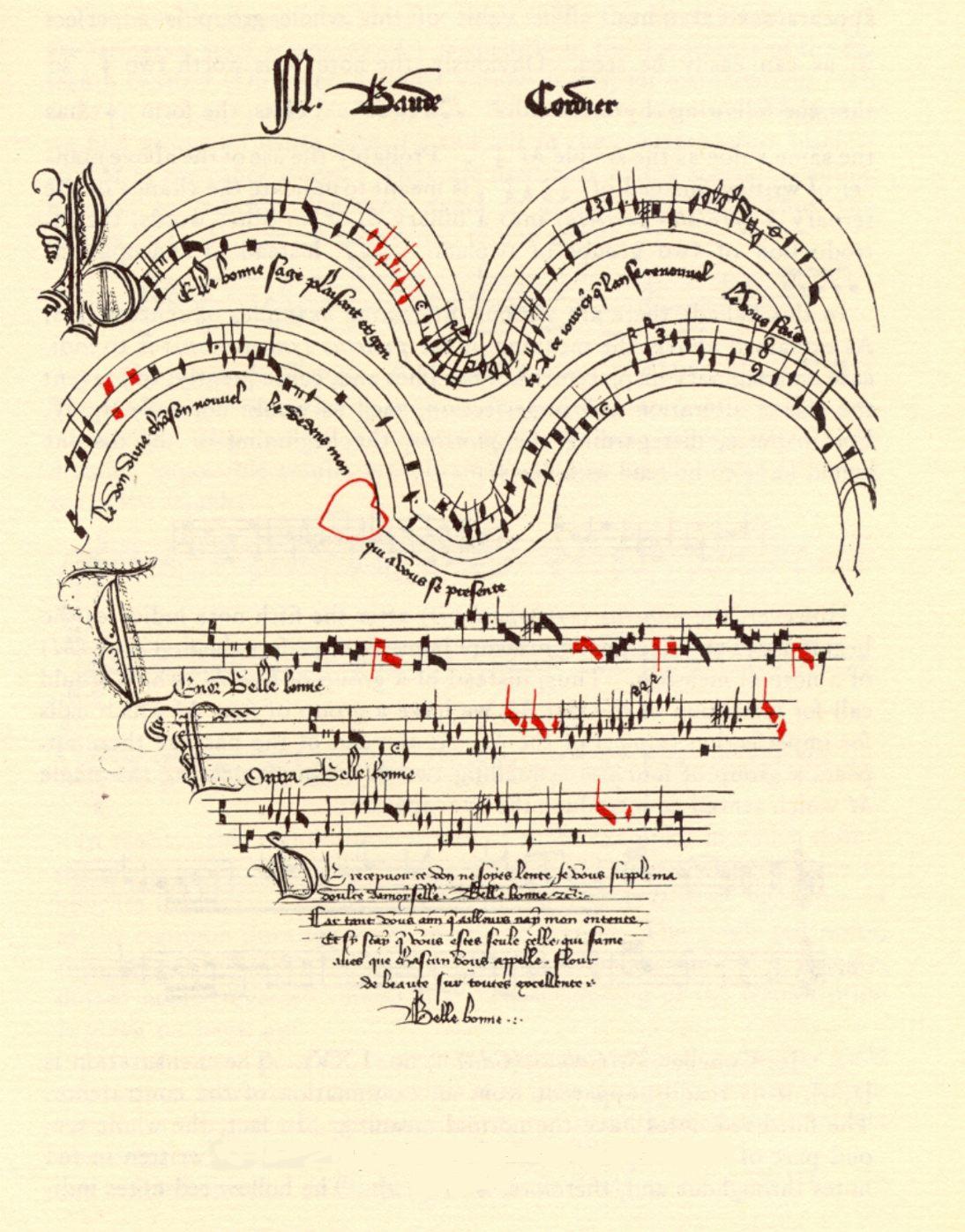
Baude Cordier, "Belle Bonne, Sage"

Bonus: George and Ira Gershwin, "I've Got a Crush on You"

6.2.06

Futures

A. C. Douglas is concerned that Osvaldo Golijov represents "the future" of concert music. Mr. Douglas need not worry--the multi-cultural polystylism of Golijov, whose Ayre has received reviews both rapturous and reserved--is not the future. It is a future, one of a thousand stylistic flowers that will bloom.

Golijov is indeed having a big and very visible year. But so are John Adams, Tobias Picker, Jennifer Higdon, and Elliott Carter.

Some will argue that this year's celebration of Carter is a final blooming of a Modernism that is over, but I believe (and I don't think it is merely wishful thinking on my part) the next several years will see the growth and acceptance of what I'll call, for now, "neo-modernism".

In addition to the above named, Kaija Saariaho should be getting quite a bit of attention when her second opera, Adriana Mater, premeires in Paris.

In addition to the diverse styles of the composers listed above, we have neo-romanticism, totalism, jazz-inflected improvisatory music, and live-electronic music. Minimalism and serialism also have their adherents. I'm sure, at least I hope, that Mr. Douglas can find something in all of this abundance to like and admire.

5.2.06

Davidovsky

My review of a new disc of music by Mario Davidovsky, including three of the Synchronisms series, is up at Sequenza 21.

3.2.06

Workshop: Revision

That's an interesting word: revision.

I wrote Episodes in Anticipation (band, 2001) in longhand on 30-stave paper. I copied the parts in pencil. I wrote in longhand rather than in Finale, because of a short timeline and because I didn't feel strong enough in the software to get the piece done in time. Rehearsals and a performance had been scheduled and everyone involved was committed to a performance on a date certain.

I was happy with the piece--it did pretty much what I wanted it to do, the performers enjoyed playing it and did so with style, and the audience was generally receptive. Still, I'm sure everybody reading this has seen room for improvement after the fact in pieces, performances, or other creative work.

There are a couple of people who have aksed to see the score and I want to send it to some others, so the time was right to load it into Finale. And, since I'm having to do all that work on the piece anyway, why not do some of the revisions. The score aleady had many marks in it from the rehearsals for the premiere, including some added percussion notes, so there was already some revision there.

Which brings us back to that word,"revision".

The Merriam-Webster OnLine Dictionary defines "revision":

1 a : an act of revising b : a result of revising : ALTERATION2 : a revised version

Fine, as far as it goes. But when does the act of revising proceed to the point where the root of the word changes fron "revise" to "re-vision", to see the work anew and, so seeing, make it new again? Should you make this work everything it can be, fix it up a little, or leave it be and try again next time?

The answer is different for every artist and every work, of course, but the temptation to make wholesale changes is there, and is made greater by the ease of doing it in software. For example, in a hand-copied score, if you wanted to add a measure or (especially) two or more, it usually meant re-copying the rest of the score after the additions. With Finale (and other music-writing software packages) you can insert measures into the middle of a piece at will.

In this case, I'm adding a measure or two here and there, giving some of the players a little more to do (even adding an instrument that I inadvertantly left out), but mostly I'm leaving it as it was and moving on to the next piece.

By the way, I have an mp3 of the premiere. If anybody is interested in hearing it, let me know.

31.1.06

4'33" Video

Video of a performance of John Cage's essential 4'33". Not the best performance I've ever heard, but still.

Here's my take on the piece.

30.1.06

Review, etc.

Here's my review of a recital by pianist Joyce Yang.

I saw Terrence Malick's latest film, The New World. I don't have the vocabulary needed to give it a full-fledged review, but I wanted to say that I found it moving and deeply felt. The pace of Malick's films is slow, allowing images and events to resonate for the viewer, and I find that very compelling. I did want to comment on his use of Wagner's "Vorspiel" to Das Rheingold at crucial moments in the film. The New World is an elegiac telling of one of America's creation myths, the founding of the Jamestown colony. The use of the Wagner during the opening scene depicting the arrival of the ships (and two other times) was poetic as well as beautiful.

I also saw David Lynch's Eraserhead on DVD. For my money, Lynch uses sound (as opposed to music) as an expressive element in his films better than any other director I am aware of. The sense of foreboding that hangs over this film is in no small part a result of the sonic environment.

11.1.06

Running the Voodoo Down

I don't have much technical knowledge of jazz in any of its incarnations, but I do like it quite a bit. I especially enjoy '50s and early '60s era Miles Davis. His various quintets of the period are chamber music of a very high order.

Music critic and fellow High Hat contributor Phil Freeman has just published a book on Davis' later, electric music, Running the Voodoo Down. Here's a very positive review by John Kelman of all about jazz. Mr. Kelman's emphasis on the author's status as a jazz "outsider" (Phil is best known for his reviews of metal) and how that informs both Mr. Freeman's listening and writing offers another hint for those of us who want to expand the audience for concert music. We need to listen with new ears and write with a new mind.

I look forward to reading Running the Voodoo Down and expanding my own appreciation for Miles Davis' remarkable artistry. I want also to acknowledge Jeff Harrington's invaluable new music reblog, where posts about new music are compiled in what amounts to a one stop blogroll, for pointing me to this review.

10.1.06

20K

Greetings and Happy New Year!

Sometime this morning a lost soul wandered in here and became this blog's 20,000th visitor.

Greg Sandow continues his "improvised book" on the future of classical music. I agree with Mr. Sandow that "form and structure" are essential differences between classical music and other kinds of music:

It gives classical music a special richness, not a greater richness than any other kind of music, but a richness unique to itself.

21.12.05

Four Play

Four jobs you've had in your life: Ladies' wear stock clerk; library technical assistant; grantswriter; teacher

Four movies you could watch over and over: The Searchers, Nashville, Godfather II, Chinatown

Four places you've lived: Poughkeepsie, Ithaca, Durham, Iowa Citry

Four TV shows you love to watch: Scrubs, Law & Order (mothership), Boomtown, 24

Four places you've been on vacation: Atlanta, Tampa, Chicago, New York

Four websites you visit daily: All of the sites on the blogroll plus dailykos, bopnews, Salon, Slate

Four of your favorite foods: fresh pasta with marinara sauce and cheese, various Indian dishes, black beans and rice, salad

Four places you'd rather be: Atlanta, New York, Italy, France

13.12.05

Storms

[Up front disclaimer: I've known Stirling Newberry for nearly ten years of internet discussion and arguement. It's impossible for me to hear his music without my experience of him affecting my perceptions, and I wouldn't want to hear it that way.]

_________________________

Political activism and music are among the passions/obsessions of Stirling Newberry's life. These obsessions come together in the two string quartets recorded on In The Year of Storms.

The two quartets on this disc, (No. 7 in Eb, Op. 35, and No. 8 in B, Op. 36) were written in response to the storm season of 2005 and its aftermath, both political and human. A combination of grief, anger, and longing suffuse the music of both quartets.

Mr. Newberry's music is tonal/modal in both forward and backwards senses. The works are governed by large-scale harmonic and melodic ideas while at the same time there is often a hint (or more) of the minimalist project underlying the surface. And it's a compelling surface. Mr. Newberry's melodies are memorable enough to carry the musical weight they are given in these pieces, though they aren't tunes you'll whistle afterwards (for the most part). His admiration (obsession, really) for Beethoven is reflected in his melodies, which are almost always ripe for contrapuntal treatment.

The composer's brand of post-modernism comes out in his stylistic references. The opening of the first movement of Quartet 7, for example, recalls the opening of Beethoven’s Ninth and a later movement includes the Dies Irae as a theme. Mr. Newberry is also fluent in many popular styles of the past and present and deploys them with ease.

I can recommend this disc without serious reservation. It brings up important issues about the nature of performance (and what constitutes a musical work) and the distribution of concert music, which I will discuss later.

11.12.05

Happy Birthday, Chronometros

My work was submitted under the pseudonym of Chronometros . . .

--Elliott Carter in his entry in the 25th Anniversary Report of the Harvard Class of 1930, referring to his First Quartet and its entry in a composition competition.

Carter goes on, quoting a letter he received after the Quartet won the competition:

I don't know if Feldbusch, the 'cellist of the Liege Quartet, has written you, but if not, here's his story, which may please you. He and Koch, the leader, detested the quartet all through rehearsals and the first performance. The eve of the final desicion, the judges listened to tape recordings and for the first time F and K were able to listen, not play. They were overwelmed, and F, a big hulk of an extrovert, not at all given to romanticism, I assure you, said he found himself on the verge of tears, and K also was moved. Meeting an old friend the day of the final concert, F insisted he come, deliberately telling him he must hear Chronometros, a terrible work, nonsensical, no rhyme or reason. Now the old friend was a coal miner, a guy who went down in the pits at the age of fourteen and has done nothing else in his life, is now forty-five, and goes once a year or so to the opera for Manon or Carmen. He came to the concert and the next day looked up F, threatened to bash his nose in, called him every dirty name in the Walloon vocabulary, said F knew nothing about music and deserved to hear nothing better than Manon or Carmen if he couldn't understand Chronometros. Says he: "This is the first time I have felt in music that a man was talking to me like a man; the guy who wrote that understands the fear I experience when I get down into a new mine not sure whether or not it is going to cave in on me; he's got guts and muscle, and he digs in his music like I dig in hard rock; he sweats like I do, he's a worker like I am; and you, Feldbusch, you're nothing but a goddamned fool of a musician if you can't understand that."


Other Carter posts at listen.:

Carter in Atlanta

More on Carter in Atlanta

Birthday

1.12.05

A Different Perspective

This column by Chadwick Jenkins, from the PopMatters 'zine, is the first in a series of pieces on why "classical" music should matter to consumers of popular culture. I look forward to the rest of the series. It has the makings of an important contribution to the ongoing discussion of the place of concert music in postcontemporary life.

30.11.05

Counter Culture

I quite agree with Alex Ross when he says:

I'll repeat my outré contention that classical music, for all its elite trappings, is actually a radical, disruptive force in American culture, whereas most popular culture, for all its rebellious trappings, is intensely conservative.

I'll only add that it's been true for a very long time.

29.11.05

Elsewhere

Around the 'sphere:

Terry Teachout has some thoughful observations about the nature of criticism and its relation to art. Of particluar interest to me, as both critic and composer, are his musings on what it means and whether or not it's important for critics to be "right" about the work they criticize.

The Blogger Known as Pliable posts a fascinating, informative, and link-rich piece about the development and testing of the atomic bomb. Plenty to hold us until the recording of Doctor Atomic comes out.

Daniel Felsenfeld responds to an article in the Wall Street Journal about audiences and orchestras embracing new music that throws off the yoke of serialist oppression. Mr. Felsenfeld points out that this "might have been something worth noting were this, say, 1952". He also quotes composer Daniel Kellogg as saying he writes music that "he wants to hear," and that the article frames this as "novel". Mr. Felsenfeld sighs:

I do not come down on either side of this argument because frankly I think it is an old and dead struggle. These are no longer the sides any more than the Yankees and the Confederates. We hear daily of the "problems" in classical music, and if we are ever to take a step to solving them we have to address the issues of our own time (even if we do not like our own time) rather than a more simplistic contrempts of a vanished world. The implication--that serial music and its descendants rules the roost while there is a new generation trying to upturn it by returning to the old ways--is a quaint and lovely notion that might have been riveting half a century ago but in 2005 it is laughably far from true...though I, like Mr. Russell, [the author of the Journal article] wish these were the only problems we faced. Our world would be a better place were this true.


Finally, Heather Heise asks questions of composers. My answers, for the record: No; no; no; yes, I have two; sure, why not; no; yes and no; no; no; not for me; yes, though it's more an "ooze" than a "spill"; yes.

24.11.05

Thanksgiving

I want to take this opportunity to wish everyone a Happy Thanksgiving Day. I hope it is going well.

22.11.05

Frontier

Stirling Newberry's article on Jeff Harrington is important for several reasons. First, it's good to see a composer get some pub in a non-traditional place.

More importantly, the piece is among the first, to my knowledge, to take as a subject the relationship betweens a composer's work and his relationship to the internet. The internet (and digitality as a whole) will be, for a while at least, the best way for a composer (and other artists, too) to get their work before the public. It's good to see someone attempt a beginning of an analysis.

17.11.05

Books

As should be clear, I like lists. Lists of essential pieces, lists of music for holidays, whatever. Here’s another one: my thirty favorite books on concert music (as of today). The criteria could neither be simpler nor as unassailable: they have to be on concert music and I have to like them. No more meaning should be ascribed to the order of the list than to the list itself.

The Classical Style; Charles Rosen
Silence; John Cage
Instrumentation; Andrew Stiller
Essays Before a Sonata; Charles Ives
The Time of Music; Jonathan Kramer
Arnold Schoenberg; Charles Rosen
Flawed Words and Stubborn Sounds; Alan Edwards and Elliott Carter
The Music of John Cage; James Pritchett
The Music of Elliott Carter (Second Edition); David Schiff
Simple Composition; Charles Wuorinen
Give My Regards to Eighth Street; Morton Feldman
A Generative Theory of Tonal Music; Fred Lehrdahl and Ray Jackendoff
Music in Theory and Practice; Bruce Benward and Marilyn Saker
Computer Music; Charles Dodge
Emotion and Meaning in Music; Leonard B. Meyer
Compendium of Modern Instrumental Techniques; Gardner Read
The Musical Experience of Performer, Composer, Listener; Roger Sessions
The Beethoven Quartets; Joseph Kerman
Writings About Music; Steve Reich
Harmony; Walter Piston
The Technique of Orchestration; Kent Kennan
Counterpoint; Kent Kennan
Harmony Book; Elliott Carter
A Practical Approach to Sixteenth-Century Counterpoint; Robert Gauldin
Music Notation; Gardner Read
The Acoustical Foundations of Music; John Backus
Poetics of Music; Igor Stravinsky
Form in Tonal Music; Douglass Green
For the End of Time: The Story of the Messiaen Quartet; Rebecca Rischin
Gustav Mahler; Bruno Walter

15.11.05

Blogroll

The blogroll at right has two new listings: Deceptively Simple, the blog of Chicago music journalist Marc Geelhoed, and Felsenmusic, the blog of composer Daniel Felsenfeld.

EDITED 15 Nov to reflect the correct spelling of Mr. Felsenfeld's name.

14.11.05

Da-Da-dadada.

Start spreading the news! listen. is listed in this week's Big Apple Blog Festival. Should I tell them?

Critics and Critics

Ken Nielsen, commenting at Jessica Duchen's blog, observes:

Tis very useful to get such from someone whose taste I understand, even if I don't always share it.

This is the best reason to read criticism (in the "review" or "notice" sense) that I can think of. The more you read a given critic, the more you understand where she or he is coming from, in terms of aesthetics, tastes, and standards. It makes the expenditure of your cultural currency less of a crap shoot.

Example: I've read enough of Alex Ross' criticism to factor his views into the equation, even when I don't agree with them, which is true at least occasionally. His writing about John Adams hasn't convinced me, but it reminds me that Mr. Adams is there and that serious people take him seriously. His new review of music by Giacinto Scelsi, when taken along side other readings, seals the deal.

You can learn as much or more by reading critics you rarely agree with, too. The point is, that if the critic has a staked out, complex, and nuanced aethetic positon, it is easier to locate yourself in relation to that position and use the criticism to inform your own experience.

11.11.05

Holiday Listening

I want to give warmest wishes and thanks to veterans on this day. Here's a brief list of music appropriate to the day. My criteria were: 1) some relation to the first World War, 2) something about a soldier's life, and/or 3) music about peace (in light of the original intent of the holiday).

Benjamin Britten, War Requiem
John Adams, The Wound Dresser
Vincent Persichetti, A Lincoln Address
Terry Riley, Salome Dances for Peace
Elliott Carter, Adagio tenebroso, from Symphonia: Sum Fluxae Pretium Spei
Charles Ives, Three Songs of the War
Igor Stravinsky, l'Histoire du soldat

Please remember the sacrifice of soldiers and their families, and work for peace so that sacrifice can be more rare.

8.11.05

Tables Turned

Lisa Hirsch has written an article about how concert music critics prepare for concerts. It's very well done and the information in it tracks with my experience. The short answer to how a critic prepares for a concert is this: It depends. It depends on the program, the performers, the occasion--the variables are numerous. I'm finding my preparations for the current Tallahassee Symphony Orchestra season of music director auditions unique, in that the music is, for the most part, the Warhorses of the Apocalypse. I know most of the music fairly to very well, so I am able to concentrate on the various parts of the conductors' work.

I enjoy reviewing new music the most, though that has its own pitfalls. The greatest of which, in my experience, is not knowing for certain whether the performance of a new work has been a good one. And what does good mean in that situation? Accurate? Putting "more" into the piece than the composer meant so as to make it a better piece than the score? You might be surprised how often this happens when the composer is present at some rehearsals, especially if the composer is young and/or inexperienced.

At any rate, thanks to Ms. Hirsch for an interesting discussion.

6.11.05

Susannah and George

Review.

Also, this interview with playwright and blogger George Hunka offers a fascinating glimpse inside the world of theater. George's comments on the relationship between playwright, director, and actors illustrate a creative collaboration that is very similar to preparing the first performance of a new piece.

31.10.05

Here and There

Alex Ross points us to the New York music scene blog of Steve Smith. I have added it to the blogroll. It is a style wars-free zone, so far.

Greg Sandow posted the first installment of his book on the future of concert musc today. The issues he brings up will be familiar to his readers, as well as to readers of this and other music blogs and publications. I find these questions particularly interesting and in need of answers:

Are performances of classical music very interesting, these days? Are they creative? Surprising? Individual? Why all the emphasis—in program notes, for instance, or music education—on scholarship, history, and technical analysis? If all this is changing (which it is), is it changing fast enough? And what’s our relation—all of us in the classical music world—to contemporary culture? Theater companies do plays by living playwrights; classical musicians, in striking contrast, play music from the past. And, sure, there’s more new classical music played now than there was 10 years ago, but how much of it sounds new? How much of it sounds like the world outside the concert hall, the world we really live in?


I look forward to Greg's exploration of these and other questions.

30.10.05

Workshop (V)

I finished a short piece for oboe solo, called Night Music, this weekend. As usual, a score is available in Finale format (*.mus) for those interested. A PDF version may be available later this week.

The opera is trying to get attention, but there are a couple of other pieces in front of it. More on those later.

This coming weekend in reviewing: 50th anniversary production of Tallahassee resident Carlisle Floyd's Susannah at the Florida State Opera. More about that as the week progresses.

20.10.05

11.10.05

To Ayre is Human

GOLIJOV: Ayre; BERIO: Folk Songs. Dawn Upshaw, s; Andalucian Dogs; Ensemble. DG B0004782. 62 minutes.

First, up front: Dawn Upshaw is a force of nature. Her performances on both Osvaldo Golijov's Ayre (2004) and Luciano Berio's Folk Songs (1964) are nothing short of spectacular. Her voice is warm and rich, her phrasing expressive, and she has a strong sense of style that comes into play in both of these pieces.

Ayre is a cycle of recreations/arrangements of traditional songs from Arab, Jewish, and Christian cultures. Golijov weaves the differences between the cultures in a form of counterpoint, where slight changes is harmony or melody shift cultural gears. The result is an amalgamation that Alex Ross calls "a new beast, of bastard parentage and glorious plumage" that should appeal to pop and concert music fans alike. To my ears, the piece is a little long at 40 minutes, but it works very well if I listen to it a song or two at a time. Some of the rapid sections sound a little like Tears of Joy era Don Ellis, without the metric complexities. Ayre is a worthy composition; it makes me want to hear more Golijov and to revisit his Dreams and Prayers of Isaac the Blind, which I reviewed in my days as a style warrior at ARG.

Berio's Folk Songs are also recreations/arrangements (Golijov wrote Ayre as a companion piece). Berio's work is subtle and spare, and never gets in the way of the melodies or the texts. Again, Ms. Upshaw gives a very fine performance, one that does honor to Berio and to the legendary Cathy Berberian, for whom they were written.

Alex mentions the excellent sound on this disc. It has an immediacy that is unusual in concert music performances. I hope we hear more like it in the furure.

Finally, the notes (by Ara Guzelimian) are excellent--no tedious lists of commissioning bodies and performance organizations. The biographical details given are only those that have some resonance to the art at hand. Otherwise, they do what notes should, in my opinion, do. They provide several entry points into the music.

Workshop (IV) and Miscellany

I've completed the second-and-God-as-my-witness-final draft of A Certain Light, for brass quintet. If anyone is interested in playing it or punishing their students with it, let me know. The opera is still on the backburner. I'm going through a change. It's really more of an approach change than a style change. And it's very much related to EiG and opera in general. More later.

I've added Andrea Burnsworth to the 'blogroll. Please give her a read.

The New York Times has an article on Van Gogh's drawings. He called drawing "the root of everything". What is the root of everything for composers? Performers?

4.10.05

Stuff

Review: Jupiter String Quartet.

Stirling Newberry begins a series of posts taking the uptown/downtown model out for a spin. He finds it inadequate to even begin to describe the current situation.

Stirling also has kind words to say about one of me pieces. The post includes a link to a streaming performance.

Radiation Sickness: I'm sure I'll eventually get to see/hear Doctor Atomic, the new opera by John Adams that was premiered on Saturday. In fact, given the hype/attention (take your pick) paid to it in the music press, I was surprised not to see a recording of it at my local Borders on Sunday morning. I do look forward to it, but I must say that every new piece of his gets this treatment (to an extent) and is written about by the best writers in the business, and is so pre-sold that his music is always a disappointment to me when I finally get to hear it. The ideas behind the compositions seem somehow bigger than the resulting music can deal with.

Another good young writer waxes eloquently about Mr. Adams, but if I had a dollar for every time in the last 35 years I've read that a composer "doesn't shy away from an occasional tonal center" I could get my own hype machine.

28.9.05

Today in History

1850 - The United States Congress outlaws flogging.

1892 - A football game was played in Mansfield, PA. The game, between Mansfield State Normal School and Wyoming Seminary, was the first one in the U.S. to be played at night.

1939 - The final broadcast of The Fleischmann Hour was heard on radio. The star of the show, Rudee Vallee, wrapped things up after a decade of entertaining radio. The Fleischmann Hour was sponsored by Fleischmann’s Yeast.

1944 - First TV Musical comedy (The Boys from Boise) .

1954 - George Harrison Shull dies. An American botanist, he is frequently called the 'father of hybrid corn.'

1955 - “The following program is brought to you in living color on NBC.” The World Series was seen in all its colorful glory for the first time this day. The New York Yankees beat the Brooklyn Dodgers in the first game, 6-5.

1963 - Giuseppe Cantarella roller-skates a record 41.5 kph for 440 yds.

1968 - Alberto Giolani of Italy roller skates record 23.133 miles in 1 hour. Naomi Watts born.

2002 - Edwina Currie reveals she had love affair with John Major.

2004 - listen. established.

25.9.05

I Am Spartacus!

Not Spartacus? Wozzeck? Oh.

[A tip of the fedora to Alex for the link.]

EDIT: I imagine a "Which Vivaldi Concerto are you?" quiz would be most entertaining.

20.9.05

Selling

Slate magazine has an article by Seth Stevenson on a TV commercial that features Paul McCartney (Did you guys know he was in a band before Wings?). I have no opinion one way or the other about pop stars selling their images and/or music to commercial interests for use in advertising campaigns. But this sentence from the article seems to me to directly address those of us in the concert music world who are concerned about the future of our art:

[C]an we really consider it selling out when what you crave above all else is to put your new art in front of your audience?

What should we be doing in this regard? What would be too much?

19.9.05

Review

Here's my review of the opening concert of the Tallahassee (FL) Symphony Orchestra season.

Also, I've added Michael Kaulkin's composer's 'blog to the blogroll. As of this writing, his top post is about composing and sketching on computer.

14.9.05

Workshop (III)

I mentioned before that I was revising my brass quintet piece. It's a fairly substantial rewrite. I had already put the score into Finale, so I'm working from that "copy". It's interesting--this is the first time I've revised a piece (this much) that was already in Finale, and I've found myself actually composing directly into Finale. I know that many (most?) do that, but it's new for me. I don't know if I'll do that from scratch or for a piece for a larger ensemble (one where all the instruments don't fit on the screen at once), but I like doing it this way so far.

Search

The 2005-2006 season of the Tallahassee Symphony Orchestra opens this weekend with a concert of music by North and South American composers. This season will be an “audition season”: The Orchestra is seeking a new Music Director and the six concerts of the season will serve as auditions for the finalists.

I’ve been told by Board members that my reviews will be read as part of the process. This is a new responsibility, one that I don’t take lightly. Anybody have any suggestions on how to approach the season?

12.9.05

Because the Stakes Are So Small

In a couple of provocative posts, Kyle Gann discusses the state of composition teaching in present day America. I can't speak to the accuracy of his description, as I have no institutional affiliation, but I am reminded of the central point of art critic Dave Hickey's essay "The Heresy of the Zone Defense", in which he describes the inevitable process through which freedom becomes obligation. In other words, in the likely-pretty-near-future, young composers will seek out mentors and complain to them of being unable to write the kind of music they wish to write--and that music will be not be tonal. This kind of hegemony is, it would seem, unescapabale.

But what I really find interesting and valuable is this:

I’ll allow any kind of music I know how to criticize, and if I can’t criticize it, I’ll send them to someone else.

That strikes me as both artistically and educationally sound.

NOTE: I wish that this post had a included a page number from Silence. My memory is that the answer "To thicken the plot" is given to the question "Given that God is good, why did he put evil in the world?"

7.9.05

The List

My list of 101 essential pieces of 20th centruy concert music has undergone some changes since the last time I posted it. Here it is, in its current final state, subject, as always, to change:

Adams, John: Violin Concerto
Barber, Samuel: Knoxville: Summer of 1915
Barber, Samuel: Piano Sonata
Bartok, Bela: Concerto for Orchestra
Bartok, Bela: String Quartet 4
Berg, Alban: Violin Concerto
Berg, Alban: Wozzeck
Berio, Luciano: Sinfonia
Bernstein, Leonard: Suite from On the Waterfront
Bolcom, William: Songs of Innocence and Experience
Boulez, Pierre: Repons
Bridge, Frank: Piano Trio 2
Britten, Benjamin: Peter Grimes
Britten, Benjamin: War Requiem
Busoni, Ferrucio: Piano Concerto
Cage, John: 4'33"
Cage, John: Sonatas and Interludes
Carter, Elliott: String Quartet 5
Carter, Elliott: Symphonia: Sum Fluxae Pretium Spei
Copland, Aaron: Billy the Kid
Copland, Aaron: Piano Variations
Corigliano, John: Violin Sonata
Crawford, Ruth: Quartet
Crumb, George: Black Angels
Daugherty, Michael: Metropolis Symphony
Debussy, Claude: La Mer
Debussy, Claude: Sonata for flute, viola, and harp
Durufle, Maurice: Requiem
Elgar, Edward: Cello Concerto
de Falla, Manuel: Nights in the Gardens of Spain
Feldman, Morton: Rothko Chapel
Gershwin, George: Porgy and Bess
Gershwin, George: Rhapsody in Blue
Glass, Philip: Einstein on the Beach
Granados, Ernesto: Goyescas
Gubaidulina, Sofia: Offertorium
Harris, Roy: Symphony 3
Henze, Hans Werner: The Bassarids
Hindemith, Paul: Six Chansons
Hindemith, Paul: Symphonic Metamophoses on a Theme by Weber
Holst, Gustav: The Planets
Honneger, Arthur: Pacific 231
Hyla, Lee: We Speak Etruscan
Ives, Charles: The Unanswered Question
Janacek, Leos: The Makropulos Case
Janacek, Leos: Quartet 2
Korngold, Erich von: Violin Concerto
Ligeti, Gyorgy: Etudes
Ligeti, Gyorgy: Le Grand Macabre
Lutoslawski, Witold: Symphony 3
Mahler, Gustav: Das Lied von Der Erde
Mahler, Gustav: Symphony 6
Martin, Frank: Concerto for Seven Wind Instruments
Martinu, Bohuslav: Symphony 2
Menotti, Gian Carlo: The Medium
Messiaen, Olivier: Quatour pour la fin du temps
Messiaen, Olivier: Turangalilia-Symphonie
Milhaud, Darius: La Creation du Monde
Nielsen, Carl: Symphony 4
Orff, Carl: Carmina Burana
Part, Arvo: Passio Domini nostri Jesu Christi secundum Johannem
Penderecki, Krzysztof: Threnody
Poulenc, Francois: Dialogues du Carmelites
Prokofiev, Sergei: Sonata 7
Prokofiev, Sergei: Violin Concerto 2
Puccini, Giacomo: Madama Butterfly
Rachmaninoff, Sergei: Piano Concerto 2
Rautavaara, Einojuhani: Symphony 7
Ravel, Maurice: Bolero
Ravel, Maurice: Piano Concerto in G
Reich, Steve: Come Out
Respighi, Ottorino: Pines of Rome
Riley, Terry: In C
Rochberg, George: Quartet 3
Rodrigo, Joaquin: Concierto de Aranjuez
Rzewski, Frederic: The People United Will Never Be Defeated!
Saariaho, Kaija: Nymphea (Jardin secret III)
Satie, Erik: Parade
Schnittke, Alfred: Concerto Grosso 1
Schoenberg, Arnold: Pierrot Lunaire
Scriabin, Alexander: Poeme d'Ecstases
Scriabin, Alexander: Sonata 9
Shostakovich, Dmitri: String Quartet 8
Shostakovich, Dmitri: Lady Macbeth of Mtsensk
Sibelius, Jean: Symphony 4
Sibelius, Jean: Violin Concerto
Stockhausen, Karlheinz: Gesang der Junglinde
Strauss, Richard: Salome
Strauss, Richard: Four Last Songs
Stravinsky, Igor: Le Sacre du Printemps
Stravinsky, Igor: Symphony of Psalms
Szymanowski, Karol: King Roger
Thomson, Virgil: Four Saints in Three Acts
Tippett, Michael: King Priam
Varese, Edgard: Ionisation
Vaughan Williams, Ralph: Fantasia on a Theme of Thomas Tallis
Walton, William: Viola Concerto
Webern, Anton: Six Bagatelles, op. 9
Weill, Kurt: Seven Deadly Sins
Weir, Judith: A Night at the Chinese Opera
Xenakis, Iannis: Pithoprakta

6.9.05

Workshop (II)

I've been pondering several comments about A Certain Light, the piece for brass quintet I thought I had finished a few weeks ago. I'm doing extensive revisions, using the same material as before, only from a very different perspective. It will be recognizable as the same piece, only a few feet off the ground.

For what it's worth, I think Pervasive Zeppelins would make a fine title for a piece.

Changes

I've added Cathey Fuller's Fullermusic to the 'blogroll and deleted Mark Dancigers' and Martin Suckling's 'blog, which has fallen into desuetude. I'll replace it if they star posting again.

I've replaced Richard Strauss' Ariadne auf Naxos with his Salome on the 101 list.

23.8.05

This and That

A reader sent me a copy of this CD, by Duo 46. The duo consists of violinist Beth Ilana Schneider and guitarist Matt Gould. All of the music on this album (by Anthony Joseph Lanman, Daniel Adams, Paul Richards, Kristi McGarity, Richard P. Schaefer, Pierre Jalbert, Joshua Penman, Neil Flory, Russell Sarre, and Stacy Garrop) was commissioned by the Duo. The program explores a great deal of the textural possibility (but hardly all of it) presented by this challenging medium. The pieces are exceptionally well-played and recorded. Buy it, and the Duo can commission more music!

I've added Rob Witts' Musicircus to the blogroll. For two reasons: He has the good taste to post about Richard Powers, one of my favorite writers, and the bad judgement to list me as one of his "Daily Readings".

Kyle Gann rhapsodizes about finally getting to hear a performance of Roy Harris' Third Symphony (scroll about 5/8 of the way down). In a later post, about the need for different kinds of singers for different kinds of operas (a point I heartily agree with), Mr. Gann perorates thusly:

Maybe they'll appear when classical music finally dies, which classical musicians keep promising me is about to happen, so I keep waiting for the final announcement. It's been dying longer than friggin' Generalissimo Franco.

It would have been bitterly ironic had the hoped-for demise (accent on the first syllable, ala Ward Bond) occured before Mr. Gann got to hear the Harris.

22.8.05

New Directions in Lounge Music

I went to lunch last Friday with some new colleaques. The restaurant had a grand piano that was outfitted with a device (several generations [technologically speaking] old) that sent MIDI signals to the piano, causing it to play standards and pop songs. For minutes at a time, however, the device would malfunction and send out MIDI signals that would play isolated chords (triads up through 9th chords) and brief (two- or three-notes) melodic fragments with long, pregnant pauses between them. I dropped a chip into the tip jar and wondered how much it got per Gig.

9.8.05

The Times Are Never So Bad

Two recent posts highlight some issues that are central to artistic experience in today's world.

Greg Sandow rebuts the canard that young people have a shorter attention span than earlier generations. Greg mentions activity after activity associated with young people that require intense concentration for long periods of time. He goes on to attribute the aesthetic trends that some point to when leveling the short-attention-span charge--quick cutting in film and video, especially--to a desire for complexity, due to the ability to process more information, faster. I tend to agree with Greg, in part, but I would point out that more information doesn't necessarily lead to more complexity. And both of these desires may be in play here. (Alex Ross gently bemoaned the desire of some younger composers for more complexity not too long ago in a post that pre-echoes some of Greg's points.)

I think the kind of complexity that Greg notes may have more to do with an aesthetic that I have felt in the air for a few years than with a desire for complexity, per se. I call it the aesthetic of co-incidence, and I've seen and felt in the films of Paul Thomas Anderson (Boogie Nights, Magnolia, and Punch-Drunk Love), the television series Boomtown, and in the novels of Richard Powers (especially Gain and Plowing the Dark). All of these treat coincidence as thematic material, and have coincidences that would be eye-roll inducing in other contexts. The techniques used in these works--radical tone shifts, changes of cinematography, multiple points-view, and changes of voice and tone--all provide the layering necessary for this aesthetic of co-incidence to work. And they can be very complex.

The other post is an excellent one by George Hunka on his struggles with one of Schoenberg's piano pieces. Read the whole thing, of course, but the part most relevant to our discussion is this:

As I mentioned in an earlier post (and with the nagging feeling I'm beating a dead horse), the piece I'm working on is scarcely a minute long, but so far I've heard it (in both my own dreadful rendition and those of other pianists) a hundred times, at least. As Beethoven and Wagner reshaped the course of music, their more daring compositions waited for years to be recognized; now the Choral Symphony and the Tristan love-death motif are as familiar and listenable to many of us as old show tunes, even if only as an element of a movie score. As we heard them over and over again, as their innovations trickled down to more popular and less rarefied forms of music, they became a part of the culture–not offensive or challenging to the ears any more, even boring to some. Considering the disapprobation that still attaches to the work of Schönberg and the Second Viennese School generally nearly a century or so following its composition, I wonder how much of this is attributable to the fragmentation of our leisure time.
I think he's right about the fragmentation of leisure time, though that doesn't square with certain points Greg made about the willingness of people to spend hours learning the complexities of video games or to spend hours getting a sound just right on a recording. Still.

There's something to this, and it may be, as George suggests, related to the strangeness of Schoenberg's idiom, despite the fact that it is nearly a century old. It is interesting to note that in an age when people will gladly sit through multiple viewings/hearings of Tolkien and/or Wagner, the blazing intensity of these short pieces by Schoenberg (and others like them) remains problematic.

3.8.05

Workshop (I)

Everything is Green is simmering on the back burner for the moment, while I take care of some other projects that keep insisting on attention. I just finished a short piece for brass quintet called A Certain Light. The title comes from the remarkable Chapter VI of Kate Chopin's The Awakening.

Let the trumpets sound! But not too loudly.

Miscellany

I've been asked to post a link to the allClassicHall classical music forum. If it proves to be substantive, I'll link it in the "Links and Resources" on the main page here.

Tim Rutherford-Johnson provides an introduction to Frederic Rzewski's The People United Will Never Be Defeated here. There's a link for just about every section of the piece.

I'm cleaning up the blogroll a bit by removing the links to individual Sequenza21 composer/bloggers. The growing list of composers blogging at S21 can be found on the magazine's homepage, or at the S21 Composer's Forum, which will remain in the blogroll.

21.7.05

Cornicello

I've added Anthony Cornicello's 'blog to the 'blogroll. I knew Anthony back when he was an undergraduate. Kids!

20.7.05

Search and Celebration

I was looking through William W. Austin's Music in the 20th Century: From Debussy through Stravinsky (New York: W. W. Norton, 1966) and I came across this passage regarding Bela Bartok's Sonata for Two Pianos and Percussion and Music for String Instruments, Percussion and Celesta (p.323):

The differences between the two great works with percussion are as remarkable as the similarities. The Music for Strings is like a search, poignant and thorough; the Sonata for Two Pianos is like a celebration, festive, mysterious at times, playful often, and gloriously affirmative.

It seems as if we must categorize works of art, since there are two types of people, those who divide the world into two types of people and those who--well, you know the rest. As readers of this and other blogs know, the concert music world is full of conversations and controversies centered on divisions of musical repertoires based on such characteristics as style, compositional techniques, and even whether pieces are "simple" or "complex".

None of these categorizations really gets at the reasons we write, play, or listen to music and truth be told, they are often as not used to deny intellectual and artistic space to the music of the "other side" of the categorization and its supporters.

Of course, few pieces will fit simpy or wholly into either the "search" or "celebration" category. Even so, it seems to me that the ideas behind these categories could, with some expansion and explication, prove useful in probing the connections between pieces that seem on the surface to be unrelated. This would be far more beneficial to our art than spending our energy on pointing out differences that are more superficial than they are substantive.

8.7.05

Teaching/Learning

Corey Dargel posts about trying to find new ways to teach theory, if teach it we must. And we must, otherwise we're limited by habit.

Kyle Gann responds with an excellent idea--teach acoustics first. More specifically, the acoustics of interval. All pitched music, whatever tuning system or style, is based, at least in part, on interval (the "distance" between two notes). So, if you teach interval first, you can go in most any direction you want or need.

4.7.05

Happy Fourth!

Some music for the day:

John Cage: Apartment House 1776
Charles Ives: The Fourth of July
John Adams: Short Ride on a Fast Machine
Duke Ellington: "Diminuendo and Crescendo in Blue"
George & Ira Gershwin: "They All Laughed"
Elliott Carter: A Celebration of Some 150x150 Notes
Terry Riley: In C
Steve Reich: Clapping Music
Milton Babbitt: Whirled Series

1.7.05

Just listen to the music of the traffic in the city

Kyle Gann directs us to an article by Jennifer Higdon on her early experiences with the music and ideas of John Cage. He describes it as "the frankest admission and most thoughtful self-analysis I've ever seen of why an Uptown composer doesn't like (some) Downtown music".

Hmmm. The thing is, I don't consider Cage to be a downtown composer. Mr. Gann's own definition of downtown music is helpful, but it's more indicative of what downtown isn't rather than what it is, as he himself suggests. I don't consider Morton Feldman downtown, either. Much of Stockhausen fits Mr. Gann's definition better than Feldman or as well as Cage, for that matter.

Everything's waiting for you.

22.6.05

Denk

A. C. Douglas points to this exquisite post by pianist and latest Blogroll inductee Jeremy Denk.

Mr. Denk's post includes some telling analytical comments about the ending of Elliott Carter's Piano Sonata (1945-46). I've commented in the past about the value of analysis for performers and listeners alike, and I wonder what Mr. Douglas, who is less amenable to analytical commentary, thinks of Mr. Denk's analysis.

One more thing. I wonder how the piece of the score included (via photograph) in the post got that way. We're left with a mystery: Does the pedal ever get released?

21.6.05

Traditional Musician

The Boston Globe has an interesting article on pianist/composer Frederic Rzewski.

Note the tension between Mr. Rzewski's institutional acceptance (he's being feted by the New England Conservatory) and his wry attitude towards the state of such institutions. It's a good, if uncomfortable, position for an artist to be in. I think the way the artist handles it will go a long way towards determining the quality of the work after the acceptance. That is, does the artist get comfortable (or worse) or does s/he take it in stride and continue making the art they would have made without the institutional imprimatur?

20.6.05

Changes and Stuff

I've added Frederic Rzewski's The People United Will Never Be Defeated! to the 101 list. It replaces Rachmaninoff's Paganini Rhapsody.

I've added Alan Thiesen to the Blogroll. His post on Elliott Carter is a winner. Speaking of the Blogroll, has anybody heard anything from Mark Dancigers and/or Martin Suckling lately?

Alex Ross on film music in general and Philip Glass in particular.

Interesting article from the Chronicle of Higher Education on giving up an academic career not because you can't get a job, but because the students you train won't be able to get one.

Kyle Gann waxes eloquent on composers' politics and personality. The last sentence is very fine:

When we love the music and are disappointed in the musician, we can only tolerantly shake our heads and wonder at what fallible vessels the Spirit of Music embraces to express itself through.
Have you read Robert Penn Warren's All the King's Men? You should.

8.6.05

Ludwig van Narcissus

Dylan Evans, writing in the Guardian, tells us that Beethoven was a "narcissistic hooligan", concerned only about himself when he wrote his music of "morbid self-obsession ", that by the late quartets and the Ninth became "simply a vehicle for a self-indulgent display of bizarre mood swings and personal difficulties". Mr. Evans would have preferred the composer to recognize what his predecessors had, that "musical beauty was based on a mysterious connection between sound and mathematics, and that this provided music with an objective goal, something that transcended the individual composer's idiosyncrasies and aspired to the universal", and eschew the explorations that led to music that embodied an "inward-directed, narcissistic focus on the composer himself and his own tortured soul".

It was simply beyond the pale for Beethoven to believe that as a composer he should have written what he imagined, felt, and heard. Selfish bastard. He should have written for the sensibilities of Dylan Evans.

2.6.05

Screed

I was going to post a sarcastic response to Miles Hoffman's article here, but the piece doesn't deserve even that. It is full of inaccuracies, as the comments after the article indicate. The inaccuracies are so extensive that it is clear that Mr. Hoffman is either spectacularly unqualified to write on the subject or he is engaged in culture war propaganda. In either case, shame on him, and shame on the Wilson Quarterly for publishing it.

29.5.05

Opera Review

The following is reprinted from the Tallahassee Democrat, 29 May 2005, with permission.

Summer, in the world of concert music and opera, is usually a time of lighter, "pops"-oriented fare and a relaxed atmosphere. At institutions with large and prominent opera programs, such as Florida State University, the summer is also the time for directing students to stage productions of one-act operas as part of their academic programs. Because these projects are often the first time these students are in charge of a full production, the operas mounted and the productions themselves frequently are at least a little outside the mainstream.

This was the case at FSU's double bill of Leonard Bernstein's domestic dramedy Trouble in Tahiti and Luigi Dallapiccola's totalitarian nightmare The Prisoner on Friday and Saturday evenings at Opperman Music Hall. The operas were chosen by the directors, Tracie Pope (Tahiti) and Tal Shahar (Prisoner), independently, but the evening as a whole provided an unsettling view of two very different, and very modern, ways of being trapped.

Sam (Evan Jones) and Dinah (Melissa Vitrella) are no longer communicating. In an attempt to avoid their problems, they decide at the end of the opera to go see the new film, Trouble in Tahiti, which Dinah already saw that afternoon. A trio (Christopher Diaz, Lisa Kotara, and David Margulis) comments on their life like a chorus in a Greek tragedy.

Ms. Pope's staging was inventive and engaging, though I found the mugging of the stagehands as they moved the scenery superfluous and distracting. An instrumental trio (Music Director Elizabeth Blood, piano, Sergio Acerb, bass, and Dave Cochran, percussion) provided lively accompaniment. Krista A. Franco's scenery rendered the '50s suburban milieu subtly and directly. All of the singers were in fine voice, and they handled Ms. Pope's blocking and Marko Westwood's choreography with style.

While Sam and Dinah's marriage leaves them feeling trapped, the incarceration of the unnamed protagonist of Dallapiccola's Prisoner is quite literal. His predicament is rendered concrete and personal in the composer's searing Modern, lyrical score. Ms. Shahar's production eschews specifics as to time and place, so the Prisoner's plight is universal. Ian Zywica's abstract scenic and lighting design was uncomfortably claustrophobic and transgressive. At times the light's shone at the audience, and felt as if you were under the gaze of the Inquisitor yourself.

Ms. Shahar's staging was lean and minimal, letting the music and the singers speak for themselves, for the most part. A Dancer (Terence Duncan) was a distraction, though he danced well. Lara Billings delivered a heartbreaking performance as the Prisoner's Mother and Aaron Beck was all false hope and bureaucratic emptiness as the Jailer/Inquisitor. Music Director Eric Schnobrick conducted a taut, well-paced performance, with FSU Professor Douglas Fisher and Ms. Blood on piano and a fine chorus in the pit.

Scott MacLeod dominated the proceedings as the Prisoner. He communicated anguish, fear, and exhaustion in his voice and in the demanding physicality of the role. It was a challenging role in a challenging opera. The Prisoner is not easy in any sense of the word, and the prolonged ovation by the audience was gratifying on many levels.

24.5.05

Addition

I've added the fine On An Overgrown Path to the blogroll. Dig especially the list of concert music web resources down the right side of the home page.

20.5.05

Goings On

Charles Downey, of the always interesting ionarts, has posted lots of valuable information on Leos Janacek's Makropoulos Affair (a 101 piece)and the composer's other operas. This quote, from an interview with soprano Anja Silja, is particularly telling with regard to shaping a character and a performance:

When I began singing it 35 years ago, I thought that Emilia Marty was a capricious, heartless diva. With time, I realized that she was instead a hypersensitive artist, a wounded woman, who has lived too long fearing death. The events of my own life obliged me to see things as they are. When you get older, you lose your friends, your loves. I know of what I speak: in 1966 and 1967, I lived through the loss of two men I loved, the director Wieland Wagner and the conductor André Cluytens. Emilia Marty became the identifying role of my life.


I hope you have been following the excellent series of posts by Drew McManus and his collaborators on the Take a Friend to Orchestra month project. There are no orchestra concerts in Tallahassee this month, but I do intend to take some friends to the FSU Opera production of Dallapiccola's Prisoner and Bernstein's Trouble in Tahiti next weekend.

19.5.05

Critical Convictions

Terry Teachout and George Hunka have posts up about their own critical biases and prejudices. Readers of this 'blog and of my High Hat articles will not be surprised to learn that I would tend to find more of Mr. Hunka's views generally more amenable than those of Mr. Teachout.

In addition, Mr. Teachout's tend to lean quite a bit more to the prescriptive than do Mr. Hunka's. I wonder if that is at least in part due to Mr. Hunka's status as an artist/critic, while Mr. Teachout lacks the "/" and the different slant* it confers.


*As it were.

18.5.05

Everything is Green (IV)

I'm well into the second (of three) scenes of Everything is Green. The action is simple--a couple, in their kitchen in the morning, argue about something the man believes the woman has done, and which she denies. This scene plays out three times, each time at greater length and in greater detail than before, but with no greater communication between the characters.

The music forms the background for this domestic inaction, rather than amplifying or "commenting" on it. Each scene has a different textural basis and rhythmic profile, but is based on similar harmonic material. The two singers share some melodic materials (but not at the same time or even in the same scene) and rhythmic characteristics, but generally speaking, their music remains as separate as they seem to be.

I also have three other pieces going, at various early stages, and I'll probably write about them as they progress.

2.5.05

Review: Tallahassee 101

The following was published in the Tallahassee Democrat, 2 May 2005. It is reprinted here by permission.

Two things were abundantly clear at the final concert of the 2004-2005 season of the Tallahassee Symphony Orchestra, which was also David Hoose's final appearance as the orchestra's music director.

The first of these was that one of the motivating factors in the music of the early 20th century was a desire among composers to free themselves of what they saw as the strictures of Germanic Romanticism and to establish musical identities for themselves and their countries.

The concert opened with a delightful performance of French composer Erik Satie's buoyantly absurdist ballet, Parade (1917). The score of Parade anticipates many of the innovations of the century, including minimalism, "moment form" (pieces made up of musical moments that could come in any order without changing the substance of the piece), the use of popular idioms in concert music and the use of extra-musical sound effects (a gun and a typewriter, among others).

Hoose and the orchestra reveled in the piece's eccentricities without resorting to exaggeration or slapstick.

Mark Rohr's program note quotes another Frenchman, Maurice Ravel: "The music of a concerto should, in my opinion, be lighthearted and brilliant, and not aim for profundity or dramatic effects." Ravel's Piano Concerto In G Major (1931) avoids Germanic "profundity" but does not avoid drama. Florida State University faculty member James Nalley joined the orchestra for a lively reading of the concerto. Hoose and the orchestra provided nimble and colorful accompaniment. Nalley's playing was stylish and clean, if a little heavy at times in the lyrical slow movement.

Continuing discussion in the concert-music world centers on ways to increase audiences, especially among younger people. Many people, and not just the young, find the atmosphere at concerts artificial and stuffy. The first movement of the Ravel concerto ends with a flourish that seems designed to elicit applause from the audience. The silence with which we now treat such moments seemed extremely artificial to this audience member.

Late in life, Claude Debussy followed his signature with the phrase "Musician of France." His Prelude a 'L'Apres-midi d'un Faune' ("Prelude to 'The Afternoon of a Faun'," 1894) went a long way toward establishing a French sound in concert music that echoes in today's music.

I've commented before that because of the presence of FSU faculty members in the principal chairs in the TSO, repertoire can be played here that generally can't be heard from the local orchestra in most cities the size of Tallahassee. Prelude, with its lush solos from several instruments, is one of those pieces. Eva Amsler gave a warm and expressive reading of the iconic opening flute solo, and clarinetist Frank Kowalsky, bassoonist Jeffrey Keesecker, oboist Eric Ohlsson, harpist Mary Brigid Roman, hornist David Cripps and concertmistress Karen Clarke acquitted themselves admirably in solos and exposed passages.

Italian composer Ottorino Respighi was very conscious of expressing his national identity in his music, especially in the Roman trilogy, of which Pini di Roma ("The Pines of Rome," 1924) is the most popular. Saturday evening's performance was bright and exciting.

Respighi's particular genius was in his orchestration, and the gripping finale of this work, "The Pines of the Appian Way," gets its power from the way the composer layers the motives so the volume grows through the addition of instruments. Hoose and the orchestra exhibited great control throughout, saving the biggest sound for the end. The large closing-night audience responded with a lengthy and boisterous ovation.

The other thing alluded to above is that Hoose leaves the TSO and its audience in very good shape for whoever takes up the baton after next season's year of audition concerts. And you can't ask much more of a music director's leave-taking than that.

28.4.05

Tallahassee 101

The 2004-2005 season of the Tallahassee Symphony Orchestra concludes tomorrow evening with a program replete with rich 101 goodness. Eric Satie's Parade, Ottorino Respighi's Pini di Roma, and the G Major Piano Concerto of Maurice Ravel constitute the 101 portion of the program, which is filled out with Claude Debussy's Prelude a l'apres-midi d'un faune. Would it have killed them to play La Mer?

The concert also marks the end of David Hoose's tenure as TSO Music Director. Mr. Hoose leaves the Orchestra in good musical shape, as I hope is clear from the reviews of this season's concerts.

Next season will be an audition season, as the Orchestra searches for Mr. Hoose's replacement. Six concerts, six different conductors. What's a critic to do?

Piano Tech

I had the pleasure to attend an open house at the new Piano Technology Lab at the College of Music at Florida State University. The Lab is home to FSU's recently implemented Master of Arts in Piano Technology program. This program is the only one of its kind in the United States. There are trade programs leading to a certificate in Boston and at the University of Western Ontario. Through a partnership agreement, Western Ontario students are able to complete their training in the FSU program. Program director Anne Garee said they have received inquiries from several institutions regarding hiring the program's graduates, of which there are two so far.

Most of the clinical work in the program will be on the College's dozens of practice, classroom, and concert insturments. The first graduating class got to work on a 1927 Mason & Hamlin instrument that was part of a significant donation that helped to get the program off the ground. It will be returned to the donor and used in a Tallahassee performance venue. Ms. Garee said that the instrument represented a unique opportunity for the students because of its high quality. The piano had a warm and rich tone when I heard it played at the open house. Debussy and Feldman (for example) would sound wonderful on this instrument.

The Lab itself was fascinating--parts and tools everywhere and in order. There were various kinds of actions out on workbenches so visitors (and students, of course) could see how the many parts worked together. I asked Ms. Garee what role (if any) electronic technology plays in the process. She said they use computers mostly to generate charts and graphs for use in the diagnosis and measurement of problems with the action. These meaurements represent the biggest step in piano technology in over 100 years. But the real work remains in the hands and in the ear.

25.4.05

Review: Hamelin

Review of Marc-Andre Hamelin's Tallahassee recital, from the Tallahassee Democrat, 25 April 2005. Reprinted with permission.

Pianist Marc-Andre Hamelin is world-renowned for his thoughtful and sometimes unusual programming as much as for his prodigious technique and deeply musical playing.

All of these attributes and many more were in evidence throughout Hamelin's season-ending Artist Series recital Sunday afternoon at Florida State University's Ruby Diamond Auditorium.

The program consisted of music by the Spanish composer Isaac Albeniz. After a virtuosic performance of Navarra (left by the composer in fragment form and completed by the eclectic American composer William Bolcom), Hamelin launched into a performance of the composer's masterpiece, Iberia (composed between 1906 and 1909).

Iberia consists of four books of three character pieces (compositions of medium length that usually maintain one or two moods, tempos, or textures throughout) each. Albeniz structured each book of pieces to make it a complete musical statement. Hamelin's performance order, the first and fourth books followed by an intermission, then books two and three, was designed to convey a larger sense of a whole musical statement, and he was largely successful, hindered only by the consistency in Albeniz' materials and style.

Hamelin's playing was ideally suited to the mercurial changes in these pieces. His technique truly is amazing. He seemed to glide over the difficulties served up in these pieces, which are rightly considered among the most difficult in the literature.

What struck me about the performance, though, was the incredible beauty and sensitivity Hamelin drew from the piano in the soft and lyrical passages in the piece. This sensitivity to nuance undoubtedly led Hamelin to underline the many unusual syntactical, melodic, and harmonic features of Iberia, but not so much that the larger picture was lost.

The pianist was brought back to the stage for an encore of Claude Debussy's Reflets dans l'eau (Reflections in the water), which Hamelin described as a "change of pace." Indeed, the languid splashes of color in the French master's piece were a contrast to the energetic drive of most of Iberia, but they were as well suited to Hamelin's playing.