A vigorous discussion is ongoing at the Sequenza 21 Composer’s Forum. It’s also been taken up at Kyle Gann’s blog. The topic under discussion is, nominally, the density of expression markings in scores. (I say that markings are the “nominal” topic of the discussions because I think the real topic is compositional pedagogy, a second front in the style wars.) I want to comment on the subject of markings themselves.
Among the markings under discussion are those that indicate dynamics (volume), articulation, including changes in dynamics, accents of various kinds, and phrasing. I pulled a few score off of my shelf just to look at the density of markings therein and found that they vary from piece to piece, even within the work of a single composer!
This is not surprising, of course. It seems to me that the markings in a score become too dense at precisely that marking that makes it harder for the performer to play the piece than it would be without the mark. How does a composer know this? Well, that’s a little more complicated. It comes with experience (and experience as a performer is even better). If the style of the piece demands few or no marks to be expressive (if that’s the goal) and vivid in performance, then a plethora of marks will get in the music’s way. On the other hand, if a certain level of specificity is desired in the realization of a note, chord, or phrase (or “moment”), the marks needed to help the performers achieve this are necessary.
I think most composers intuit this. I say that because in looking at a number of scores from various eras and in divergent styles, the density of these expression markings changes with pieces, so that some passages are rather full of markings and, a few pages later, almost none. There seems to be no consistency as to whether fast music has many markings or few, and the same for slower passages.
Let a thousand accent marks bloom! Or not.
15.2.06


14.2.06
Love Songs
Music for the day:
Johannes Brahms, Liebeslieder Walzer
Elliott Carter, "O, Breath", from A Mirror on Which to Dwell
Morton Feldman, The viola in my life
Thomas Morley, "Now is the Month of Maying"
Kaija Saariaho, L'amour de loin
Gustav Mahler, Finale from Symphony 3 (working title: "What Love Tells Me")
Franz Schubert, Der Hirt auf dem Felsen
Amy Beach, "Sweetheart, Sigh No More"
Hector Berlioz, "Absence", from Nuits d'Ete, and of course,
Baude Cordier, "Belle Bonne, Sage"
Bonus: George and Ira Gershwin, "I've Got a Crush on You"
Johannes Brahms, Liebeslieder Walzer
Elliott Carter, "O, Breath", from A Mirror on Which to Dwell
Morton Feldman, The viola in my life
Thomas Morley, "Now is the Month of Maying"
Kaija Saariaho, L'amour de loin
Gustav Mahler, Finale from Symphony 3 (working title: "What Love Tells Me")
Franz Schubert, Der Hirt auf dem Felsen
Amy Beach, "Sweetheart, Sigh No More"
Hector Berlioz, "Absence", from Nuits d'Ete, and of course,
Baude Cordier, "Belle Bonne, Sage"
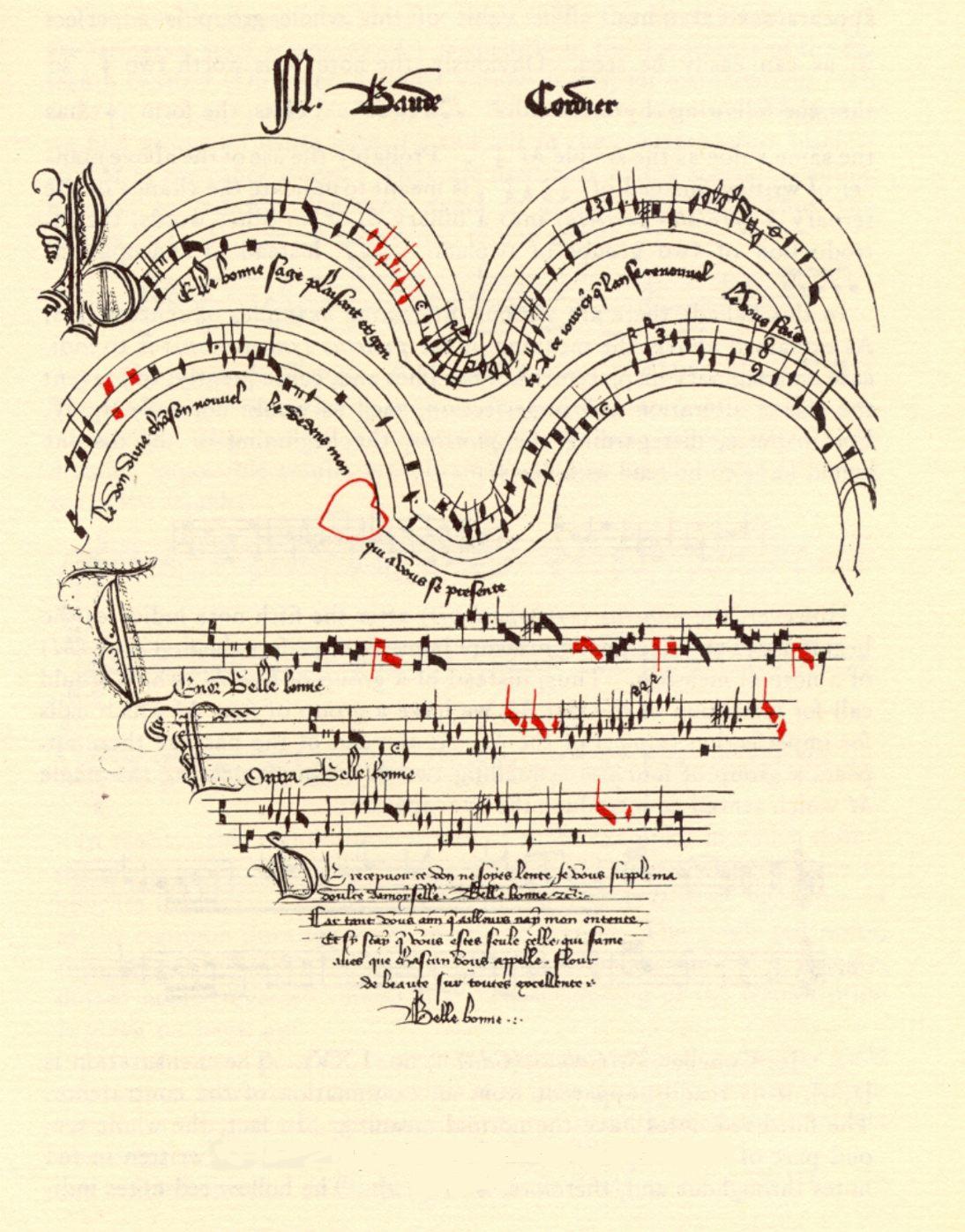
Bonus: George and Ira Gershwin, "I've Got a Crush on You"
6.2.06
Futures
A. C. Douglas is concerned that Osvaldo Golijov represents "the future" of concert music. Mr. Douglas need not worry--the multi-cultural polystylism of Golijov, whose Ayre has received reviews both rapturous and reserved--is not the future. It is a future, one of a thousand stylistic flowers that will bloom.
Golijov is indeed having a big and very visible year. But so are John Adams, Tobias Picker, Jennifer Higdon, and Elliott Carter.
Some will argue that this year's celebration of Carter is a final blooming of a Modernism that is over, but I believe (and I don't think it is merely wishful thinking on my part) the next several years will see the growth and acceptance of what I'll call, for now, "neo-modernism".
In addition to the above named, Kaija Saariaho should be getting quite a bit of attention when her second opera, Adriana Mater, premeires in Paris.
In addition to the diverse styles of the composers listed above, we have neo-romanticism, totalism, jazz-inflected improvisatory music, and live-electronic music. Minimalism and serialism also have their adherents. I'm sure, at least I hope, that Mr. Douglas can find something in all of this abundance to like and admire.
Golijov is indeed having a big and very visible year. But so are John Adams, Tobias Picker, Jennifer Higdon, and Elliott Carter.
Some will argue that this year's celebration of Carter is a final blooming of a Modernism that is over, but I believe (and I don't think it is merely wishful thinking on my part) the next several years will see the growth and acceptance of what I'll call, for now, "neo-modernism".
In addition to the above named, Kaija Saariaho should be getting quite a bit of attention when her second opera, Adriana Mater, premeires in Paris.
In addition to the diverse styles of the composers listed above, we have neo-romanticism, totalism, jazz-inflected improvisatory music, and live-electronic music. Minimalism and serialism also have their adherents. I'm sure, at least I hope, that Mr. Douglas can find something in all of this abundance to like and admire.
5.2.06
Davidovsky
My review of a new disc of music by Mario Davidovsky, including three of the Synchronisms series, is up at Sequenza 21.
3.2.06
Workshop: Revision
That's an interesting word: revision.
I wrote Episodes in Anticipation (band, 2001) in longhand on 30-stave paper. I copied the parts in pencil. I wrote in longhand rather than in Finale, because of a short timeline and because I didn't feel strong enough in the software to get the piece done in time. Rehearsals and a performance had been scheduled and everyone involved was committed to a performance on a date certain.
I was happy with the piece--it did pretty much what I wanted it to do, the performers enjoyed playing it and did so with style, and the audience was generally receptive. Still, I'm sure everybody reading this has seen room for improvement after the fact in pieces, performances, or other creative work.
There are a couple of people who have aksed to see the score and I want to send it to some others, so the time was right to load it into Finale. And, since I'm having to do all that work on the piece anyway, why not do some of the revisions. The score aleady had many marks in it from the rehearsals for the premiere, including some added percussion notes, so there was already some revision there.
Which brings us back to that word,"revision".
The Merriam-Webster OnLine Dictionary defines "revision":
1 a : an act of revising b : a result of revising : ALTERATION2 : a revised version
Fine, as far as it goes. But when does the act of revising proceed to the point where the root of the word changes fron "revise" to "re-vision", to see the work anew and, so seeing, make it new again? Should you make this work everything it can be, fix it up a little, or leave it be and try again next time?
The answer is different for every artist and every work, of course, but the temptation to make wholesale changes is there, and is made greater by the ease of doing it in software. For example, in a hand-copied score, if you wanted to add a measure or (especially) two or more, it usually meant re-copying the rest of the score after the additions. With Finale (and other music-writing software packages) you can insert measures into the middle of a piece at will.
In this case, I'm adding a measure or two here and there, giving some of the players a little more to do (even adding an instrument that I inadvertantly left out), but mostly I'm leaving it as it was and moving on to the next piece.
By the way, I have an mp3 of the premiere. If anybody is interested in hearing it, let me know.
I wrote Episodes in Anticipation (band, 2001) in longhand on 30-stave paper. I copied the parts in pencil. I wrote in longhand rather than in Finale, because of a short timeline and because I didn't feel strong enough in the software to get the piece done in time. Rehearsals and a performance had been scheduled and everyone involved was committed to a performance on a date certain.
I was happy with the piece--it did pretty much what I wanted it to do, the performers enjoyed playing it and did so with style, and the audience was generally receptive. Still, I'm sure everybody reading this has seen room for improvement after the fact in pieces, performances, or other creative work.
There are a couple of people who have aksed to see the score and I want to send it to some others, so the time was right to load it into Finale. And, since I'm having to do all that work on the piece anyway, why not do some of the revisions. The score aleady had many marks in it from the rehearsals for the premiere, including some added percussion notes, so there was already some revision there.
Which brings us back to that word,"revision".
The Merriam-Webster OnLine Dictionary defines "revision":
1 a : an act of revising b : a result of revising : ALTERATION2 : a revised version
Fine, as far as it goes. But when does the act of revising proceed to the point where the root of the word changes fron "revise" to "re-vision", to see the work anew and, so seeing, make it new again? Should you make this work everything it can be, fix it up a little, or leave it be and try again next time?
The answer is different for every artist and every work, of course, but the temptation to make wholesale changes is there, and is made greater by the ease of doing it in software. For example, in a hand-copied score, if you wanted to add a measure or (especially) two or more, it usually meant re-copying the rest of the score after the additions. With Finale (and other music-writing software packages) you can insert measures into the middle of a piece at will.
In this case, I'm adding a measure or two here and there, giving some of the players a little more to do (even adding an instrument that I inadvertantly left out), but mostly I'm leaving it as it was and moving on to the next piece.
By the way, I have an mp3 of the premiere. If anybody is interested in hearing it, let me know.
31.1.06
4'33" Video
30.1.06
Review, etc.
Here's my review of a recital by pianist Joyce Yang.
I saw Terrence Malick's latest film, The New World. I don't have the vocabulary needed to give it a full-fledged review, but I wanted to say that I found it moving and deeply felt. The pace of Malick's films is slow, allowing images and events to resonate for the viewer, and I find that very compelling. I did want to comment on his use of Wagner's "Vorspiel" to Das Rheingold at crucial moments in the film. The New World is an elegiac telling of one of America's creation myths, the founding of the Jamestown colony. The use of the Wagner during the opening scene depicting the arrival of the ships (and two other times) was poetic as well as beautiful.
I also saw David Lynch's Eraserhead on DVD. For my money, Lynch uses sound (as opposed to music) as an expressive element in his films better than any other director I am aware of. The sense of foreboding that hangs over this film is in no small part a result of the sonic environment.
I saw Terrence Malick's latest film, The New World. I don't have the vocabulary needed to give it a full-fledged review, but I wanted to say that I found it moving and deeply felt. The pace of Malick's films is slow, allowing images and events to resonate for the viewer, and I find that very compelling. I did want to comment on his use of Wagner's "Vorspiel" to Das Rheingold at crucial moments in the film. The New World is an elegiac telling of one of America's creation myths, the founding of the Jamestown colony. The use of the Wagner during the opening scene depicting the arrival of the ships (and two other times) was poetic as well as beautiful.
I also saw David Lynch's Eraserhead on DVD. For my money, Lynch uses sound (as opposed to music) as an expressive element in his films better than any other director I am aware of. The sense of foreboding that hangs over this film is in no small part a result of the sonic environment.
11.1.06
Running the Voodoo Down
I don't have much technical knowledge of jazz in any of its incarnations, but I do like it quite a bit. I especially enjoy '50s and early '60s era Miles Davis. His various quintets of the period are chamber music of a very high order.
Music critic and fellow High Hat contributor Phil Freeman has just published a book on Davis' later, electric music, Running the Voodoo Down. Here's a very positive review by John Kelman of all about jazz. Mr. Kelman's emphasis on the author's status as a jazz "outsider" (Phil is best known for his reviews of metal) and how that informs both Mr. Freeman's listening and writing offers another hint for those of us who want to expand the audience for concert music. We need to listen with new ears and write with a new mind.
I look forward to reading Running the Voodoo Down and expanding my own appreciation for Miles Davis' remarkable artistry. I want also to acknowledge Jeff Harrington's invaluable new music reblog, where posts about new music are compiled in what amounts to a one stop blogroll, for pointing me to this review.
Music critic and fellow High Hat contributor Phil Freeman has just published a book on Davis' later, electric music, Running the Voodoo Down. Here's a very positive review by John Kelman of all about jazz. Mr. Kelman's emphasis on the author's status as a jazz "outsider" (Phil is best known for his reviews of metal) and how that informs both Mr. Freeman's listening and writing offers another hint for those of us who want to expand the audience for concert music. We need to listen with new ears and write with a new mind.
I look forward to reading Running the Voodoo Down and expanding my own appreciation for Miles Davis' remarkable artistry. I want also to acknowledge Jeff Harrington's invaluable new music reblog, where posts about new music are compiled in what amounts to a one stop blogroll, for pointing me to this review.
10.1.06
20K
Greetings and Happy New Year!
Sometime this morning a lost soul wandered in here and became this blog's 20,000th visitor.
Greg Sandow continues his "improvised book" on the future of classical music. I agree with Mr. Sandow that "form and structure" are essential differences between classical music and other kinds of music:
Sometime this morning a lost soul wandered in here and became this blog's 20,000th visitor.
Greg Sandow continues his "improvised book" on the future of classical music. I agree with Mr. Sandow that "form and structure" are essential differences between classical music and other kinds of music:
It gives classical music a special richness, not a greater richness than any other kind of music, but a richness unique to itself.
21.12.05
Four Play
Four jobs you've had in your life: Ladies' wear stock clerk; library technical assistant; grantswriter; teacher
Four movies you could watch over and over: The Searchers, Nashville, Godfather II, Chinatown
Four places you've lived: Poughkeepsie, Ithaca, Durham, Iowa Citry
Four TV shows you love to watch: Scrubs, Law & Order (mothership), Boomtown, 24
Four places you've been on vacation: Atlanta, Tampa, Chicago, New York
Four websites you visit daily: All of the sites on the blogroll plus dailykos, bopnews, Salon, Slate
Four of your favorite foods: fresh pasta with marinara sauce and cheese, various Indian dishes, black beans and rice, salad
Four places you'd rather be: Atlanta, New York, Italy, France
Four movies you could watch over and over: The Searchers, Nashville, Godfather II, Chinatown
Four places you've lived: Poughkeepsie, Ithaca, Durham, Iowa Citry
Four TV shows you love to watch: Scrubs, Law & Order (mothership), Boomtown, 24
Four places you've been on vacation: Atlanta, Tampa, Chicago, New York
Four websites you visit daily: All of the sites on the blogroll plus dailykos, bopnews, Salon, Slate
Four of your favorite foods: fresh pasta with marinara sauce and cheese, various Indian dishes, black beans and rice, salad
Four places you'd rather be: Atlanta, New York, Italy, France
19.12.05
13.12.05
Storms
[Up front disclaimer: I've known Stirling Newberry for nearly ten years of internet discussion and arguement. It's impossible for me to hear his music without my experience of him affecting my perceptions, and I wouldn't want to hear it that way.]
_________________________
Political activism and music are among the passions/obsessions of Stirling Newberry's life. These obsessions come together in the two string quartets recorded on In The Year of Storms.
The two quartets on this disc, (No. 7 in Eb, Op. 35, and No. 8 in B, Op. 36) were written in response to the storm season of 2005 and its aftermath, both political and human. A combination of grief, anger, and longing suffuse the music of both quartets.
Mr. Newberry's music is tonal/modal in both forward and backwards senses. The works are governed by large-scale harmonic and melodic ideas while at the same time there is often a hint (or more) of the minimalist project underlying the surface. And it's a compelling surface. Mr. Newberry's melodies are memorable enough to carry the musical weight they are given in these pieces, though they aren't tunes you'll whistle afterwards (for the most part). His admiration (obsession, really) for Beethoven is reflected in his melodies, which are almost always ripe for contrapuntal treatment.
The composer's brand of post-modernism comes out in his stylistic references. The opening of the first movement of Quartet 7, for example, recalls the opening of Beethoven’s Ninth and a later movement includes the Dies Irae as a theme. Mr. Newberry is also fluent in many popular styles of the past and present and deploys them with ease.
I can recommend this disc without serious reservation. It brings up important issues about the nature of performance (and what constitutes a musical work) and the distribution of concert music, which I will discuss later.
_________________________
Political activism and music are among the passions/obsessions of Stirling Newberry's life. These obsessions come together in the two string quartets recorded on In The Year of Storms.
The two quartets on this disc, (No. 7 in Eb, Op. 35, and No. 8 in B, Op. 36) were written in response to the storm season of 2005 and its aftermath, both political and human. A combination of grief, anger, and longing suffuse the music of both quartets.
Mr. Newberry's music is tonal/modal in both forward and backwards senses. The works are governed by large-scale harmonic and melodic ideas while at the same time there is often a hint (or more) of the minimalist project underlying the surface. And it's a compelling surface. Mr. Newberry's melodies are memorable enough to carry the musical weight they are given in these pieces, though they aren't tunes you'll whistle afterwards (for the most part). His admiration (obsession, really) for Beethoven is reflected in his melodies, which are almost always ripe for contrapuntal treatment.
The composer's brand of post-modernism comes out in his stylistic references. The opening of the first movement of Quartet 7, for example, recalls the opening of Beethoven’s Ninth and a later movement includes the Dies Irae as a theme. Mr. Newberry is also fluent in many popular styles of the past and present and deploys them with ease.
I can recommend this disc without serious reservation. It brings up important issues about the nature of performance (and what constitutes a musical work) and the distribution of concert music, which I will discuss later.
11.12.05
Happy Birthday, Chronometros
My work was submitted under the pseudonym of Chronometros . . .
--Elliott Carter in his entry in the 25th Anniversary Report of the Harvard Class of 1930, referring to his First Quartet and its entry in a composition competition.
Carter goes on, quoting a letter he received after the Quartet won the competition:
I don't know if Feldbusch, the 'cellist of the Liege Quartet, has written you, but if not, here's his story, which may please you. He and Koch, the leader, detested the quartet all through rehearsals and the first performance. The eve of the final desicion, the judges listened to tape recordings and for the first time F and K were able to listen, not play. They were overwelmed, and F, a big hulk of an extrovert, not at all given to romanticism, I assure you, said he found himself on the verge of tears, and K also was moved. Meeting an old friend the day of the final concert, F insisted he come, deliberately telling him he must hear Chronometros, a terrible work, nonsensical, no rhyme or reason. Now the old friend was a coal miner, a guy who went down in the pits at the age of fourteen and has done nothing else in his life, is now forty-five, and goes once a year or so to the opera for Manon or Carmen. He came to the concert and the next day looked up F, threatened to bash his nose in, called him every dirty name in the Walloon vocabulary, said F knew nothing about music and deserved to hear nothing better than Manon or Carmen if he couldn't understand Chronometros. Says he: "This is the first time I have felt in music that a man was talking to me like a man; the guy who wrote that understands the fear I experience when I get down into a new mine not sure whether or not it is going to cave in on me; he's got guts and muscle, and he digs in his music like I dig in hard rock; he sweats like I do, he's a worker like I am; and you, Feldbusch, you're nothing but a goddamned fool of a musician if you can't understand that."
Other Carter posts at listen.:
Carter in Atlanta
More on Carter in Atlanta
Birthday
1.12.05
A Different Perspective
This column by Chadwick Jenkins, from the PopMatters 'zine, is the first in a series of pieces on why "classical" music should matter to consumers of popular culture. I look forward to the rest of the series. It has the makings of an important contribution to the ongoing discussion of the place of concert music in postcontemporary life.
30.11.05
Counter Culture
I quite agree with Alex Ross when he says:
I'll only add that it's been true for a very long time.
I'll repeat my outré contention that classical music, for all its elite trappings, is actually a radical, disruptive force in American culture, whereas most popular culture, for all its rebellious trappings, is intensely conservative.
I'll only add that it's been true for a very long time.
29.11.05
Elsewhere
Around the 'sphere:
Terry Teachout has some thoughful observations about the nature of criticism and its relation to art. Of particluar interest to me, as both critic and composer, are his musings on what it means and whether or not it's important for critics to be "right" about the work they criticize.
The Blogger Known as Pliable posts a fascinating, informative, and link-rich piece about the development and testing of the atomic bomb. Plenty to hold us until the recording of Doctor Atomic comes out.
Daniel Felsenfeld responds to an article in the Wall Street Journal about audiences and orchestras embracing new music that throws off the yoke of serialist oppression. Mr. Felsenfeld points out that this "might have been something worth noting were this, say, 1952". He also quotes composer Daniel Kellogg as saying he writes music that "he wants to hear," and that the article frames this as "novel". Mr. Felsenfeld sighs:
Finally, Heather Heise asks questions of composers. My answers, for the record: No; no; no; yes, I have two; sure, why not; no; yes and no; no; no; not for me; yes, though it's more an "ooze" than a "spill"; yes.
Terry Teachout has some thoughful observations about the nature of criticism and its relation to art. Of particluar interest to me, as both critic and composer, are his musings on what it means and whether or not it's important for critics to be "right" about the work they criticize.
The Blogger Known as Pliable posts a fascinating, informative, and link-rich piece about the development and testing of the atomic bomb. Plenty to hold us until the recording of Doctor Atomic comes out.
Daniel Felsenfeld responds to an article in the Wall Street Journal about audiences and orchestras embracing new music that throws off the yoke of serialist oppression. Mr. Felsenfeld points out that this "might have been something worth noting were this, say, 1952". He also quotes composer Daniel Kellogg as saying he writes music that "he wants to hear," and that the article frames this as "novel". Mr. Felsenfeld sighs:
I do not come down on either side of this argument because frankly I think it is an old and dead struggle. These are no longer the sides any more than the Yankees and the Confederates. We hear daily of the "problems" in classical music, and if we are ever to take a step to solving them we have to address the issues of our own time (even if we do not like our own time) rather than a more simplistic contrempts of a vanished world. The implication--that serial music and its descendants rules the roost while there is a new generation trying to upturn it by returning to the old ways--is a quaint and lovely notion that might have been riveting half a century ago but in 2005 it is laughably far from true...though I, like Mr. Russell, [the author of the Journal article] wish these were the only problems we faced. Our world would be a better place were this true.
Finally, Heather Heise asks questions of composers. My answers, for the record: No; no; no; yes, I have two; sure, why not; no; yes and no; no; no; not for me; yes, though it's more an "ooze" than a "spill"; yes.
24.11.05
Thanksgiving
I want to take this opportunity to wish everyone a Happy Thanksgiving Day. I hope it is going well.
22.11.05
Frontier
Stirling Newberry's article on Jeff Harrington is important for several reasons. First, it's good to see a composer get some pub in a non-traditional place.
More importantly, the piece is among the first, to my knowledge, to take as a subject the relationship betweens a composer's work and his relationship to the internet. The internet (and digitality as a whole) will be, for a while at least, the best way for a composer (and other artists, too) to get their work before the public. It's good to see someone attempt a beginning of an analysis.
More importantly, the piece is among the first, to my knowledge, to take as a subject the relationship betweens a composer's work and his relationship to the internet. The internet (and digitality as a whole) will be, for a while at least, the best way for a composer (and other artists, too) to get their work before the public. It's good to see someone attempt a beginning of an analysis.
17.11.05
Books
As should be clear, I like lists. Lists of essential pieces, lists of music for holidays, whatever. Here’s another one: my thirty favorite books on concert music (as of today). The criteria could neither be simpler nor as unassailable: they have to be on concert music and I have to like them. No more meaning should be ascribed to the order of the list than to the list itself.
The Classical Style; Charles Rosen
Silence; John Cage
Instrumentation; Andrew Stiller
Essays Before a Sonata; Charles Ives
The Time of Music; Jonathan Kramer
Arnold Schoenberg; Charles Rosen
Flawed Words and Stubborn Sounds; Alan Edwards and Elliott Carter
The Music of John Cage; James Pritchett
The Music of Elliott Carter (Second Edition); David Schiff
Simple Composition; Charles Wuorinen
Give My Regards to Eighth Street; Morton Feldman
A Generative Theory of Tonal Music; Fred Lehrdahl and Ray Jackendoff
Music in Theory and Practice; Bruce Benward and Marilyn Saker
Computer Music; Charles Dodge
Emotion and Meaning in Music; Leonard B. Meyer
Compendium of Modern Instrumental Techniques; Gardner Read
The Musical Experience of Performer, Composer, Listener; Roger Sessions
The Beethoven Quartets; Joseph Kerman
Writings About Music; Steve Reich
Harmony; Walter Piston
The Technique of Orchestration; Kent Kennan
Counterpoint; Kent Kennan
Harmony Book; Elliott Carter
A Practical Approach to Sixteenth-Century Counterpoint; Robert Gauldin
Music Notation; Gardner Read
The Acoustical Foundations of Music; John Backus
Poetics of Music; Igor Stravinsky
Form in Tonal Music; Douglass Green
For the End of Time: The Story of the Messiaen Quartet; Rebecca Rischin
Gustav Mahler; Bruno Walter
The Classical Style; Charles Rosen
Silence; John Cage
Instrumentation; Andrew Stiller
Essays Before a Sonata; Charles Ives
The Time of Music; Jonathan Kramer
Arnold Schoenberg; Charles Rosen
Flawed Words and Stubborn Sounds; Alan Edwards and Elliott Carter
The Music of John Cage; James Pritchett
The Music of Elliott Carter (Second Edition); David Schiff
Simple Composition; Charles Wuorinen
Give My Regards to Eighth Street; Morton Feldman
A Generative Theory of Tonal Music; Fred Lehrdahl and Ray Jackendoff
Music in Theory and Practice; Bruce Benward and Marilyn Saker
Computer Music; Charles Dodge
Emotion and Meaning in Music; Leonard B. Meyer
Compendium of Modern Instrumental Techniques; Gardner Read
The Musical Experience of Performer, Composer, Listener; Roger Sessions
The Beethoven Quartets; Joseph Kerman
Writings About Music; Steve Reich
Harmony; Walter Piston
The Technique of Orchestration; Kent Kennan
Counterpoint; Kent Kennan
Harmony Book; Elliott Carter
A Practical Approach to Sixteenth-Century Counterpoint; Robert Gauldin
Music Notation; Gardner Read
The Acoustical Foundations of Music; John Backus
Poetics of Music; Igor Stravinsky
Form in Tonal Music; Douglass Green
For the End of Time: The Story of the Messiaen Quartet; Rebecca Rischin
Gustav Mahler; Bruno Walter
Subscribe to:
Posts (Atom)