22.12.06


18.12.06
The Beginning of Things
A recording of the Alazan Trio performance of The Beginning of Things (2006, piano trio) is posted on my page at Classical Lounge. They did a fine job on the piece, especially considering it was the first performance.
11.12.06
Elliott Carter
Today is Elliott Carter's 98th birthday. I posted on his birthday in 2004 and in 2005. Matthew Guerrieri's list of recipes named for composers includes this:
Eggs Carter: Break an egg into a pan with a multitude of other ingredients, and place on the stove. Continually and simultaneously vary both the temperature and the cooking time. The dish is done when the aggregate intervals of the other ingredients allegorically crush the individuality of the egg.
10.12.06
5.12.06
Links and Listening
Scott Spiegelberg links to an online music dictionary maintained by Virginia Tech.
Matthew Guerrieri on the value of whimsy, magic, and serious lightness in literature and music.
Listening:
Max Levinson, piano. Music by Brahms, Schumann, Schoenberg, and Kirchner.
The Lanier Trio. Music by Stephen Paulus.
Michael Boriskin, piano. Music by Lou Harrison.
Andrzej Wasowski, piano. Chopin, Mazurkas.
Dallas Symphony/Andrew Litton. Ives, Symphonies 1 and 4, Central Park in the Dark.
Bonus Tracks:
A compilation of seventies soul and R&B, featuring, among others, The Spinners, Earth, Wind, & Fire, Marvin Gaye, The Temptations, and Al Green.
Matthew Guerrieri on the value of whimsy, magic, and serious lightness in literature and music.
Listening:
Max Levinson, piano. Music by Brahms, Schumann, Schoenberg, and Kirchner.
The Lanier Trio. Music by Stephen Paulus.
Michael Boriskin, piano. Music by Lou Harrison.
Andrzej Wasowski, piano. Chopin, Mazurkas.
Dallas Symphony/Andrew Litton. Ives, Symphonies 1 and 4, Central Park in the Dark.
Bonus Tracks:
A compilation of seventies soul and R&B, featuring, among others, The Spinners, Earth, Wind, & Fire, Marvin Gaye, The Temptations, and Al Green.
29.11.06
Elitism
Anne Midgette reviews the first performance of Kaija Saariaho's La Passion de Simone. Ms. Saariaho's piece concerns the life and death of Simone Weil, the French "philosopher, mystic and activist. Near the end of the very thoughtful review, Ms. Midgette writes:
A large part of the on-going discussion of the future of concert music, which discussion often dominates writing about concert music, concerns the music's status as an "elite" art. I have no answers, but lots of questions:
What is meant by "elitism", particularly in the artistic world?
Is elitism a good, bad, or value-neutral thing?
Are there different kinds of elitism and different kinds of elites?
Does it mean anything w/r/t elitism that, in very general terms, popular musicians are wealthier than their audiences and, in very general terms, audiences for concert music are wealthier than the musicians?
Which is, in that case, the more elitist art form?
Rather than attempting to "reach past" the monied elite that can afford to see/hear works like La Passion de Simone, isn't that elite precisely the audience that need to get the message?
Which artform has a greater claim to being "counter-cultural", popular music or concert music?
What, if anything, does the answer to that last question have to do with elitism?
. . . this piece represents many things Weil wanted to get away from; even if it is conceived in a spirit of breaking down barriers and challenging the status quo, a work presented in this form will reach only the elite it ostensibly sets out to reach past.
A large part of the on-going discussion of the future of concert music, which discussion often dominates writing about concert music, concerns the music's status as an "elite" art. I have no answers, but lots of questions:
What is meant by "elitism", particularly in the artistic world?
Is elitism a good, bad, or value-neutral thing?
Are there different kinds of elitism and different kinds of elites?
Does it mean anything w/r/t elitism that, in very general terms, popular musicians are wealthier than their audiences and, in very general terms, audiences for concert music are wealthier than the musicians?
Which is, in that case, the more elitist art form?
Rather than attempting to "reach past" the monied elite that can afford to see/hear works like La Passion de Simone, isn't that elite precisely the audience that need to get the message?
Which artform has a greater claim to being "counter-cultural", popular music or concert music?
What, if anything, does the answer to that last question have to do with elitism?
28.11.06
Around and About
Helen Radice on education.
Alex Ross on Adams and Kurtág.
Greg Sandow on cultural boundaries. I disagree with a lot of Mr. Sandow's ideas about how to expand the audience for concert music, but I admire his willingness to think out loud about issues that are fraught with emotion for many people.
Pliable on how commemorations of the biggest name composers often sucks all of the oxygen out of the room, leaving lesser-known, worthy composers to struggle in a smaller cultural space.
Sun sets in east.
Alex Ross on Adams and Kurtág.
Greg Sandow on cultural boundaries. I disagree with a lot of Mr. Sandow's ideas about how to expand the audience for concert music, but I admire his willingness to think out loud about issues that are fraught with emotion for many people.
Pliable on how commemorations of the biggest name composers often sucks all of the oxygen out of the room, leaving lesser-known, worthy composers to struggle in a smaller cultural space.
Sun sets in east.
23.11.06
Thanksgiving
I hope everyone is enjoying the day, whether it's a holiday where you are or not.
Here's a post from two years ago about Thanksgiving Day listening.
Here's a post from two years ago about Thanksgiving Day listening.
21.11.06
There's a long goodbye . . .
Robert Altman has died at age 81.
Obituaries and tributes will accumulate on the web and elsewhere, but I want to point again to the recently pulished issue of The High Hat, which contains a special section on Altman, who I believe is one of the greatest artists of the second half of the 20th centruy.
Obituaries and tributes will accumulate on the web and elsewhere, but I want to point again to the recently pulished issue of The High Hat, which contains a special section on Altman, who I believe is one of the greatest artists of the second half of the 20th centruy.
20.11.06
17.11.06
The Still, Small Voice (III)
Part I
Part II
Jeffrey Potter collects reminiscences of Jackson Pollock’s wake in his “oral biography” of the artist, called To a violent grave (New York: Putnam, 1985):
Part II
Jeffrey Potter collects reminiscences of Jackson Pollock’s wake in his “oral biography” of the artist, called To a violent grave (New York: Putnam, 1985):
MORTON FELDMAN: What stays with me is that baked Virginia ham. I have never tasted such ham, never.
I was asked to write a piece for saxophone trio in 1988, and I decided to make it a memorial to Feldman, who had recently passed the previous year. Feldman’s influence on my music up until that time had been manifest in the slow movements/sections of my pieces, which tended to be really slow and very soft. On the surface of these pieces, with fast rhythms, irregular phrase structures, and frequent changes in harmony, Carter’s influence was clearer.
I can see in retrospect that the occasion of the sax trio was an opportunity for me to explore a reconciliation between what I had learned from Feldman and Carter. The solution (I’m not sure “solution” is the right word, because this is a “problem” that I’m not sure anybody else had) was simple: Combine the kinds of slow and soft textures that had attracted me to Feldman’s music in the first place with the fixed vertical sonorities around which Carter’s music was organized.
Without getting overly technical about it, but providing enough information to communicate the issues, the resulting piece, What stays with me, is made from a specific voicing of a particular six-note pitch-class set (Forte number 6-Z17, for the terminally dorky, and you know who you are). This set is unique in that it contains at least one iteration of every three-note set in the 12-note equal temperament universe.
The materials of What stays with me are the single notes (six), intervals (15), and three-note chords (20) that can be drawn from a six-note set whose notes are fixed in a specific register. (The chord is voiced so that all six notes are playable by all three saxes.) As the piece unfolds over its approximately eight minutes, each of these 41 “sonorities” is sounded once. The sonorities are often extended by the instruments trading notes or overlapping entrances and exits.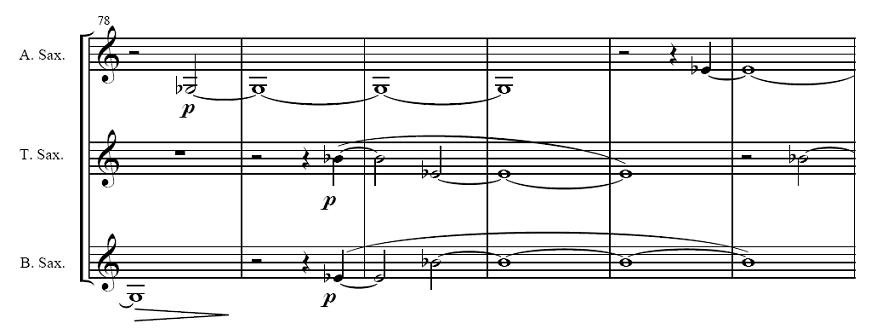
I didn’t realize it at the time, but the techniques I worked out for myself for What stays with me would resurface in different and surprising ways in almost every piece I’ve written since then.
14.11.06
The High Hat
The new issue of The High Hat is up. My article on Pierrot Lunaire is here, and my article on Robert Altman is here.
As usual, the whole issue is worth a read.
As usual, the whole issue is worth a read.
13.11.06
Time for Another Blogger Ethics Panel?
In the summer of 2003 The Washington Post ran an article ridiculing former Vermont governor Howard Dean's plans to raise money and support for his 2004 presidential campaign over the internet. Also in for criticism was Dr. Dean's reliance on bloggers for support as well as for position dissemination. The article, and its placement in the establishment beltway newspaper, was an attempt to downplay and ultimately squash the idea that the political discourse could be taken out of the hands of the top-down media. It was the beginning of a campaign against the emergence of a wider political community of interest that would have to be dealt with directly, through blogs and other new media, rather than business as usual.
We know how that turned out--newspapers and other old-line top-down media are struggling to adapt to the new, open source, world of contemporary politics. The citizen's media as broken through in the world of politics, and the genie will not go back in the bottle.
Which brings us to Norman Lebrecht.
In this column, Mr. Lebrecht writes that "[c]lassical blogs are spreading but their nutritional value is lower than a bag of crisps" and that "[u]ntil bloggers deliver hard facts and estate agents [Mr. Lebrecht earlier refers to a blogger who is a 'New York estate agent'] turn into credible critics, paid-for newspapers will continue to set the standard as only show in town". The body of the column is devoted to praise for some blogs, which praise is accepted, but not without reservation.
Bob Shingleton, of On An Overgrown Path, responds to criticisms of him in Mr. Lebrecht's column here. The errors Mr. Shingleton points out in Mr. Lebrecht's piece about the unreliability of blogs reminds me of Atrios' refrain when the top-down media make inaccurate attacks on political bloggers: Time for another panel on blogger ethics!
What does this have to do with the Washington Post article I started off with? That article came at a time when political blogs were on the cusp of breaking out into the mainstream and becoming the important part of politics that they are today, and the Post saw its revenue and prestige streams threatened and responded accordingly. Could it be that the same thing may be coming in classical music and the Norman Lebrechts of the world see their positions threatened?
What it would take would be a pushback against a musical institution from the blogs, a pushback that is covered in the top-down musical press. There was some pushback earlier this year from blogs when the musical establishment declared teen sensation Jay Greenberg the Next Big Thing. Very little of the establishment press (Alan Rich being a notable exception) offered a differing view, but many blogs did. The pushback was not covered, though. There will eventually be another flavor-of-the-month, either in composition or performance, that music bloggers are not sold on, and when the pushback is covered it will be a sign of the growing prominence of blogs in musical journalism.
(h/t to Stirling Newberry for some background and context for this post.)
We know how that turned out--newspapers and other old-line top-down media are struggling to adapt to the new, open source, world of contemporary politics. The citizen's media as broken through in the world of politics, and the genie will not go back in the bottle.
Which brings us to Norman Lebrecht.
In this column, Mr. Lebrecht writes that "[c]lassical blogs are spreading but their nutritional value is lower than a bag of crisps" and that "[u]ntil bloggers deliver hard facts and estate agents [Mr. Lebrecht earlier refers to a blogger who is a 'New York estate agent'] turn into credible critics, paid-for newspapers will continue to set the standard as only show in town". The body of the column is devoted to praise for some blogs, which praise is accepted, but not without reservation.
Bob Shingleton, of On An Overgrown Path, responds to criticisms of him in Mr. Lebrecht's column here. The errors Mr. Shingleton points out in Mr. Lebrecht's piece about the unreliability of blogs reminds me of Atrios' refrain when the top-down media make inaccurate attacks on political bloggers: Time for another panel on blogger ethics!
What does this have to do with the Washington Post article I started off with? That article came at a time when political blogs were on the cusp of breaking out into the mainstream and becoming the important part of politics that they are today, and the Post saw its revenue and prestige streams threatened and responded accordingly. Could it be that the same thing may be coming in classical music and the Norman Lebrechts of the world see their positions threatened?
What it would take would be a pushback against a musical institution from the blogs, a pushback that is covered in the top-down musical press. There was some pushback earlier this year from blogs when the musical establishment declared teen sensation Jay Greenberg the Next Big Thing. Very little of the establishment press (Alan Rich being a notable exception) offered a differing view, but many blogs did. The pushback was not covered, though. There will eventually be another flavor-of-the-month, either in composition or performance, that music bloggers are not sold on, and when the pushback is covered it will be a sign of the growing prominence of blogs in musical journalism.
(h/t to Stirling Newberry for some background and context for this post.)
11.11.06
Veteran's Day
Last year.
Addition:
Bernd Alois Zimmermann: Die Soldaten
Franz Joseph Haydn: Mass in Time of War
Charles Ives: From Hanover Square North, at the End of a Tragic Day, the Voice of the People Again Arose
Addition:
Bernd Alois Zimmermann: Die Soldaten
Franz Joseph Haydn: Mass in Time of War
Charles Ives: From Hanover Square North, at the End of a Tragic Day, the Voice of the People Again Arose
8.11.06
Coming Soon to a Blog Near You
I'm working on the third installment of "The Still, Small Note" (Parts I and II), which will deal with specific instances of how I came to write the series of quiet pieces I recently completed with The Beginning of Things, which premieres tomorrow evening at Stephen F. Austin University in Nacogdoches, Texas. I'm wrestling with the age-old problem of how technical/detailed to get in writing about the music itself.
Adam Baratz' post on Morton Feldman's writings highlights the difficulty of writing about one's own music:
I'm working on finding the balance between technical and personal that will enable me to write about my experience and my music that's useful to me and informative to you, and to performers.
Listening in the meantime:
Stravinsky: Symphony of Psalms, Les Noces, Threni; Robert Craft.
Beethoven: Quartet, Op. 130. Guarneri Quartet.
Adam Baratz' post on Morton Feldman's writings highlights the difficulty of writing about one's own music:
Don't get me wrong. A solid technical piece on "so you think this music is intuitively assembled, but really it's highly structured and organic" is invigorating in its own way. There is something particularly probing, though, about Feldman writing about "concentration," or why he only worked only in pen, or the time when he finally found the perfect chair. It's a view of composition not fixated on the end product, but as a process that is a kind of performance.
Last year, I wrote about perhaps why composers are so guarded about these issues. I still feel the same way, that the act of writing music is a very personal process, one
that other people shouldn't necessarily be privy to. With that in mind, Feldman's writings on compositional process strike me now as courageous in a certain way.
I'm working on finding the balance between technical and personal that will enable me to write about my experience and my music that's useful to me and informative to you, and to performers.
Listening in the meantime:
Stravinsky: Symphony of Psalms, Les Noces, Threni; Robert Craft.
Beethoven: Quartet, Op. 130. Guarneri Quartet.
7.11.06
Election Day
VOTE!!
Listening for the day:
John Adams, The Wound Dresser
Charles Ives: "Majority"
Elliott Carter, Concerto for Orchestra
Steve Reich, Come Out
Aaron Copland, Fanfare for the Common Man
Laurie Anderson, United States
Leonard Bernstein, Songfest
Julia Wolfe, Arsenal of Democracy
Listening for the day:
John Adams, The Wound Dresser
Charles Ives: "Majority"
Elliott Carter, Concerto for Orchestra
Steve Reich, Come Out
Aaron Copland, Fanfare for the Common Man
Laurie Anderson, United States
Leonard Bernstein, Songfest
Julia Wolfe, Arsenal of Democracy
6.11.06
FSU Percussion Ensemble
I attended a very well-played and enjoyable concert by the Florida State university Percussion Ensemble, directed by John Parks. As I have mentioned before, I am working on a concerto for Mr. Parks, who is an energetic conductor as well as a fine player.
Among the pieces on the program was John Mackey's Damn, for clarinet and percussion quartet. The soloist was FSU faculty member Deborah Bish, who gave a good accounting of herself against the brash drumming behind her. I liked this piece much more than Mr. Mackey's Percussion Concerto, for whatever, if anything, that's worth.
The highlight of the concert for me was a performance of Steve Reich's Six Marimbas, which was the freshest, most challenging, and most entertaining piece on the program. The players made a strong case for Mr. Reich's music, which is everywhere (even Tallahassee!) this fall.
Speaking of making strong cases for Steve Reich, here's Alex.
Among the pieces on the program was John Mackey's Damn, for clarinet and percussion quartet. The soloist was FSU faculty member Deborah Bish, who gave a good accounting of herself against the brash drumming behind her. I liked this piece much more than Mr. Mackey's Percussion Concerto, for whatever, if anything, that's worth.
The highlight of the concert for me was a performance of Steve Reich's Six Marimbas, which was the freshest, most challenging, and most entertaining piece on the program. The players made a strong case for Mr. Reich's music, which is everywhere (even Tallahassee!) this fall.
Speaking of making strong cases for Steve Reich, here's Alex.
5.11.06
Alazan Trio
This coming Thursday, 9 November, the Alazan Trio (Jennifer Dalmas, violin, Evgeni Raychev, cello, Ron Petti, piano) will give the premiere of my The Beginning of Things (2006). The rest of the program consists of Robert Muczynski's third Piano Trio, Op. 46 (1987), Leonard Bernstein's Trio for Violin, Violincello, and Piano (1937), and Ned Rorem's Spring Music (1991).
The concert will be given at the Cole Concert Hall on the campus of Stephen F. Austin State University in Nacogdoches, Texas, where the Alazans serve on the faculty. The program begins at 7:30.
The concert will be given at the Cole Concert Hall on the campus of Stephen F. Austin State University in Nacogdoches, Texas, where the Alazans serve on the faculty. The program begins at 7:30.
1.11.06
Score Marking
Conductor Kenneth Woods provides yet another fascinating look inside his profession with this post on score marking. Among the many gems is this:
I own most of the scores I own for analytical, not performing, purposes. For the pieces I constantly return to, I have at least two copies, one for analysis (with tons of markings), and a clean one for reading/listening.
Speaking of listening:
Brahms: Symphony 4. Karajan, BPO. I love this performance, but I'd also be interested in recommendations of others, especially by active conductors.
Golijov: Ayre. I remain unconvinced by this piece as a whole, as I remain in awe of Dawn Upshaw's performance. This time though, I found myself quite moved by the final song, "Ariadna en su labertino".
Bartok: Quartet 4. Emerson Quartet. A tough-minded reading of this terse, hard-boiled work.
Matthew Sweet, 100% Fun. Power-pop, my favorite kind: Melodic and crunchy.
Some conductors highlight every meter change- I was taught to do this, but rarely do it at all anymore. However, if there is a choice between putting in a big, ugly, yellow highlighter mark or fucking up a concert, I find that is an easy choice.When I was conducting regularly, I was doing mostly new pieces, my own and others. I found that the more conducting I did, the less I marked. Looking through scores I performed, I find the occasional circle around something, or an expression marking underlined.
I own most of the scores I own for analytical, not performing, purposes. For the pieces I constantly return to, I have at least two copies, one for analysis (with tons of markings), and a clean one for reading/listening.
Speaking of listening:
Brahms: Symphony 4. Karajan, BPO. I love this performance, but I'd also be interested in recommendations of others, especially by active conductors.
Golijov: Ayre. I remain unconvinced by this piece as a whole, as I remain in awe of Dawn Upshaw's performance. This time though, I found myself quite moved by the final song, "Ariadna en su labertino".
Bartok: Quartet 4. Emerson Quartet. A tough-minded reading of this terse, hard-boiled work.
Matthew Sweet, 100% Fun. Power-pop, my favorite kind: Melodic and crunchy.
Subscribe to:
Posts (Atom)