Part I
Later, while an undergraduate, I discovered the music of Morton Feldman and Elliott Carter. The experiences described in the first part of this essay occurred over a period of about 18 months in the first half of the 1970s. The cultural moment embodied in these musical encounters now seems incredibly remote and as though they had happened yesterday. My memory is that I found them on my own, without direction from a teacher or a peer, though that is hard now to credit.
At any rate, I did find them, and the experience was galvanic. I found, in their very different musics, a fulfillment of the promise of the initial encounters with Satie, Cage, and Stockhausen. When I mention Feldman and Carter as my two favorite composers, and, more important, as the two composers with the most direct influence on my own music, people are puzzled. I understand this, as it puzzles me sometimes.
The first pieces of Feldman’s that I dug into were The viola in my life and False Relationships and the Extended Ending. What I found there was what I’ve found in all of the composer’s music I’ve heard—a strong sense of color and a keen awareness of how music works in time.
With Carter, it was the Piano Concerto and the seventh Etude from Eight Etudes and a Fantasy. In these pieces, and in Carter’s other music, I found the same strong sense of color I had heard in Feldman’s music and an awareness of how time passes that was just as keen as Feldman’s but expressed in a very different rhythmic environment.
What these pieces had in common for my ears at that time (and this is really the whole point of talking about the subject) was an insistence on the expressive power of single notes, repeated, sustained, or recurring.
Feldman’s music is replete with this emphasis on single, recurring notes. To a great extent, it is a central feature of his style. In False Relationships, the opening chord reverberates in waves over the course of the piece, with notes from the chord coming back at unpredictable times, as the instruments go their separate ways (the “false relationships” of the title). The viola in my life includes almost obsessive repetitions of chords and melodic fragments. These melodic fragments were to become the means the composer used to create the vast pieces of the late part of his career.
Carter’s seventh etude is the “one note” piece whose expressive structure comes from changes in color, dynamics, and attacks. The passage in the Piano Concerto that is relevant to this discussion is towards the end of the second movement. The orchestral strings play monolithic chords that get ever thicker, taking up more and more space. As the strings appropriate new notes, the space for the piano to move expressively in is gradually reduced, so that finally the piano is reduced to one note (the F natural above middle C, to be precise), surrounded by the string cloud. Further study of Carter revealed that he uses pitches in fixed registral positions (like the F in the piano) in many ways in almost all of his pieces since the Concerto.
All of this came to the surface in my music in the first piece I wrote after Feldman died.
31.10.06


30.10.06
27.10.06
The Still, Small Note (I)
(A great deal of my music over the last 18 years has been conceived out of a desire to explore the expressive possibilities of extremely limited amounts of material. To my mind, this dovetailed closely with an interest in exploring the relationship between sound and silence, and between stasis and change. In looking back over what now seems like a group of pieces, I can see where they came from (influences) and where I might be going as a composer. The following is the first of an as-yet-to-be-determined-number part essay on the subject.)
The most striking moment of a performance of Erik Satie’s Pages Mystique comes at the end of the second movement, “Vexations”. “Vexations” consists of 640 repetitions of a minute-and-a-half of tonally-ambiguous music and lasts about 18 hours. The roaring silence that followed the end of the movement at a performance I heard as a student was shattering and profoundly unsettling.
I’ve seen a good number of performances of John Cage’s 4’33”. As I described here, performances of this piece can vary in quality and effect:
UNLIMITED
play a sound
with the certainty
that you have an infinite amount of time and space
The most striking moment of a performance of Erik Satie’s Pages Mystique comes at the end of the second movement, “Vexations”. “Vexations” consists of 640 repetitions of a minute-and-a-half of tonally-ambiguous music and lasts about 18 hours. The roaring silence that followed the end of the movement at a performance I heard as a student was shattering and profoundly unsettling.
I’ve seen a good number of performances of John Cage’s 4’33”. As I described here, performances of this piece can vary in quality and effect:
If a performer camps up the beginning and ending of the movements, the effect is lessened, much as the effect is lessened in a performance of Beethoven’s “Tempest” Sonata if the important structural points aren’t articulated, for example. I’ve seen such a performance, and the piece is reduced to an undergraduate prank.
I got a copy of a DGG recording of a couple of the pieces in Karlheinz Stockhausen’s Aus den sieben Tagen (From the Seven Days) after having heard recordings of the composer’s Hymnen and Stimmung. The way the composer used electronics combined with instruments and voices was fascinating to me at the time, and I was also very interested in improvisation in both performance and in composition. Shortly afterwards I found the score to Aus den sieben Tagen and came across this piece (marked “for ensemble”):
UNLIMITED
play a sound
with the certainty
that you have an infinite amount of time and space
This piece is a great centered listening experience/exercise, even if you never play or hear of it.
Some of my first experiences in music outside of school and pick-up bands of various kinds involved these close encounters with Satie, Cage, and Stockhausen. Then came the music of Morton Feldman and Elliott Carter, which have been constants at the center of my musical life and thought ever since.
Some of my first experiences in music outside of school and pick-up bands of various kinds involved these close encounters with Satie, Cage, and Stockhausen. Then came the music of Morton Feldman and Elliott Carter, which have been constants at the center of my musical life and thought ever since.
26.10.06
Keeping Score
I received the following press release from Kimberly Harding of the San Francisco Symphony:
I spent a little time surfing around the Beethoven portion of the site and found it fascinating and very informative. I'd love to see the same treatment given to recent pieces!
I work with the San Francisco Symphony and wanted to let you know that its interactive Keeping Score web site just launched. The web site, www.keepingscore.org, is a companion piece to the San Francisco Symphony’s Keeping Score television series on PBS which explores the stories behind classical music; the series features works by Beethoven, Stravinsky and Copland.
The web site allows you to dig into the score, listen as musicians share their insights, and learn about the lives of the composers, music theory and keys. The site gives an understanding of classical music thru the dissection of a score and the examination of the history, personal lives, and politics that created the music. You have to play with it to get a true sense of the capabilities, but here are some highlights from the section on Beethoven’s Eroica:
Learn about key, themes and markup – as the Eroica Symphony score plays you can choose to show keys, themes and markup on the screen. A video of the San Francisco Symphony in concert plays in tandem while you explore the score.
Beethoven’s deafness story – two video clips of Dr. Goodhill, from Hope4Hearing Foundation, simulate what Beethoven heard as he was going deaf and describes Beethoven conducting the 9th Symphony after he was deaf. Also included is a musical excerpt of how the 9th Symphony possibly sounded to Beethoven.
Each composer’s section on the Keeping Score web site launches a week before the program featuring them airs on television (Beethoven is already up and running as Keeping Score begins airing on PBS stations nationwide next week).
I spent a little time surfing around the Beethoven portion of the site and found it fascinating and very informative. I'd love to see the same treatment given to recent pieces!
24.10.06
Misc
I've added the blog of composer and man-about-Boston Matthew Guerrieri to the blogroll. Check him out.
I was going to post an e-mail I got about a film on Beethoven's Ninth, but Jerry beat me to it.
Early voting (for the 7 Nov general election) is beginning in various parts of the US, so vote, dammit!
I was going to post an e-mail I got about a film on Beethoven's Ninth, but Jerry beat me to it.
Early voting (for the 7 Nov general election) is beginning in various parts of the US, so vote, dammit!
20.10.06
Per Nørgård, Bent Sørensen, Steve Reich
Review of pieces by Per Nørgård and Bent Sørensen.
David Schiff makes a strong case for Steve Reich. (h/t to Alex Ross for the link to the Reich site.)
David Schiff makes a strong case for Steve Reich. (h/t to Alex Ross for the link to the Reich site.)
18.10.06
Sir Paul and the BeeDude
Greg Stepanich of The Palm Beach Post on Sir Paul McCartney's "strange, mystical attachment to his inability to read music or notate it":
Pliable, of On An Overgrown Path, has some suggestions for Sir Paul and Sting regarding their recent efforts in "classical" music:
Go ahead and learn how to read and write music, Sir Paul. It won’t hurt your talent one little bit, and you might find you’ll get more inspiration from the simple act of putting the notes on paper. I promise you it’s happened before.
Pliable, of On An Overgrown Path, has some suggestions for Sir Paul and Sting regarding their recent efforts in "classical" music:
If Paul McCartney really wanted to put communication centre stage he could have underwritten a performance of a little known and deserving contemporary choral work (let's take Rudolf Mauersberger's sublime Dresden Requiem as an example) in London, he could have made sure the hall was full by promoting it in the media, and he could have persuaded his record company, EMI, to record and really market the results. That way new audiences would have experienced real creativity, conviction and communication. Meanwhile [Mr.] Sting could have put his efforts behind persuading (and funding) an online archive of the BBC's contemporary music riches similar to that hosted in Finland by YLE, and he could have persuaded some of his super-rich rock buddies to fund the first year's composer royalties to allow free downloading - now that would be breaking the mould.
17.10.06
16.10.06
Of Powers and Electricity
Greg Sandow finished reading Richard Powers' novel The Time of Our Singing this weekend and posts about it here. I finished it this weekend, too, and my take on Mr. Powers' view of the future of concert music is less pessimistic than Greg's.
There is no question that the novelist sees that the institutions of concert music have to be more expansive to survive in the future. I find hope in the book's ending for two reasons. I think the participatory "musicking" that occurs near the end to be a possible continuation of concert music rather than a replacement for it. Also, the way that time is treated in the book (I don't want to reveal too much to those who plan to read it) offers a strong hope for constant renewal, of both life and music.
I highly recommend The Time of Our Singing, as well as other Powers, especially The Gold-Bug Variations, which also treats of music and renewal.
The response was immediate, as was the response to the response. Before you could say "baffle", those most horrible epithets known to blogo sapiens musicalis were thrown about like "Nazi" and "Commie" at a political site: "postmodern" and "elitist".
Buried in the story itself was the important fact that artists that use the hall will have the option to employ the electronic enhancements or not. This should act as smelling salts to ease the vapors of some. Scott Speigelberg has the authoritative last word: It depends. Put it in a hall, let people who want to use it use it, and we'll see if it can be made to work.
Scott also wants some recommendations for science fiction books. Please reward him with some.
There is no question that the novelist sees that the institutions of concert music have to be more expansive to survive in the future. I find hope in the book's ending for two reasons. I think the participatory "musicking" that occurs near the end to be a possible continuation of concert music rather than a replacement for it. Also, the way that time is treated in the book (I don't want to reveal too much to those who plan to read it) offers a strong hope for constant renewal, of both life and music.
I highly recommend The Time of Our Singing, as well as other Powers, especially The Gold-Bug Variations, which also treats of music and renewal.
* * * * *
I've not commented on the blog-for-all that has erupted in response to this badly-written (What in the name of Sears and Roebuck is a "supersonic" mixing board? Does it fly around the hall faster than the seed of sound or does make the sound emanate from speakers at a faster speed?) article about electronic enhancement of the acoustics in a hall in Berkeley, California.
The response was immediate, as was the response to the response. Before you could say "baffle", those most horrible epithets known to blogo sapiens musicalis were thrown about like "Nazi" and "Commie" at a political site: "postmodern" and "elitist".
Buried in the story itself was the important fact that artists that use the hall will have the option to employ the electronic enhancements or not. This should act as smelling salts to ease the vapors of some. Scott Speigelberg has the authoritative last word: It depends. Put it in a hall, let people who want to use it use it, and we'll see if it can be made to work.
Scott also wants some recommendations for science fiction books. Please reward him with some.
TSO: Shostakovich, Mozart
Miriam Burns makes her debut as Music Director of the Tallahassee (FL) Symphony. Review.
12.10.06
Workshop (VII)
I recently finished Spiral Geometries, for clarinet and alto saxophone. It's a chaconne/passacaglia on a four-note theme (or one-fourth as many variations on a 16-note theme, depending on how you hear it) and will sound like a significant departure to anyone who has heard any of the pieces I've done recently, including for John Boda: What stays with me II.
Next up, a percussion concerto for John Parks of Florida State. Also, the opera is working its way to the front burner.
Next up, a percussion concerto for John Parks of Florida State. Also, the opera is working its way to the front burner.
11.10.06
Audience Building in North Carolina
Barbara Norton, writing in The Independent (Raleigh/Durham/Chapel Hill, NC), introduces the marketing and programming strategies of the Opera Company of North Carolina:
(I don't know how long the link will be live. I'll see what I can do about keeping the text around if the link goes dead.)
Its general director, Frank Grebowski, and artistic director, Robert Galbraith, are committed to bringing opera to the people by bringing people into opera. The OCNC's upcoming production of Wolfgang Amadeus Mozart's Don Giovanni gives us a glimpse of how the company plans to infuse new humanity and vitality into an art form that has been at risk of becoming the kind of empty shell that blights our cultural landscape.
(I don't know how long the link will be live. I'll see what I can do about keeping the text around if the link goes dead.)
10.10.06
The Joy of Sets
The page behind the "Pitch Class Set Identification" link on the list of resources on the sidebar seems to have disappeared, so I am replacing it with a new one. This one is run by Jay Tomlin. I've used it for a while and seems to work pretty well. As with any such page, don't take the results as gospel without verifying a couple of tests against Allen Forte's list.
5.10.06
Reich
I missed posting about Steve Reich's 70th birthday, which was on Tuesday. Or maybe I'm just a little out of phase.
My wife commented on Tuesday that it is kind of weird to notice that the composers we grew up with were getting to be pretty advanced in age. (We did most of our heavy Reich listening between '73 and '79 or so.) It beats the alternative, though.
My favorite Reich:
Come Out
It's Gonna Rain
Clapping Music
Music for Mallet Instruments, Voices, and Organ
Drumming
My wife commented on Tuesday that it is kind of weird to notice that the composers we grew up with were getting to be pretty advanced in age. (We did most of our heavy Reich listening between '73 and '79 or so.) It beats the alternative, though.
My favorite Reich:
Come Out
It's Gonna Rain
Clapping Music
Music for Mallet Instruments, Voices, and Organ
Drumming
3.10.06
More Powers To You
Greg Sandow joins the list of music bloggers (Marc Geelhoed and yours truly) reading Richard Powers' The Time of Our Singing. Greg's post includes several quotes from the novel. They reminded me of this passage from Powers' The Gold-Bug Variations:
The seeds of a way out of the shrinking audience problem, and the style wars that contribute to it, lie in the approach suggested in that quote.
"The trick to listening," he said, lifting me by the hand, "is to hear the pieces speaking to one another. To treat each one as part of an enormous anatomy, still carrying the traces of everything that ever worked, seemed beautiful awhile, became too obvious, and had to be replaced. Music can only mean anything through other music." (p. 377)
The seeds of a way out of the shrinking audience problem, and the style wars that contribute to it, lie in the approach suggested in that quote.
28.9.06
Two Years On
It was two years ago today that I inaugurated listen. with this post. I just wanted to mark the occasion with a thanks to all those who have read, linked to, and/or commented on the content here. I appreciate it.
19.9.06
Class Act
Last September, I reviewed a concert of the Tallahassee Symphony Orhcestra that included a performance of two movements from John Mackey's Percussion Concerto, performed by John Parks.
Through the wonders of the messaging system at Classical Lounge I received this note from Mr. Mackey (quoted with his permission):
We had a brief exchange in which Mr. Mackey listed some of the challenges in writing a percussion concerto, how his approach has changed since he wrote the piece in question, and about finding an audience for band music.
As the title of this post indicates, he's a class act.
Through the wonders of the messaging system at Classical Lounge I received this note from Mr. Mackey (quoted with his permission):
I just realized how I recognized your name. You're the critic who once called one of my pieces "brash and empty." To be honest, I didn't wholly disagree with your assessment of that particular work, and the review made me chuckle.
We had a brief exchange in which Mr. Mackey listed some of the challenges in writing a percussion concerto, how his approach has changed since he wrote the piece in question, and about finding an audience for band music.
As the title of this post indicates, he's a class act.
18.9.06
Díaz Trio
Review. Tallahassee Democrat, 18 September 2006.
Elsewhere, Stirling Newberry offers his perspective on Jay Greenberg, including some parallels with the current political situation.
Elsewhere, Stirling Newberry offers his perspective on Jay Greenberg, including some parallels with the current political situation.
7.9.06
Two Endings
Near the end of a thoughful piece on Jay Greenberg, Mark Swed, writing in the Los Angeles Times, makes this observation:
And near the end of his thoughtful post on Greenberg and the reaction to him, Greg Stepanich makes this observation:
I hope he's wrong. To paraphrase Crash Davis, "I'm too old for that shit."
Recent Listening:
Beethoven: Symphonies 3 and 5; John Eliot Gardiner; Orchestre Révolutionnaire Et Romantique.
Mozart: Requiem, Wesler-Most, et al.
Stravinsky: Music for piano and orchestra, Paul Crossley, Salonen.
Stevie Wonder: Fulfillingness' First Finale.
Don Ellis: Tears of Joy.
Adams: Näive and Sentimental Music, Salonen, LA Phil.
I leave you with this. At the age when Greenberg began his Fifth Symphony, John Cage was so entranced by the piano music of Edvard Grieg that he wanted to devote his life to learning every romantic note of it.
And near the end of his thoughtful post on Greenberg and the reaction to him, Greg Stepanich makes this observation:
What we might be in for is a long period of excellent music that isn’t very profound. It may take a very different kind of musical intelligence to make something truly lasting out of all the influences that are now so abundantly available.
I hope he's wrong. To paraphrase Crash Davis, "I'm too old for that shit."
Recent Listening:
Beethoven: Symphonies 3 and 5; John Eliot Gardiner; Orchestre Révolutionnaire Et Romantique.
Mozart: Requiem, Wesler-Most, et al.
Stravinsky: Music for piano and orchestra, Paul Crossley, Salonen.
Stevie Wonder: Fulfillingness' First Finale.
Don Ellis: Tears of Joy.
Adams: Näive and Sentimental Music, Salonen, LA Phil.
5.9.06
And furthermore . . .
I had more thoughts on Friday evening's performance of Die schöne Müllerin than I had space for in the review:
- Mr. Olsen displayed great power in his high notes, particularly in "Impatience" (no. 7). But this power was always at the service of expression;
- Both performances imbued the entire work with flexible and dramatic phrasing, including slight, very pregnant pauses. I noticed this especially in "Good Morning" (no. 8);
- A very light touch from both in "The Miller's Flowers" (no. 9);
- Desperation grows dramatically in "Jealousy and Pride" (no. 15);
- The tension between the words and music in "The beloved color" (no. 16) was palpable in the hall;
- The complete psychological breakdown of the persona in "The loathsome color" (no. 17);
- The subtle changes in color from both Mr. Olsen and Mr. Fisher to represent the different voices in "The Miller and the Brook" (no. 19); and
- The clear, open, almost näive sound in "The Brook's Lullaby" (no. 20).
If the music season lives up to this beginning, it's really going to be something to experience.
29.8.06
The Player's the Thing
One of the great things about the rise of the concert music blogosphere is that we get to hear from people inside the music who are rarely, if ever, "published". Performer-bloggers such as Helen Radice, Patricia Mitchell, Brian Sacawa, and Jeremy Denk (among many) provide a unique point-of-view that is valuable to the rest of us, as well as being entertaining. The BBC Scottish Symphony Orchestra has established a players' blog that is already filling up with choice observations:
I've added the blog to the blogroll. I think you'll enjoy it.
Listening:
Johannes Brahms: Symphony 1, Karajan, Berliner Philharmoniker.
Miles Davis All-Stars: Walkin'.
Karl Henning: Evening Service (2006).
There isn’t a much bigger test of sheer stamina and concentration than Meistersinger. I’ve got a big problem with it. It simply doesn’t do it for me. But if I’m going to have a bit of a nark about Wagner, you need to be re-assured that I haven’t forgotten my place in life. Ant snarling at elephant. I have no delusions. Rank and file, below stairs, humbler than Uriah Heep. There’s nothing I can do that will harm Wagner’s music or folks love for it. (Cellist Anthony Sayer)
Musicians often dream about strange things happening on stage. I was talking to Etienne last week and he told me about a couple of recurring dreams he has. During the first, which I’ve heard from other brass players, his teeth fall out just before the first downbeat and he is unable to produce a note! In another he is stood at the front of the orchestra ready to perform a Mozart Horn Concerto; as soon as he begins to play, he realises that he has no idea how to produce a sound, it is as if he has gone back to the age of 8 and taking his first ever lesson! I wondered if it was just brass players who have these dreams and asked a few string-players. My favourite reply was from Harry (Harris, cello) who once dreamt that he was playing Overture to Marriage of Figaro, and not at all put off by the fact that his cello had been replaced by a bowl of fruit salad! Scary stuff, and proof that performers cannot escape their instruments and all the mental aspects of performance, even in their sub-conscious. (Trumpeter Mark Allen)
We came back from the first Prom trip to find ourselves in deep gloss all over the cover of the new BBC Scotland Annual Report (that’s the annual “Look how well we’ve all done, and how much better we are going to do” book). Now what’s amazing about that, to Jurassic period players like me, is that when I joined the BBC the only chance we had of hearing ourselves being talked about was when they were having another go at getting rid of us. (Mr. Sayer again)
I've added the blog to the blogroll. I think you'll enjoy it.
Listening:
Johannes Brahms: Symphony 1, Karajan, Berliner Philharmoniker.
Miles Davis All-Stars: Walkin'.
Karl Henning: Evening Service (2006).
24.8.06
Sidebar
Just a quick one to draw your attention to a couple of new items on the sidebar. First, a link to bloggapedia, a blog-listing site. Second, a link to the classical lounge, a networking site for musicians and concert music enthusiasts. Finally, there's a link to my classical lounge page.
Listening:
Luciano Berio: Sinfonia, Peter Eotvos, Goteberg Symfoniker. DG
Olivier Messiaen: Oiseaux Exotiques, Coleurs de la cite celeste, Paul Crossley, Salonen, London Sinfonietta. CBS.
Kaija Saariaho: L'aile Du Songe, Saraste, Finnish Radio Symphony.
Listening:
Luciano Berio: Sinfonia, Peter Eotvos, Goteberg Symfoniker. DG
Olivier Messiaen: Oiseaux Exotiques, Coleurs de la cite celeste, Paul Crossley, Salonen, London Sinfonietta. CBS.
Kaija Saariaho: L'aile Du Songe, Saraste, Finnish Radio Symphony.
19.8.06
David Toub
I've added composer David Toub's blog to the blogroll. Please give him a few clicks and a few good reads.
17.8.06
On Envy and Concert Scheduling
I promised yesterday that I would have more to say about Greg Stepanich's statement about other composers being "jealous" of Jay Greenberg. I think, as commentor JVM indicated yesterday, the "envy" is a better word than "jealousy", but besides that and one other point I'll eventually get to, it turns out I don't have much to say about it.
Other than this: I do wish I had Mr. Greenberg's opportunities and resources. I don't think that influences my opinion of his music (when and if I ever have a strong opinion about it).
Of more interest is this article from The New York Times, on concert starting times. If I were in a position to influence scheduling and formatting of concerts, starting times and as concert length are two of the things I would be most experimental with.
Meanwhile, I'm listening to Peter Eotvos' fine recording of Luciano Berio's Sinfonia, one of my favorite pieces, and all is right in my very little corner of the world.
Other than this: I do wish I had Mr. Greenberg's opportunities and resources. I don't think that influences my opinion of his music (when and if I ever have a strong opinion about it).
Of more interest is this article from The New York Times, on concert starting times. If I were in a position to influence scheduling and formatting of concerts, starting times and as concert length are two of the things I would be most experimental with.
Meanwhile, I'm listening to Peter Eotvos' fine recording of Luciano Berio's Sinfonia, one of my favorite pieces, and all is right in my very little corner of the world.
16.8.06
Some Thoughts on Jay Greenberg
Lisa Hirsch, in a comment on my post linking to an article about Jay Greenberg:
However, it reminds me of feelings I had as an undergraduate regarding the funding and attention given to intercollegiate athletics. I felt at the time that the money and attention should be going elsewhere, especially the arts. This was based on the misquided notion that if the money and attention wasn't given to sports, it would naturally go to something more "worthy". It wouldn't.
In this situation, I think it would be naive to think that if Sony Classical wasn't recording Mr. Greenberg that they would be recording [insert the name of a composer you consider under-recorded]. I don't believe that this is the case. Regardless of the merits of Mr. Greenberg's music, I don't believe it would have been recorded were it not for his age. I have no doubt of this.
I haven't heard the two pieces on the Sony release. Based on the one-minute snippets available at amazon.com, Mr. Greenberg's melodic skill is considerable, and his rhythmic pallete appropriate and limited. I can't really judge the harmony, because I would need to hear how it plays out over the large-scale for to get a real grasp of it. As for his skill in handling structure (arguably the most important aspect in tonal symphonic [sonata-style] music), I haven't a clue, because the excerpts aren't long enough.
I don't know if Mr. Greenberg is the real deal or not. To proclaim him a "genius" at this time would, it seems to me, have to be based largely on the idea that genius equals facility and/or prolificacy. I think there's more to it than that. I think it has to include a profound sense of the human condition that most of us lack plus the talent and skill to present that sense in aesthetic form. It's way too early to tell if Mr. Greenberg has that.
I do think it is interesting how eager some are to label him a genius. There seems to be a need to have a composer we can all label the contemporary Mozart or Mendelssohn. I'm not sure I understand this. I don't know if there are any such geniuses out there, but I do know that there are countless new and recent works of genius that most of us don't get to hear and don't even get to hear about. To that extent, I do agree with Ms. Hirsch's lament that the Greenberg marketing effort has sucked so much oxygen out of the room.
I realize I ought to read the article, but it makes me so angry that this young man can get recorded because of his age when established composers can't count on getting their work recorded.This phenomenon brings up all sorts of feelings, doesn't it? I understand Ms. Hirsch's anger at these opportunities not going to more established composers.
However, it reminds me of feelings I had as an undergraduate regarding the funding and attention given to intercollegiate athletics. I felt at the time that the money and attention should be going elsewhere, especially the arts. This was based on the misquided notion that if the money and attention wasn't given to sports, it would naturally go to something more "worthy". It wouldn't.
In this situation, I think it would be naive to think that if Sony Classical wasn't recording Mr. Greenberg that they would be recording [insert the name of a composer you consider under-recorded]. I don't believe that this is the case. Regardless of the merits of Mr. Greenberg's music, I don't believe it would have been recorded were it not for his age. I have no doubt of this.
I haven't heard the two pieces on the Sony release. Based on the one-minute snippets available at amazon.com, Mr. Greenberg's melodic skill is considerable, and his rhythmic pallete appropriate and limited. I can't really judge the harmony, because I would need to hear how it plays out over the large-scale for to get a real grasp of it. As for his skill in handling structure (arguably the most important aspect in tonal symphonic [sonata-style] music), I haven't a clue, because the excerpts aren't long enough.
I don't know if Mr. Greenberg is the real deal or not. To proclaim him a "genius" at this time would, it seems to me, have to be based largely on the idea that genius equals facility and/or prolificacy. I think there's more to it than that. I think it has to include a profound sense of the human condition that most of us lack plus the talent and skill to present that sense in aesthetic form. It's way too early to tell if Mr. Greenberg has that.
I do think it is interesting how eager some are to label him a genius. There seems to be a need to have a composer we can all label the contemporary Mozart or Mendelssohn. I'm not sure I understand this. I don't know if there are any such geniuses out there, but I do know that there are countless new and recent works of genius that most of us don't get to hear and don't even get to hear about. To that extent, I do agree with Ms. Hirsch's lament that the Greenberg marketing effort has sucked so much oxygen out of the room.
* * * * *
There is another aspect of this I will touch on in a later post. Greg Stepanich brings it up here:
There is a word for composers who say they’re not jealous of Greenberg’s accomplishments at this point, and that word is liars. It’s impossible not to see in Greenberg all the dreams you had for yourself as a composer, if only your piano teacher hadn’t moved away, or a cousin stole your favorite banjo, or, frankly, that you had enough talent.
More to come.
13.8.06
Sunday Reading
A. C. Douglas points to an article in The New York Times about composer Jay Greenberg, whose Fifth Symphony and String Quintet will be released on Sony Classical on Tuesday. Mr. Greenberg was the subject of a lively round of blogscussion back in '04.
Pliable points to a review by Michael Kimmelman in the New York Review of Books of Stephen Walsh's Stravinsky: The Second Exile: France and America, 1934–1971. Pliable notes the end of Mr. Kimmelman's review:
I respectfully dissent, for that time and for our own. It is not necessary to diminish the present in order to uphold and love the past. It flourishes on its own.
Pliable points to a review by Michael Kimmelman in the New York Review of Books of Stephen Walsh's Stravinsky: The Second Exile: France and America, 1934–1971. Pliable notes the end of Mr. Kimmelman's review:
The composer George Perle observed when Stravinsky died that the world was without a great composer for the first time in six hundred years. It still is.
I respectfully dissent, for that time and for our own. It is not necessary to diminish the present in order to uphold and love the past. It flourishes on its own.
12.8.06
Politics, Again
Word comes from a member of the Orchestra of St. Luke's, whose appearance at the Edinburgh Festival and the Proms was previewed here, by Pliable, that the Orchestra's trip has been cancelled. The cancellation is due to the increased security imposed after a plot to blow up trans-Atlantic flights was broken up on Thursday.
According to the Orchestra member, the cancellation came about because the Orchestra was unable to obtain dispensation to carry their instruments on the plane. This dispensation would have had to come from officials at and near the top of the British and American governments.
According to the Orchestra member, the cancellation came about because the Orchestra was unable to obtain dispensation to carry their instruments on the plane. This dispensation would have had to come from officials at and near the top of the British and American governments.
11.8.06
Powers and Politics
I'm reading Richard Powers' The Time of Our Singing and finding it delightful. One of the themes of the novel is the poers of music, and Powers renders the effect and lure of music and the musical life as well as anybody writing today. He's done it before, too. His Gold-Bug Variations includes as good an overview of JS Bach's Goldberg Variations as I've read anywhere. Both of these books are highly recommended.
I've noticed that many arts and music blogs have included political topics over these last few weeks. I don't typically do politics here, and I consider myself a political person. The reason I don't is simple: I don't want politics to get between people and the music. And, human nature being what it is, that's often what happens when the two are mixed. When you know someone's politics, and they mix that with their discussion of the arts, it's hard not to relate the two.
A couple of my recent posts have been political in the broadest sense, but as a rule, I don't post on the subject here, especially not on electoral politics.
How do you all feel about the issue?
* * * * *
I've noticed that many arts and music blogs have included political topics over these last few weeks. I don't typically do politics here, and I consider myself a political person. The reason I don't is simple: I don't want politics to get between people and the music. And, human nature being what it is, that's often what happens when the two are mixed. When you know someone's politics, and they mix that with their discussion of the arts, it's hard not to relate the two.
A couple of my recent posts have been political in the broadest sense, but as a rule, I don't post on the subject here, especially not on electoral politics.
How do you all feel about the issue?
2.8.06
Kenneth Woods
I've added the blog of conductor Kenneth Woods to the blogroll. Mr. Woods has an interesting take on the the future of concert music. He asks the following questions:
- How are arts organizations affected by regulatory changes in publishing and broadcasting that have caused most formerly locally-owned and operated radio, television and newspaper outlets to become subsidiaries of huge national conglomerates? When so much of our media content is nationally syndicated, don’t local performing arts organizations get less coverage of everything that they do?
- How are arts organizations affected by the erosion of educational standards in all areas, let alone by the wholesale demolition of arts education?
- How are arts organizations affected by the national governments massive general reductions in humanitarian aid over the last 25 years? Funds to help victims of a tragedy like the Indian Ocean tsunami would have come from the state in prior generations, now they’ve come primarily from private foundations, foundations that used to fund arts organizations.
I don't know the answers to these questions, but I think they push the issue in an important direction. In an earlier post, he discusses the relationship of the arts to the marketplace, and what state support for the arts means and, just as important, what it doesn't mean:
State support for the arts does not have to lead to state control of the arts. The (now nearly defunct) National Science Foundation in the USA provides a useful, and incredibly successful model. Instead of vetting funding requests through a central council or a legislature, NSF requests were always vetted via blind peer review. Decisions were made not on the potential market value of the proposed research, or the likelihood of outside co-funding, or the political popularity of the proposed research, but solely and exclusively on its SCIENTIFIC VALUE AS DETERMINED BY THE AD HOC COMMITTEE EVALUATING THAT PROPOSAL.
I've looked around his blog and his web site a little bit, and I think you'll find a number of items of interest.
1.8.06
Two Quotes
The science of government it is my duty to study, more than all other sciences; the arts of legislation and administration and negotiation ought to take the place of, indeed exclude, in a manner, all other arts. I must study politics and war, that our sons may have liberty to study mathematics and philosophy. Our sons ought to study mathematics and philosophy, geography, natural history and naval architecture, navigation, commerce and agriculture in order to give their children a right to study painting, poetry, music, architecture, statuary, tapestry and porcelain.--President John Adams
In times like these, when the world seems to be coming apart at the seams (and people in and around power are cheering the destruction on), we're reminded of how little progress we've made in Adams' generational strategic plan. To be fair, though, I'm sure he was well aware of human nature, and his hopes were more like a dream. Which brings us to the truth of the following:
The theater is an empty box; it is our task to fill it with fury, and ecstasy, and with revolution.
This is a line from the outstanding Canadian television series Slings & Arrows, about the travails of a provincial theater company. The idea behind this list (incomplete, of course) of the "purposes" of art is a challenge to all of us who create, recreate, and write about art. Entertainment has its place, of course, but we shouldn't lose sight of the power of art to move, excite, and enrage people. Not to mention the oft-stated and under-attempted power of art to comfort the afflicted and afflict the comfortable.
When we choose works to perform/produce, write about, or create, it wouldn't hurt to keep in mind the power we might have. If you can move people away from where they feel safe, even if only for a hour or two, you will have done some good. If you can play the development section of the first movement of the Beethoven 3 with more bite, you will have done some good. If your Weill is a bit vile, you will have done some good. If your Shostakovich makes them squirm, you will have done some good.
Fill the box.
31.7.06
Donald Martin Jenni
I read, with sadness and fond memories, David Lang's memorial tribute to composer and teacher Donald Martin Jenni. I didn't study composition with Prof. Jenni, but I do recall learning a tremendous amount about music and about how to think about music in some of the classes David mentions in his piece.
RIP
RIP
24.7.06
New Blog
I'm adding the blog of the San Francisco Chronicle music critic Joshua Kosman to the blogroll.
In one of his first posts, Mr. Kosman demonstrates a good ear and the not-all-that-common ability to translate what he hears (in Mahler's Symphony No. 9, I) into meaningful prose:
In one of his first posts, Mr. Kosman demonstrates a good ear and the not-all-that-common ability to translate what he hears (in Mahler's Symphony No. 9, I) into meaningful prose:
Complications are in the air. We careen around the corner, and — whoosh, everything gets sucked out of the atmosphere. Suddenly there's just this gaping
wide-spaced ninth: B in the bass, C# way up in the first violins, and nothing much in between except a sugary harp arpeggio to fill in the simple harmony. It's like biting into what you think is a hunk of bread and finding meringue.
21.7.06
Eve Beglarian
My review of a disc of music by Eve Beglarian will soon be up at Sequenza21. [EDIT, 22 July: The review is posted.]
I've been aware since I started the 101 project that I needed a "Downtown" piece on the list. Ms. Beglarian's The Marriage of Heaven and Hell is that piece. It replaces Karol Symanowski's King Roger on the list. (The change is reflected in the list at the bottom of listen.'s main page.)
I've been aware since I started the 101 project that I needed a "Downtown" piece on the list. Ms. Beglarian's The Marriage of Heaven and Hell is that piece. It replaces Karol Symanowski's King Roger on the list. (The change is reflected in the list at the bottom of listen.'s main page.)
10.7.06
5.7.06
Lorraine Hunt Lieberson
By now you will have read that Lorraine Hunt Lieberson has died at 52. I never heard her in performance, but from the recordings I have heard it was clear that she was an artist of the first rank, and her loss is a major one. May she rest in peace. My heartfelt condolences go out to her family and friends.
Addendum, 7 July: Marc Geelhoed has posted a lovely tribute in Slate. Also, The Standing Room has a good round-up of the obituaries and remembrances.
Addendum, 7 July: Marc Geelhoed has posted a lovely tribute in Slate. Also, The Standing Room has a good round-up of the obituaries and remembrances.
4.7.06
Happy Fourth: The People United
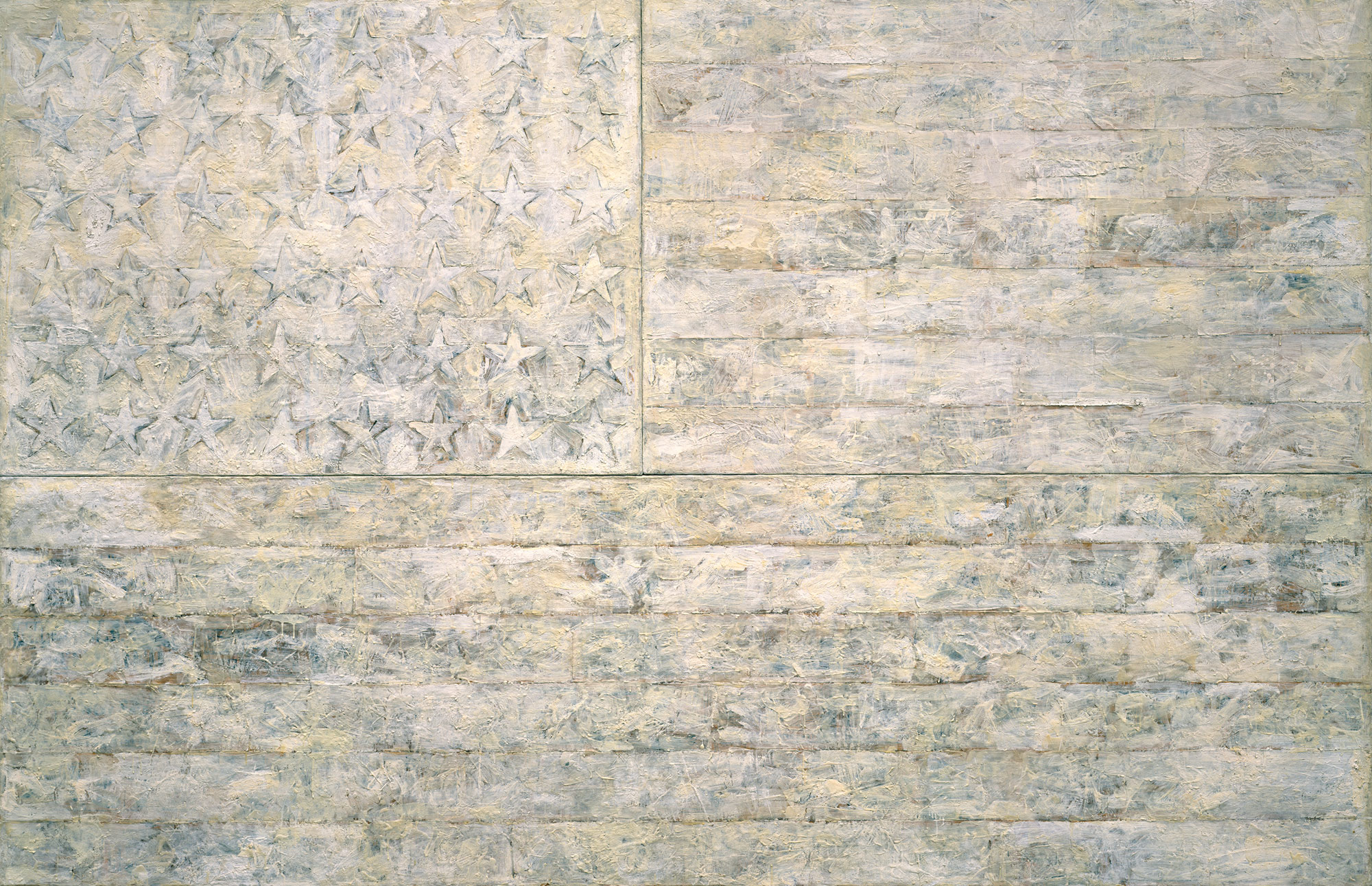
(White Flag, 1955, Jasper Johns)

(Flag, Barbara Kruger)
The United States is a revolutionary country, the first nation ever established on ideas, ideas that in themselves were revolutionary. Even though the founding documents themselves violated these ideals, both by what they said (blacks were counted as 3/5 of a person and allowed to be held as slaves) and by what they left out (no voting rights for women), these documents also included the means to resolve the contradictions.
America has been looked upon by people around the world as a symbol of our aspirations toward freedom, and theirs, even when we are failing our stated ideals. One of these failures was our sponsorship of the Chilean coup in 1973. During the unrest preceding the coup, television producer Sergio Ortega turned a popular protest chant "The people united will never be defeated" into a song, a powerful cry for freedom.
American composer Frederic Rzewski composed an epic set of 36 variations on the song in 1975. The resulting piece is one of the great solo piano works of the 20th century. The dizzying array of styles and techniques that Rzewski uses in this work become metaphors for both the desire for freedom and the multiplicity of American life. Contrary to what we are generally taught, America is not the only home of freedom in the world, but we were among the first to express the meaning of freedom in our nationhood, even when we betray those ideals at home and abroad. So, my listening list for today consists of Frederic Rzewski's The People United Will Never Be Defeated!
Bonus track: Bruce Springsteen, "Bring 'Em Home".
Last year's July Fourth listening list is here.
Jerry Bowles and commenters' lists here.
Alan Theisen is thinking of fireworks.
1.7.06
Elsewhere
I've come to believe classical music and opera are the greatest gifts ever given to humanity and masterpieces that command a singular devotion . . .
So writes Chris Timmons in an op-ed piece in the Tallahassee (FL) Democrat. The piece is an impassioned invitation to Mr. Timmons' fellows laypersons to investigate concert music, in hopes that their lives will be enriched as his has been.
Kyle Gann has an intriguing post up about the Hudson River school of painting (coincidentally the representative painting that speaks most clearly to me). He wonders why it took American musicians longer to develop distinctly American means of expression than it did painters. It's a complicated question and I certainly don't know the answer. In fact, there is certainly no single answer, but I suspect that part of it is that a vital musical culture requires significantly more infrastructure (performers being the main part of that infrastructure) than does a visual culture.
30.6.06
Palm Beach Story
I've added the blog of Palm Beach Post writer Greg Stepanich to the blogroll. Mr. Stepanich covers concert music in the growing South Florida region, as well as recordings and events in the concert music world at large.
27.6.06
...and the list'nin' isn't necessarily easy
Pieces that refer to summer, one way or another:
"Sumer is icumen in"
Gustav Mahler, Symphonie 3, I: "Pan Awakens; Summer Marches In"
George Gershwin, "Summertime", from Porgy and Bess
Samuel Barber, Summer Music
Samuel Barber, Knoxville: Summer of 1915
Michael Tippett, The Midsummer Marriage
Felix Mendelssohn, A Midsummer Night's Dream (incidental music)
Benjamin Britten, A Midsummer Night's Dream (opera)
Anton Webern, Im Sommerwind
John Cage, "Summer" from The Seasons
Antonio Vivaldi, "L'Estate", from Le Quattro stagioni
Arnold Schoenberg, "Sommermorgen an einem See", Op. 16, No. 3
Paul Hindemith, "On hearing 'The Last Rose of Summer'"
George Crumb, Music for a Summer Evening (Makrokosmos III)
Bonus track:
Fountains of Wayne, "It Must Be Summer"
"Sumer is icumen in"
Gustav Mahler, Symphonie 3, I: "Pan Awakens; Summer Marches In"
George Gershwin, "Summertime", from Porgy and Bess
Samuel Barber, Summer Music
Samuel Barber, Knoxville: Summer of 1915
Michael Tippett, The Midsummer Marriage
Felix Mendelssohn, A Midsummer Night's Dream (incidental music)
Benjamin Britten, A Midsummer Night's Dream (opera)
Anton Webern, Im Sommerwind
John Cage, "Summer" from The Seasons
Antonio Vivaldi, "L'Estate", from Le Quattro stagioni
Arnold Schoenberg, "Sommermorgen an einem See", Op. 16, No. 3
Paul Hindemith, "On hearing 'The Last Rose of Summer'"
George Crumb, Music for a Summer Evening (Makrokosmos III)
Bonus track:
Fountains of Wayne, "It Must Be Summer"
26.6.06
Workshop (VI)
I recently completed two pieces, The Rings of Saturn (clarinet and viola, 4 minutes) and The Beginning of Things (piano trio, 19 minutes). Scores (in PDF format) are available for the asking.
13.6.06
Ross on Feldman
12.6.06
Ligeti
"'I am an enemy of ideologies in the arts. Totalitarian regimes do not like dissonances." --GL
Gyorgy Ligeti, one of the best and most important composers of the second half of the 20th century, has died. His publisher, Schott, has an article here. Alex Ross links to this obituary.
Update, 13 June: Tim Rutherford-Johnson has assembled links to the many tributes and obituaries that have appeared in the blogosphere and throughout the web so far. In a separate post Tim provides a link to a filmed performance of Ligeti's Poeme Symphonique (1962), for 100 metronomes. The ending of the piece is especially poignant today.
Gyorgy Ligeti, one of the best and most important composers of the second half of the 20th century, has died. His publisher, Schott, has an article here. Alex Ross links to this obituary.
Update, 13 June: Tim Rutherford-Johnson has assembled links to the many tributes and obituaries that have appeared in the blogosphere and throughout the web so far. In a separate post Tim provides a link to a filmed performance of Ligeti's Poeme Symphonique (1962), for 100 metronomes. The ending of the piece is especially poignant today.
5.6.06
Miriam Burns
The Tallahassee (FL) Symphony Orchestra has appointed Miriam Burns its Music Director and Conductor. (My review of her audition concert is here.)
I look forward to hearing what Ms. Burns can do to move the Orchestra forward. I'm also very interested to see what her relationship will be (if any) with the composers in the community.
I look forward to hearing what Ms. Burns can do to move the Orchestra forward. I'm also very interested to see what her relationship will be (if any) with the composers in the community.
30.5.06
Shostakovich
Please read this column on Dmitri Shostakovich, by fellow Tallahassean Samuel L. Scheib. Prophets are, in fact, often without honor in their own countries.
29.5.06
Florida State Opera, etc.
Here's my review of this past weekend's Florida State Opera production of Gustav Holst's Sāvitri and Marius Constant's adaptation of George Bizet for La Tragédie de Carmen.
Elsewhere, Allan Kozinn of the New York Times examines some statistics that indicate that reports of the demise of concert music are premature and exaggerated. I have noticed mostly good sized audiences for events here this season, including Saturday evening's opera production, so my recent experience is in line with the numbers in Mr. Kozinn's article. I am not surprised to see the statistics supporting the idea that early and new musics are bringing new listeners into the fold.
Finally, a few pieces for Memorial Day listening, in honor of those who gave the ultimate sacrifice in service:
Charles Ives, "Decoration Day", from the Holidays Symphony;
Benjamin Britten, War Requiem;
Aaron Copland, Fanfare for the Common Man;
Paul Hindemith, When lilacs last in the door-yard bloom'd. A Requiem "For those we love"; and
Roger Sessions, When lilacs last in the door-yard bloom'd.
Elsewhere, Allan Kozinn of the New York Times examines some statistics that indicate that reports of the demise of concert music are premature and exaggerated. I have noticed mostly good sized audiences for events here this season, including Saturday evening's opera production, so my recent experience is in line with the numbers in Mr. Kozinn's article. I am not surprised to see the statistics supporting the idea that early and new musics are bringing new listeners into the fold.
Finally, a few pieces for Memorial Day listening, in honor of those who gave the ultimate sacrifice in service:
Charles Ives, "Decoration Day", from the Holidays Symphony;
Benjamin Britten, War Requiem;
Aaron Copland, Fanfare for the Common Man;
Paul Hindemith, When lilacs last in the door-yard bloom'd. A Requiem "For those we love"; and
Roger Sessions, When lilacs last in the door-yard bloom'd.
22.5.06
Virtuosity
Robert Gable posts about listening to Elliott Carter's Violin Concerto:
Mr. Gable is referring to Oliver Knussen's recording of the Occasions, the Violin Concerto, and the Concerto for Orchestra. (My review of a more recent recording of the Violin Concerto is here.) It won't surprise regular readers that my experience of this music is different from Mr. Gable's (I'm interested in his choice of the word "dour" and what exactly he means by it), but that's not what intriqued me about his post.
What did catch my eye is the bit about virtuosity ("Although presumably difficult to play, I don't get a sense of virtuosic showmanship and a result, this is not much fun.") This brings up a problem I have thought about for some time: How does a composer (and soloist) communicate the idea and fact of "virtuosity" in a pantonal context?
In tonal music a listener can readily hear wrong notes, flubbed notes, less-than-felicitous phrasing, and the like. They can even predict (within bounds) what's coming next in pieces they've never heard before. The feats of virtuosity are themselves part of the expressive content of many concertos. Those that fail to integrate the virtuosity with other expressive elements (if any) are heard as exercises in "empty" virtuosity.
Pantonal music doesn't typically have the predictive elements (what tonal theorists sometimes describe as "postion-finding" and "pattern-matching") of tonal music and so it can be difficult to tell if the right notes have been played, especially in a new or unfamiliar piece. It can be difficult, then, for the pantonal composer to communicate the triumph of the soloist through the overcoming of technical obstacles that is so much a part of the "narrative" of a solo concerto.*
Mr. Gable notes a preference for Carter's Piano Concerto, and that may be telling in light of the virtuoso issue. The Piano Concerto is far less colorful than the Violin Concerto (the word "dour" almost comes to mind) and its vision more tragic. The piano soloist is cast as an anti-hero whose prodigious virtuosity is eventually overwelmed by the orchestral mass. It may be that this clear dramatic structure and virtuoso struggle is more immediately apparent to the listener than the ever-changing relationships in the Violin Concerto.
One reason these thoughts readily popped up after reading Mr. Gable's post is that I am preparing to write a concerto for percussion and band, and the idea of virtuosity will certainly arise, along with a host of others that I'll blog about from time to time.
______________________________
*It should go without saying that the soloist as hero is not the only narrative strategy available, regardless of the musical style.
After two listens, I still can't parse Three Occasions for Orchestra. Much as I prefer my violin concertos to be aged several hundred years, Carter's Violin Concerto is easier to understand than the first piece since one voice is usually prominent. Still, it strikes me as a dour piece. Although presumably difficult to play, I don't get a sense of virtuosic showmanship and a result, this is not much fun. And if I want to experience Carter's compositional rigor, I prefer the clarity of his works for piano or string quartet (or even his Piano Concerto).
Mr. Gable is referring to Oliver Knussen's recording of the Occasions, the Violin Concerto, and the Concerto for Orchestra. (My review of a more recent recording of the Violin Concerto is here.) It won't surprise regular readers that my experience of this music is different from Mr. Gable's (I'm interested in his choice of the word "dour" and what exactly he means by it), but that's not what intriqued me about his post.
What did catch my eye is the bit about virtuosity ("Although presumably difficult to play, I don't get a sense of virtuosic showmanship and a result, this is not much fun.") This brings up a problem I have thought about for some time: How does a composer (and soloist) communicate the idea and fact of "virtuosity" in a pantonal context?
In tonal music a listener can readily hear wrong notes, flubbed notes, less-than-felicitous phrasing, and the like. They can even predict (within bounds) what's coming next in pieces they've never heard before. The feats of virtuosity are themselves part of the expressive content of many concertos. Those that fail to integrate the virtuosity with other expressive elements (if any) are heard as exercises in "empty" virtuosity.
Pantonal music doesn't typically have the predictive elements (what tonal theorists sometimes describe as "postion-finding" and "pattern-matching") of tonal music and so it can be difficult to tell if the right notes have been played, especially in a new or unfamiliar piece. It can be difficult, then, for the pantonal composer to communicate the triumph of the soloist through the overcoming of technical obstacles that is so much a part of the "narrative" of a solo concerto.*
Mr. Gable notes a preference for Carter's Piano Concerto, and that may be telling in light of the virtuoso issue. The Piano Concerto is far less colorful than the Violin Concerto (the word "dour" almost comes to mind) and its vision more tragic. The piano soloist is cast as an anti-hero whose prodigious virtuosity is eventually overwelmed by the orchestral mass. It may be that this clear dramatic structure and virtuoso struggle is more immediately apparent to the listener than the ever-changing relationships in the Violin Concerto.
One reason these thoughts readily popped up after reading Mr. Gable's post is that I am preparing to write a concerto for percussion and band, and the idea of virtuosity will certainly arise, along with a host of others that I'll blog about from time to time.
______________________________
*It should go without saying that the soloist as hero is not the only narrative strategy available, regardless of the musical style.
16.5.06
25 in 25
I've gotten quite a few hits from this thread in the last couple of days. Also, Scott Spiegelberg and A. C. Douglas have revived an on-going discussion of how best to bring new listeners to the world of concert music, or even if it is worth the effort to do so. Their posts contain numerous links to a variety of conversations on the subject, including recommendations of pieces for newbies to listen to.
What I propose to do is to focus for a while on music of the last 25 years. Why? Because it is my strong belief that composers have always written their works as people living in their times. This seems obvious, but there is still the idea out there that artists are detatched from the world around them. They are often separated in some important ways, but they were/are perceptive, aware people.
Therefore, one way to attract new listeners is to expose people to works written during their lifetimes, in an environment that is not totally foreign to them. What about the past? The past is always with us. Sometimes it's not even past. Listeners capture by our music will often look around for older music that is new to them.
Accordingly, I'm asking you to nominate pieces for a list of 25 Significant Pieces of the Last 25 Years. Anything written between 1981 and now is eligible for inclusion. Please e-mail me your nominations (or post them as comments) along with any criteria you may have used.
I'll compile what I get and, since I'm in Florida, I'll post the results I think we should have. (I kid, I kid.)
What I propose to do is to focus for a while on music of the last 25 years. Why? Because it is my strong belief that composers have always written their works as people living in their times. This seems obvious, but there is still the idea out there that artists are detatched from the world around them. They are often separated in some important ways, but they were/are perceptive, aware people.
Therefore, one way to attract new listeners is to expose people to works written during their lifetimes, in an environment that is not totally foreign to them. What about the past? The past is always with us. Sometimes it's not even past. Listeners capture by our music will often look around for older music that is new to them.
Accordingly, I'm asking you to nominate pieces for a list of 25 Significant Pieces of the Last 25 Years. Anything written between 1981 and now is eligible for inclusion. Please e-mail me your nominations (or post them as comments) along with any criteria you may have used.
I'll compile what I get and, since I'm in Florida, I'll post the results I think we should have. (I kid, I kid.)
7.5.06
High Hat
The new of issue of The High Hat is out. It includes, among other pieces on art, pop culture, and politics, my article on Olivier Messiaen's Quatuor pour la fin du temps. Please give the rest of the magazine a look while you are there.
1.5.06
26.4.06
Talk to Me
A fairly recent trend in how performers present music in concert is for the performer to give a verbal introduction to the music from the stage. I say "fairly recent" even though many years ago I attended an all-Schoenberg recital by the great Paul Jacobs, who, after a somewhat tepid reception to the first piece, drew his hands away from the piano just before beginning to play the next work, and gave brief talk that had the audience in rapt attention for the rest of the difficult program.
This now-more-prevalent practice has not been welcomed by everyone. Critic Andrew Clark of The Financial Times wrote this mostly-critical piece, wherein remarks from the podium are called representative of "insidious" thinking about concert music on the part of presenters who "fear that classical music may not be sufficiently communicative or 'entertaining'. Mr. Clark goes on to say that "[y]ou don’t have to explain jazz to anybody" (!) and that concert music needs no explanation. Thanks to A. C. Douglas for pointing out this piece and pulling some of the more negative quotes from it.
Mr. Clark says that discussion of the music from the stage:
This is not inherently true, anymore than reading program notes or having prior knowledge of the piece restrict the listening experience. Every experience one has with a given composition, composer, style, or body of music (maybe even bad experiences) adds to the totality of one's musical knowledge.
Mr. Clark closes:
Exactly so.
This now-more-prevalent practice has not been welcomed by everyone. Critic Andrew Clark of The Financial Times wrote this mostly-critical piece, wherein remarks from the podium are called representative of "insidious" thinking about concert music on the part of presenters who "fear that classical music may not be sufficiently communicative or 'entertaining'. Mr. Clark goes on to say that "[y]ou don’t have to explain jazz to anybody" (!) and that concert music needs no explanation. Thanks to A. C. Douglas for pointing out this piece and pulling some of the more negative quotes from it.
Mr. Clark says that discussion of the music from the stage:
. . . limits the imaginative scope of the music. Listening to someone discussing a piece of music before you have a chance to hear it pre-programmes your responses. The music has no chance to communicate freely. You are left with a number of objective ideas about what to think and feel, circumscribing the subjective impressions that music seeks to create in the listener through the medium of sound.
This is not inherently true, anymore than reading program notes or having prior knowledge of the piece restrict the listening experience. Every experience one has with a given composition, composer, style, or body of music (maybe even bad experiences) adds to the totality of one's musical knowledge.
Mr. Clark closes:
Of course, it doesn’t do to be too purist. I recall several occasions at the Cheltenham festival in the past 10 years when festival director Michael Berkeley introduced a concert from the podium. He happens to be a composer but, unlike most composers, he is also a relaxed public speaker. He thinks as a composer does, but knows what information will be most relevant in advance. Exceptionally the formula worked. But please note - it was the exception.
Exactly so.
Mr. Clark makes a number of valid points against the practice, the most telling of which is that not everyone is good at it. I like brief, well thought-out remarks before the performance of a piece, especially if these remarks are accompanied by musical examples. But I don't want to hear it from performers who can't, for whatever reason, do it well. Come to think of it, I don't want to hear music played by people who can't do it well, but I'm not about to condemn the practice of live performance of music just because some people who do it don't do it very well.
24.4.06
23.4.06
Top 10
This blog has been selected by the editors of Top 10 Sources for their group of 10 classical music resources. The site includes top 10 sources in a wide array of subjects from "Business & Money" through "Life" to "Television".
I appreciate the editors adding listen. to their site, and I welcome visitors directed here from there.
I've added Top 10 Classical Music Sources to the "Links" on the sidebar.
I appreciate the editors adding listen. to their site, and I welcome visitors directed here from there.
I've added Top 10 Classical Music Sources to the "Links" on the sidebar.
22.4.06
Chicago Classical Music
Several arts organizations in Chicago have started a blog/forum called Chicago Classical Music. It is billed as "An Online Community for Classical Music Enthusiasts". Despite their questionable judgement in listing this blog on their blogroll, the site looks promising.
I've added it to the Links section.
I've added it to the Links section.
14.4.06
Confusion
An article from Bloomberg.com about Finnsh composer/conductor Esa Pekka-Salonen and his travails with the postponed-then-performed world first of Kaija Saariaho’s Adriana Mater includes this:
Neither writer has much to say about music. Even given that, I can highly recommend them both.
Reading both of these books and thinking about the ideas and issues involved made me thinkof this story from Silence:
Also unusual is the clear narrative form of "Adriana Mater,'' in a continental context where new operas are generally modernist deconstructions.
"This is not a post-modern, distanced view of the very idea of opera,'' says Salonen. "It's an opera which absolutely believes in the art of opera, a simple story told in a linear way. It is a statement of faith in the fact that opera is an art form which can deal with big emotions and huge subjects. I'm very tired of the modernist idea that there are things you should not do because they are against the historic determinist paradigm or the Hegelian dialectical idea.''
Note that the writer of the article says that AM is not “modernist” because it has a “clear narrative form” and Mr. Salonen says it’s not “post-modern” because it’s a “simple story told in a linear way” and that he is tired of the "modernist" view of opera, which he says rejects linear story-telling. Mr. Salonen doesn't say he is also tired of modernism. His disavowal of modernism for AM seems like a continuation of his disavowal of pomo.
The issue here for me is not whether Ms. Saariaho’s opera is “modernist” or “postmodernist” but rather the use of those terms as a shibboleth to identify one as being among friends or as club with which to beat upon one’s enemies. In any case, it’s clear that there’s not clarity about what modernism is and what post-modernism’s relationship to it is.
And vice versa.
* * * * *
While we're on the subject of postmodernism, I recently read Christopher Butler's Postmodernism: A Very Short Introduction and am now reading Glenn Ward's Teach Yourself Postmodernism. The two authors take very different approaches, with Mr. Butler adopting a very skeptical stance and Mr. Ward a more sympathetic yet questioning posture.
Neither writer has much to say about music. Even given that, I can highly recommend them both.
Reading both of these books and thinking about the ideas and issues involved made me thinkof this story from Silence:
Before studying Zen, men are men and mountains are mountains. While studying Zen, things are confused. After studying Zen, men are men and mountains are mountains. After telling this, Dr. Suzuki was asked, "What is the difference between before and after?" He said, "No difference, only the feet are a little bit off the ground."
Conversation
Alex Ross, A. C. Douglas, and Lisa Hirsch are having a spirited discussion of some issues raised by Steve Metcalf on increasing the audience for concert music. The ground has been covered pretty well, so I don't have any big points to add. I do think the iPod/soundtrack-of-my-life model of music consumption/listening does need to be addressed by concert music folks; I'm just not sure how.
On the idea of a need for a superstar composer or a composer as a household name cultural hero, it's not going to happen. If the hype around the user-friendly music of John Adams and Osvaldo Golijov hasn't made it happen for them, it isn't going to happen for anybody. I'm not sure it would be so good if it did.
On the other hand, I'd like to see some performers who excel at a variety of contemporary styles become big name cultural heroes. Dawn Upshaw immediately comes to mind. Are there others?
On the idea of a need for a superstar composer or a composer as a household name cultural hero, it's not going to happen. If the hype around the user-friendly music of John Adams and Osvaldo Golijov hasn't made it happen for them, it isn't going to happen for anybody. I'm not sure it would be so good if it did.
On the other hand, I'd like to see some performers who excel at a variety of contemporary styles become big name cultural heroes. Dawn Upshaw immediately comes to mind. Are there others?
11.4.06
Polyphonic.org
I've added what is supposed to be a mini-banner leading to the just-launched Polyphonic.org, a website whose aim is to provide orchestral musicians with information about the business. listen.'s crack technology staff is working overtime to fix the picture banner. In the meantime, the link works.
[EDIT: The banner is fixed.]
[EDIT: The banner is fixed.]
6.4.06
Out There
Charles T. Downey of ionarts has a round-up of the early reviews of Kaija Saariaho's Adriana Mater, which premiered Monday evening in Paris, after a four-day delay due to labor unrest. Alex Ross' take on the opera is still to come. EDIT: Here it is.
Marcus Maroney and Lisa Hirsch take on Bernard Holland of the New York Times, with examples and suggestions, while A. C. Douglas offers a defense-by-assertion of the critic.
I've added former Tallahasseean Tim Risher to the blogroll.
Marcus Maroney and Lisa Hirsch take on Bernard Holland of the New York Times, with examples and suggestions, while A. C. Douglas offers a defense-by-assertion of the critic.
I've added former Tallahasseean Tim Risher to the blogroll.
1.4.06
31.3.06
Kaija Saariaho
Charles T. Downey of ionarts posts about the cancellation of last night's premiere performance of Kaija Saariaho's second opera, Adriana Mater. He includes some good comments about some of the composer's music that is available on discs, compact and digital video.
My understanding is that the premiere is scheduled now for Monday evening. Still enough time to get there.
My understanding is that the premiere is scheduled now for Monday evening. Still enough time to get there.
24.3.06
This and that
Terry Teachout has provocative posts up, one about criticism and the other about the standard repertoire and multiple recordings thereof. I agree with the larger points of posts, if not with some of the particulars. For example, I agree w/r/t Gatsby over The Sun Also Rises, but not with the statement about accessibility in new music. The point being, of course, that opinion is what opinion writing is all about.
I've added M. Keiser and PWS to the blogroll.
Workshop note: I've finished a pair of piano nocturnes. If you would like a copy, drop me an e-mail.
I've added M. Keiser and PWS to the blogroll.
Workshop note: I've finished a pair of piano nocturnes. If you would like a copy, drop me an e-mail.
22.3.06
Here and There
I've added Bart Collins and Adam Baratz to the blogroll. Enjoy!
Helen Radice notes connections between two 101 pieces, Britten's War Requiem and Mahler's Das Lied von der Erde. Connections between pieces of different styles are any important part of the 101 project, and Ms. Radice shows in her post how it works. Granted, the difference between Mahler and Britten is not all that large, but the gap in time and history is telling, and further connections, to styles more far afield, are waiting to be heard and remarked upon.
Helen Radice notes connections between two 101 pieces, Britten's War Requiem and Mahler's Das Lied von der Erde. Connections between pieces of different styles are any important part of the 101 project, and Ms. Radice shows in her post how it works. Granted, the difference between Mahler and Britten is not all that large, but the gap in time and history is telling, and further connections, to styles more far afield, are waiting to be heard and remarked upon.
20.3.06
Review
Tallahassee Symphony Orchestra
For those of you in the Greenville, SC area, my for John Boda: What stays with me II (for flute, clarinet, and marimba) is being performed Wednesday evening at Furman University at 8 o'clock.
For those of you in the Greenville, SC area, my for John Boda: What stays with me II (for flute, clarinet, and marimba) is being performed Wednesday evening at Furman University at 8 o'clock.
16.3.06
Magic, etc.
Far be it from me to speak for Greg Sandow, who is capable and willing to do so for himself, but I still think A. C. Douglas is misreading Greg's post about Brahms' orchestration. A. C. reads Greg's analysis of the practical reasons that may have motivated some of Brahms' choices as an attempt to deny the "magic" of the music, the "magic" of other composers of the past, and thereby to raise the composers of today to their level. It's very clear from this post and others that the only way contemporary composers can be on the level of the greats of the past (in A.C.'s ear) is to denigrate the past.
I don't find that in Greg's post. Not at all. He fully acknowledge's the greatness of Brahms' music. Hell, he spends a lot of time, thought, and virtual ink on a couple of measures of a symphony in order to show part of how it's done. A. C. writes that these the magical results of the masters of the past is part of the result of these practical choices, which is not substantially different from what Greg finds, though he comes at it from a different direction.
A. C.'s approach is essentially to use the past to bludgeon the present, but that only works if you accept his assumption that high quality, magical music isn't being written today, at least not by today's "visible" composers. If one listens and reads from that assumption, then one can find support for it, even if it isn't there.
Finally, A.C. criticizes Greg's analysis as "simpleminded at best, not to say approached from the wrong direction", which comment I find baffling. It was a narrowly focused article, treating it's subject in great detail, and from a variety of angles. It also inspires further thought, like the notion I've had for some time that one of the indications of a great tonal composer is how that composer handles the middle voices, which is one of Brahms' strengths (Mozart's as well, for that matter). As to the "wrong direction" comment, the house of art has many mansions, and many ways to approach. Any critical/analytic approach that helps you hear the piece or repertoire in question differently/more clearly is most assuredly not from the "wrong direction".
I don't find that in Greg's post. Not at all. He fully acknowledge's the greatness of Brahms' music. Hell, he spends a lot of time, thought, and virtual ink on a couple of measures of a symphony in order to show part of how it's done. A. C. writes that these the magical results of the masters of the past is part of the result of these practical choices, which is not substantially different from what Greg finds, though he comes at it from a different direction.
A. C.'s approach is essentially to use the past to bludgeon the present, but that only works if you accept his assumption that high quality, magical music isn't being written today, at least not by today's "visible" composers. If one listens and reads from that assumption, then one can find support for it, even if it isn't there.
Finally, A.C. criticizes Greg's analysis as "simpleminded at best, not to say approached from the wrong direction", which comment I find baffling. It was a narrowly focused article, treating it's subject in great detail, and from a variety of angles. It also inspires further thought, like the notion I've had for some time that one of the indications of a great tonal composer is how that composer handles the middle voices, which is one of Brahms' strengths (Mozart's as well, for that matter). As to the "wrong direction" comment, the house of art has many mansions, and many ways to approach. Any critical/analytic approach that helps you hear the piece or repertoire in question differently/more clearly is most assuredly not from the "wrong direction".
15.3.06
Uncool
I may be wrong, but I think A. C. Douglas may be misreading me in this post about this post. In my post I praised Marc Geelhoed's use of the word "cool" to describe a piece after he had done a more traditional discussion of it. I then ended my post with a comment about pieces by Elliott Carter that are "cool" and "bitchin'". Mr. Douglas seems to read that as my definitive statement on the pieces. It isn't. That's coming in the review I'm working on for Sequenza 21.
I think Mr. Douglas is also misreading Greg Sandow's fine and fairly technical post on Brahms' orchestration. Far from belittling or diminishing Brahms' achievement (as Mr. Douglas clearly thinks he is), Mr. Sandow is showing how it's the details, often the very practical and seemingly mundane details, that reveal how great art works. Musical instruments cannot play notes outside their ranges (normally), and how composers handle that bit of craft/technique is revelatory of their greatness as artists.
Finally, I would like to amend yesterday's post regarding the Carter Dialogues: I meant to say that the piece is "totally bitchin'".
I think Mr. Douglas is also misreading Greg Sandow's fine and fairly technical post on Brahms' orchestration. Far from belittling or diminishing Brahms' achievement (as Mr. Douglas clearly thinks he is), Mr. Sandow is showing how it's the details, often the very practical and seemingly mundane details, that reveal how great art works. Musical instruments cannot play notes outside their ranges (normally), and how composers handle that bit of craft/technique is revelatory of their greatness as artists.
Finally, I would like to amend yesterday's post regarding the Carter Dialogues: I meant to say that the piece is "totally bitchin'".
14.3.06
Cool
Marc Geelhoed, music critic for Time Out Chicago magazine and the proprietor of the blog Deceptively Simple, posts about how an art critic at the Chicago Tribune had objected to Mr. Geelhoed's use of the word "cool" in a review of a piano concerto by Marc-Andre Dalbavie:
I'm working on a review of two recent Elliott Carter discs for Sequenza 21, and I'm happy to say that, while my personal jury is still out on a couple of the pieces/performances, the Boston Concerto is actually very cool, and Dialogues (piano and orchestra) is bitchin'.
the article[. . .]closed with the sentence, "Oh, yeah—and the concerto sounds cool, too." This was after a fairly detailed description of how Dalbavie alters the patterns that comprise the work and how he ties his style to [medieval composers] Leonin and Perotin.This seems perfectly resonable to me. It's important for concert music to expand its audience (given the pay for play world we inhabit) and using language that is understood by the public-at-large is a perfectly legitimate way to communicate. I don't see how it cheapens our art in the least.
I'm working on a review of two recent Elliott Carter discs for Sequenza 21, and I'm happy to say that, while my personal jury is still out on a couple of the pieces/performances, the Boston Concerto is actually very cool, and Dialogues (piano and orchestra) is bitchin'.
1.3.06
Crumb
I've posted a review of music by George Crumb at Sequenza 21.
I listened to a lot of Crumb as an undergraduate. I kind of overdosed on it, but not before I was able to attend a great concert of Crumb's music by performers including the great Jan DeGaetani, Gilbert Kalish, and others. Eventually, it started to sound like strung together sound effects.
So it was with some interpidation that I began to listen to the two Bridge discs for that review. I wanted to be able to give it a fair hearing. It turned out to be a revelatory experience, and I'm glad I got the opportunity.
I overdosed on minimalism at the same time. Maybe I need some hair of that dog, too.
I listened to a lot of Crumb as an undergraduate. I kind of overdosed on it, but not before I was able to attend a great concert of Crumb's music by performers including the great Jan DeGaetani, Gilbert Kalish, and others. Eventually, it started to sound like strung together sound effects.
So it was with some interpidation that I began to listen to the two Bridge discs for that review. I wanted to be able to give it a fair hearing. It turned out to be a revelatory experience, and I'm glad I got the opportunity.
I overdosed on minimalism at the same time. Maybe I need some hair of that dog, too.
20.2.06
The Heart of the Matter
Alex Ross has a fine article on Puccini up at the New Yorker. In addition to a number of telling insights into the Italian master's ability to hold the stage, Alex touches on some issues of central importance in the ongoing struggle to keep concert music culturally viable and to regain its place in our intellectual life.
Two quotes in particular address this issue, and as is often the case, Alex sums it up well. After mentioning two crossover events held at important venues in NYC:
Then after discussing a Puccini performance that emphasized what is unusual/challenging in Turandot:
Exactly so. What we should be hearing in the music of the 20th and early 21st centuries are the ideas that hold the different styles together, not the stances that separate them.
Two quotes in particular address this issue, and as is often the case, Alex sums it up well. After mentioning two crossover events held at important venues in NYC:
The idea is not to dilute classical music with crossover novelties but to move it back into the thick of modern life. The old art will no longer hold itself aloof; instead, it will play a godfather role in the wider culture, able to assimilate anything new because it has assimilated everything in the past.
Then after discussing a Puccini performance that emphasized what is unusual/challenging in Turandot:
Even composers may have something to learn from Puccini. “Turandot” becomes a different piece when it is removed from the colossal clutter of Franco Zeffirelli’s production at the Met; it begins to sound nearly avant-garde, because it assimilates an array of modern sounds while maintaining an inexorable singing line. Berio [whose completion of Turnadot was given in the performance Alex reviewed] also superimposed old and new, but the pieces in his collages remain alienated from one another. Many young composers still play the same glass-bead game with the past, upholding artificial differences in musical language rather than questioning them. Puccini might say: Don’t make it new. Make it whole.(If I could write like that, I'd never leave the house.)
Exactly so. What we should be hearing in the music of the 20th and early 21st centuries are the ideas that hold the different styles together, not the stances that separate them.
15.2.06
Marky Mark
A vigorous discussion is ongoing at the Sequenza 21 Composer’s Forum. It’s also been taken up at Kyle Gann’s blog. The topic under discussion is, nominally, the density of expression markings in scores. (I say that markings are the “nominal” topic of the discussions because I think the real topic is compositional pedagogy, a second front in the style wars.) I want to comment on the subject of markings themselves.
Among the markings under discussion are those that indicate dynamics (volume), articulation, including changes in dynamics, accents of various kinds, and phrasing. I pulled a few score off of my shelf just to look at the density of markings therein and found that they vary from piece to piece, even within the work of a single composer!
This is not surprising, of course. It seems to me that the markings in a score become too dense at precisely that marking that makes it harder for the performer to play the piece than it would be without the mark. How does a composer know this? Well, that’s a little more complicated. It comes with experience (and experience as a performer is even better). If the style of the piece demands few or no marks to be expressive (if that’s the goal) and vivid in performance, then a plethora of marks will get in the music’s way. On the other hand, if a certain level of specificity is desired in the realization of a note, chord, or phrase (or “moment”), the marks needed to help the performers achieve this are necessary.
I think most composers intuit this. I say that because in looking at a number of scores from various eras and in divergent styles, the density of these expression markings changes with pieces, so that some passages are rather full of markings and, a few pages later, almost none. There seems to be no consistency as to whether fast music has many markings or few, and the same for slower passages.
Let a thousand accent marks bloom! Or not.
Among the markings under discussion are those that indicate dynamics (volume), articulation, including changes in dynamics, accents of various kinds, and phrasing. I pulled a few score off of my shelf just to look at the density of markings therein and found that they vary from piece to piece, even within the work of a single composer!
This is not surprising, of course. It seems to me that the markings in a score become too dense at precisely that marking that makes it harder for the performer to play the piece than it would be without the mark. How does a composer know this? Well, that’s a little more complicated. It comes with experience (and experience as a performer is even better). If the style of the piece demands few or no marks to be expressive (if that’s the goal) and vivid in performance, then a plethora of marks will get in the music’s way. On the other hand, if a certain level of specificity is desired in the realization of a note, chord, or phrase (or “moment”), the marks needed to help the performers achieve this are necessary.
I think most composers intuit this. I say that because in looking at a number of scores from various eras and in divergent styles, the density of these expression markings changes with pieces, so that some passages are rather full of markings and, a few pages later, almost none. There seems to be no consistency as to whether fast music has many markings or few, and the same for slower passages.
Let a thousand accent marks bloom! Or not.
14.2.06
Love Songs
Music for the day:
Johannes Brahms, Liebeslieder Walzer
Elliott Carter, "O, Breath", from A Mirror on Which to Dwell
Morton Feldman, The viola in my life
Thomas Morley, "Now is the Month of Maying"
Kaija Saariaho, L'amour de loin
Gustav Mahler, Finale from Symphony 3 (working title: "What Love Tells Me")
Franz Schubert, Der Hirt auf dem Felsen
Amy Beach, "Sweetheart, Sigh No More"
Hector Berlioz, "Absence", from Nuits d'Ete, and of course,
Baude Cordier, "Belle Bonne, Sage"
Bonus: George and Ira Gershwin, "I've Got a Crush on You"
Johannes Brahms, Liebeslieder Walzer
Elliott Carter, "O, Breath", from A Mirror on Which to Dwell
Morton Feldman, The viola in my life
Thomas Morley, "Now is the Month of Maying"
Kaija Saariaho, L'amour de loin
Gustav Mahler, Finale from Symphony 3 (working title: "What Love Tells Me")
Franz Schubert, Der Hirt auf dem Felsen
Amy Beach, "Sweetheart, Sigh No More"
Hector Berlioz, "Absence", from Nuits d'Ete, and of course,
Baude Cordier, "Belle Bonne, Sage"
Bonus: George and Ira Gershwin, "I've Got a Crush on You"
6.2.06
Futures
A. C. Douglas is concerned that Osvaldo Golijov represents "the future" of concert music. Mr. Douglas need not worry--the multi-cultural polystylism of Golijov, whose Ayre has received reviews both rapturous and reserved--is not the future. It is a future, one of a thousand stylistic flowers that will bloom.
Golijov is indeed having a big and very visible year. But so are John Adams, Tobias Picker, Jennifer Higdon, and Elliott Carter.
Some will argue that this year's celebration of Carter is a final blooming of a Modernism that is over, but I believe (and I don't think it is merely wishful thinking on my part) the next several years will see the growth and acceptance of what I'll call, for now, "neo-modernism".
In addition to the above named, Kaija Saariaho should be getting quite a bit of attention when her second opera, Adriana Mater, premeires in Paris.
In addition to the diverse styles of the composers listed above, we have neo-romanticism, totalism, jazz-inflected improvisatory music, and live-electronic music. Minimalism and serialism also have their adherents. I'm sure, at least I hope, that Mr. Douglas can find something in all of this abundance to like and admire.
Golijov is indeed having a big and very visible year. But so are John Adams, Tobias Picker, Jennifer Higdon, and Elliott Carter.
Some will argue that this year's celebration of Carter is a final blooming of a Modernism that is over, but I believe (and I don't think it is merely wishful thinking on my part) the next several years will see the growth and acceptance of what I'll call, for now, "neo-modernism".
In addition to the above named, Kaija Saariaho should be getting quite a bit of attention when her second opera, Adriana Mater, premeires in Paris.
In addition to the diverse styles of the composers listed above, we have neo-romanticism, totalism, jazz-inflected improvisatory music, and live-electronic music. Minimalism and serialism also have their adherents. I'm sure, at least I hope, that Mr. Douglas can find something in all of this abundance to like and admire.
5.2.06
Davidovsky
My review of a new disc of music by Mario Davidovsky, including three of the Synchronisms series, is up at Sequenza 21.
3.2.06
Workshop: Revision
That's an interesting word: revision.
I wrote Episodes in Anticipation (band, 2001) in longhand on 30-stave paper. I copied the parts in pencil. I wrote in longhand rather than in Finale, because of a short timeline and because I didn't feel strong enough in the software to get the piece done in time. Rehearsals and a performance had been scheduled and everyone involved was committed to a performance on a date certain.
I was happy with the piece--it did pretty much what I wanted it to do, the performers enjoyed playing it and did so with style, and the audience was generally receptive. Still, I'm sure everybody reading this has seen room for improvement after the fact in pieces, performances, or other creative work.
There are a couple of people who have aksed to see the score and I want to send it to some others, so the time was right to load it into Finale. And, since I'm having to do all that work on the piece anyway, why not do some of the revisions. The score aleady had many marks in it from the rehearsals for the premiere, including some added percussion notes, so there was already some revision there.
Which brings us back to that word,"revision".
The Merriam-Webster OnLine Dictionary defines "revision":
1 a : an act of revising b : a result of revising : ALTERATION2 : a revised version
Fine, as far as it goes. But when does the act of revising proceed to the point where the root of the word changes fron "revise" to "re-vision", to see the work anew and, so seeing, make it new again? Should you make this work everything it can be, fix it up a little, or leave it be and try again next time?
The answer is different for every artist and every work, of course, but the temptation to make wholesale changes is there, and is made greater by the ease of doing it in software. For example, in a hand-copied score, if you wanted to add a measure or (especially) two or more, it usually meant re-copying the rest of the score after the additions. With Finale (and other music-writing software packages) you can insert measures into the middle of a piece at will.
In this case, I'm adding a measure or two here and there, giving some of the players a little more to do (even adding an instrument that I inadvertantly left out), but mostly I'm leaving it as it was and moving on to the next piece.
By the way, I have an mp3 of the premiere. If anybody is interested in hearing it, let me know.
I wrote Episodes in Anticipation (band, 2001) in longhand on 30-stave paper. I copied the parts in pencil. I wrote in longhand rather than in Finale, because of a short timeline and because I didn't feel strong enough in the software to get the piece done in time. Rehearsals and a performance had been scheduled and everyone involved was committed to a performance on a date certain.
I was happy with the piece--it did pretty much what I wanted it to do, the performers enjoyed playing it and did so with style, and the audience was generally receptive. Still, I'm sure everybody reading this has seen room for improvement after the fact in pieces, performances, or other creative work.
There are a couple of people who have aksed to see the score and I want to send it to some others, so the time was right to load it into Finale. And, since I'm having to do all that work on the piece anyway, why not do some of the revisions. The score aleady had many marks in it from the rehearsals for the premiere, including some added percussion notes, so there was already some revision there.
Which brings us back to that word,"revision".
The Merriam-Webster OnLine Dictionary defines "revision":
1 a : an act of revising b : a result of revising : ALTERATION2 : a revised version
Fine, as far as it goes. But when does the act of revising proceed to the point where the root of the word changes fron "revise" to "re-vision", to see the work anew and, so seeing, make it new again? Should you make this work everything it can be, fix it up a little, or leave it be and try again next time?
The answer is different for every artist and every work, of course, but the temptation to make wholesale changes is there, and is made greater by the ease of doing it in software. For example, in a hand-copied score, if you wanted to add a measure or (especially) two or more, it usually meant re-copying the rest of the score after the additions. With Finale (and other music-writing software packages) you can insert measures into the middle of a piece at will.
In this case, I'm adding a measure or two here and there, giving some of the players a little more to do (even adding an instrument that I inadvertantly left out), but mostly I'm leaving it as it was and moving on to the next piece.
By the way, I have an mp3 of the premiere. If anybody is interested in hearing it, let me know.
31.1.06
4'33" Video
30.1.06
Review, etc.
Here's my review of a recital by pianist Joyce Yang.
I saw Terrence Malick's latest film, The New World. I don't have the vocabulary needed to give it a full-fledged review, but I wanted to say that I found it moving and deeply felt. The pace of Malick's films is slow, allowing images and events to resonate for the viewer, and I find that very compelling. I did want to comment on his use of Wagner's "Vorspiel" to Das Rheingold at crucial moments in the film. The New World is an elegiac telling of one of America's creation myths, the founding of the Jamestown colony. The use of the Wagner during the opening scene depicting the arrival of the ships (and two other times) was poetic as well as beautiful.
I also saw David Lynch's Eraserhead on DVD. For my money, Lynch uses sound (as opposed to music) as an expressive element in his films better than any other director I am aware of. The sense of foreboding that hangs over this film is in no small part a result of the sonic environment.
I saw Terrence Malick's latest film, The New World. I don't have the vocabulary needed to give it a full-fledged review, but I wanted to say that I found it moving and deeply felt. The pace of Malick's films is slow, allowing images and events to resonate for the viewer, and I find that very compelling. I did want to comment on his use of Wagner's "Vorspiel" to Das Rheingold at crucial moments in the film. The New World is an elegiac telling of one of America's creation myths, the founding of the Jamestown colony. The use of the Wagner during the opening scene depicting the arrival of the ships (and two other times) was poetic as well as beautiful.
I also saw David Lynch's Eraserhead on DVD. For my money, Lynch uses sound (as opposed to music) as an expressive element in his films better than any other director I am aware of. The sense of foreboding that hangs over this film is in no small part a result of the sonic environment.
11.1.06
Running the Voodoo Down
I don't have much technical knowledge of jazz in any of its incarnations, but I do like it quite a bit. I especially enjoy '50s and early '60s era Miles Davis. His various quintets of the period are chamber music of a very high order.
Music critic and fellow High Hat contributor Phil Freeman has just published a book on Davis' later, electric music, Running the Voodoo Down. Here's a very positive review by John Kelman of all about jazz. Mr. Kelman's emphasis on the author's status as a jazz "outsider" (Phil is best known for his reviews of metal) and how that informs both Mr. Freeman's listening and writing offers another hint for those of us who want to expand the audience for concert music. We need to listen with new ears and write with a new mind.
I look forward to reading Running the Voodoo Down and expanding my own appreciation for Miles Davis' remarkable artistry. I want also to acknowledge Jeff Harrington's invaluable new music reblog, where posts about new music are compiled in what amounts to a one stop blogroll, for pointing me to this review.
Music critic and fellow High Hat contributor Phil Freeman has just published a book on Davis' later, electric music, Running the Voodoo Down. Here's a very positive review by John Kelman of all about jazz. Mr. Kelman's emphasis on the author's status as a jazz "outsider" (Phil is best known for his reviews of metal) and how that informs both Mr. Freeman's listening and writing offers another hint for those of us who want to expand the audience for concert music. We need to listen with new ears and write with a new mind.
I look forward to reading Running the Voodoo Down and expanding my own appreciation for Miles Davis' remarkable artistry. I want also to acknowledge Jeff Harrington's invaluable new music reblog, where posts about new music are compiled in what amounts to a one stop blogroll, for pointing me to this review.
10.1.06
20K
Greetings and Happy New Year!
Sometime this morning a lost soul wandered in here and became this blog's 20,000th visitor.
Greg Sandow continues his "improvised book" on the future of classical music. I agree with Mr. Sandow that "form and structure" are essential differences between classical music and other kinds of music:
Sometime this morning a lost soul wandered in here and became this blog's 20,000th visitor.
Greg Sandow continues his "improvised book" on the future of classical music. I agree with Mr. Sandow that "form and structure" are essential differences between classical music and other kinds of music:
It gives classical music a special richness, not a greater richness than any other kind of music, but a richness unique to itself.
21.12.05
Four Play
Four jobs you've had in your life: Ladies' wear stock clerk; library technical assistant; grantswriter; teacher
Four movies you could watch over and over: The Searchers, Nashville, Godfather II, Chinatown
Four places you've lived: Poughkeepsie, Ithaca, Durham, Iowa Citry
Four TV shows you love to watch: Scrubs, Law & Order (mothership), Boomtown, 24
Four places you've been on vacation: Atlanta, Tampa, Chicago, New York
Four websites you visit daily: All of the sites on the blogroll plus dailykos, bopnews, Salon, Slate
Four of your favorite foods: fresh pasta with marinara sauce and cheese, various Indian dishes, black beans and rice, salad
Four places you'd rather be: Atlanta, New York, Italy, France
Four movies you could watch over and over: The Searchers, Nashville, Godfather II, Chinatown
Four places you've lived: Poughkeepsie, Ithaca, Durham, Iowa Citry
Four TV shows you love to watch: Scrubs, Law & Order (mothership), Boomtown, 24
Four places you've been on vacation: Atlanta, Tampa, Chicago, New York
Four websites you visit daily: All of the sites on the blogroll plus dailykos, bopnews, Salon, Slate
Four of your favorite foods: fresh pasta with marinara sauce and cheese, various Indian dishes, black beans and rice, salad
Four places you'd rather be: Atlanta, New York, Italy, France
19.12.05
13.12.05
Storms
[Up front disclaimer: I've known Stirling Newberry for nearly ten years of internet discussion and arguement. It's impossible for me to hear his music without my experience of him affecting my perceptions, and I wouldn't want to hear it that way.]
_________________________
Political activism and music are among the passions/obsessions of Stirling Newberry's life. These obsessions come together in the two string quartets recorded on In The Year of Storms.
The two quartets on this disc, (No. 7 in Eb, Op. 35, and No. 8 in B, Op. 36) were written in response to the storm season of 2005 and its aftermath, both political and human. A combination of grief, anger, and longing suffuse the music of both quartets.
Mr. Newberry's music is tonal/modal in both forward and backwards senses. The works are governed by large-scale harmonic and melodic ideas while at the same time there is often a hint (or more) of the minimalist project underlying the surface. And it's a compelling surface. Mr. Newberry's melodies are memorable enough to carry the musical weight they are given in these pieces, though they aren't tunes you'll whistle afterwards (for the most part). His admiration (obsession, really) for Beethoven is reflected in his melodies, which are almost always ripe for contrapuntal treatment.
The composer's brand of post-modernism comes out in his stylistic references. The opening of the first movement of Quartet 7, for example, recalls the opening of Beethoven’s Ninth and a later movement includes the Dies Irae as a theme. Mr. Newberry is also fluent in many popular styles of the past and present and deploys them with ease.
I can recommend this disc without serious reservation. It brings up important issues about the nature of performance (and what constitutes a musical work) and the distribution of concert music, which I will discuss later.
_________________________
Political activism and music are among the passions/obsessions of Stirling Newberry's life. These obsessions come together in the two string quartets recorded on In The Year of Storms.
The two quartets on this disc, (No. 7 in Eb, Op. 35, and No. 8 in B, Op. 36) were written in response to the storm season of 2005 and its aftermath, both political and human. A combination of grief, anger, and longing suffuse the music of both quartets.
Mr. Newberry's music is tonal/modal in both forward and backwards senses. The works are governed by large-scale harmonic and melodic ideas while at the same time there is often a hint (or more) of the minimalist project underlying the surface. And it's a compelling surface. Mr. Newberry's melodies are memorable enough to carry the musical weight they are given in these pieces, though they aren't tunes you'll whistle afterwards (for the most part). His admiration (obsession, really) for Beethoven is reflected in his melodies, which are almost always ripe for contrapuntal treatment.
The composer's brand of post-modernism comes out in his stylistic references. The opening of the first movement of Quartet 7, for example, recalls the opening of Beethoven’s Ninth and a later movement includes the Dies Irae as a theme. Mr. Newberry is also fluent in many popular styles of the past and present and deploys them with ease.
I can recommend this disc without serious reservation. It brings up important issues about the nature of performance (and what constitutes a musical work) and the distribution of concert music, which I will discuss later.
11.12.05
Happy Birthday, Chronometros
My work was submitted under the pseudonym of Chronometros . . .
--Elliott Carter in his entry in the 25th Anniversary Report of the Harvard Class of 1930, referring to his First Quartet and its entry in a composition competition.
Carter goes on, quoting a letter he received after the Quartet won the competition:
I don't know if Feldbusch, the 'cellist of the Liege Quartet, has written you, but if not, here's his story, which may please you. He and Koch, the leader, detested the quartet all through rehearsals and the first performance. The eve of the final desicion, the judges listened to tape recordings and for the first time F and K were able to listen, not play. They were overwelmed, and F, a big hulk of an extrovert, not at all given to romanticism, I assure you, said he found himself on the verge of tears, and K also was moved. Meeting an old friend the day of the final concert, F insisted he come, deliberately telling him he must hear Chronometros, a terrible work, nonsensical, no rhyme or reason. Now the old friend was a coal miner, a guy who went down in the pits at the age of fourteen and has done nothing else in his life, is now forty-five, and goes once a year or so to the opera for Manon or Carmen. He came to the concert and the next day looked up F, threatened to bash his nose in, called him every dirty name in the Walloon vocabulary, said F knew nothing about music and deserved to hear nothing better than Manon or Carmen if he couldn't understand Chronometros. Says he: "This is the first time I have felt in music that a man was talking to me like a man; the guy who wrote that understands the fear I experience when I get down into a new mine not sure whether or not it is going to cave in on me; he's got guts and muscle, and he digs in his music like I dig in hard rock; he sweats like I do, he's a worker like I am; and you, Feldbusch, you're nothing but a goddamned fool of a musician if you can't understand that."
Other Carter posts at listen.:
Carter in Atlanta
More on Carter in Atlanta
Birthday
1.12.05
A Different Perspective
This column by Chadwick Jenkins, from the PopMatters 'zine, is the first in a series of pieces on why "classical" music should matter to consumers of popular culture. I look forward to the rest of the series. It has the makings of an important contribution to the ongoing discussion of the place of concert music in postcontemporary life.
30.11.05
Counter Culture
I quite agree with Alex Ross when he says:
I'll only add that it's been true for a very long time.
I'll repeat my outré contention that classical music, for all its elite trappings, is actually a radical, disruptive force in American culture, whereas most popular culture, for all its rebellious trappings, is intensely conservative.
I'll only add that it's been true for a very long time.
29.11.05
Elsewhere
Around the 'sphere:
Terry Teachout has some thoughful observations about the nature of criticism and its relation to art. Of particluar interest to me, as both critic and composer, are his musings on what it means and whether or not it's important for critics to be "right" about the work they criticize.
The Blogger Known as Pliable posts a fascinating, informative, and link-rich piece about the development and testing of the atomic bomb. Plenty to hold us until the recording of Doctor Atomic comes out.
Daniel Felsenfeld responds to an article in the Wall Street Journal about audiences and orchestras embracing new music that throws off the yoke of serialist oppression. Mr. Felsenfeld points out that this "might have been something worth noting were this, say, 1952". He also quotes composer Daniel Kellogg as saying he writes music that "he wants to hear," and that the article frames this as "novel". Mr. Felsenfeld sighs:
Finally, Heather Heise asks questions of composers. My answers, for the record: No; no; no; yes, I have two; sure, why not; no; yes and no; no; no; not for me; yes, though it's more an "ooze" than a "spill"; yes.
Terry Teachout has some thoughful observations about the nature of criticism and its relation to art. Of particluar interest to me, as both critic and composer, are his musings on what it means and whether or not it's important for critics to be "right" about the work they criticize.
The Blogger Known as Pliable posts a fascinating, informative, and link-rich piece about the development and testing of the atomic bomb. Plenty to hold us until the recording of Doctor Atomic comes out.
Daniel Felsenfeld responds to an article in the Wall Street Journal about audiences and orchestras embracing new music that throws off the yoke of serialist oppression. Mr. Felsenfeld points out that this "might have been something worth noting were this, say, 1952". He also quotes composer Daniel Kellogg as saying he writes music that "he wants to hear," and that the article frames this as "novel". Mr. Felsenfeld sighs:
I do not come down on either side of this argument because frankly I think it is an old and dead struggle. These are no longer the sides any more than the Yankees and the Confederates. We hear daily of the "problems" in classical music, and if we are ever to take a step to solving them we have to address the issues of our own time (even if we do not like our own time) rather than a more simplistic contrempts of a vanished world. The implication--that serial music and its descendants rules the roost while there is a new generation trying to upturn it by returning to the old ways--is a quaint and lovely notion that might have been riveting half a century ago but in 2005 it is laughably far from true...though I, like Mr. Russell, [the author of the Journal article] wish these were the only problems we faced. Our world would be a better place were this true.
Finally, Heather Heise asks questions of composers. My answers, for the record: No; no; no; yes, I have two; sure, why not; no; yes and no; no; no; not for me; yes, though it's more an "ooze" than a "spill"; yes.
24.11.05
Thanksgiving
I want to take this opportunity to wish everyone a Happy Thanksgiving Day. I hope it is going well.
22.11.05
Frontier
Stirling Newberry's article on Jeff Harrington is important for several reasons. First, it's good to see a composer get some pub in a non-traditional place.
More importantly, the piece is among the first, to my knowledge, to take as a subject the relationship betweens a composer's work and his relationship to the internet. The internet (and digitality as a whole) will be, for a while at least, the best way for a composer (and other artists, too) to get their work before the public. It's good to see someone attempt a beginning of an analysis.
More importantly, the piece is among the first, to my knowledge, to take as a subject the relationship betweens a composer's work and his relationship to the internet. The internet (and digitality as a whole) will be, for a while at least, the best way for a composer (and other artists, too) to get their work before the public. It's good to see someone attempt a beginning of an analysis.
Subscribe to:
Posts (Atom)